
Play-action is the cheapest explosive play you own. No new block up front, no new route tree. You just punish the defense for the way it fits your run.
But “run some play-action” isn’t a plan, it’s a category. Three coaches in this week’s clinics build it three different ways: Rich Hargitt hides it inside his sprint-out so the defense can’t tell which is which.
Joel Penner uses his option action to manufacture one-on-ones. Tyler Loftus builds vertical shots with a checkdown waiting underneath every one.
Three ideas to steal for your summer install. The slickest one hides the whole thing inside a play your defense already has to respect. Start there.
Idea 1: Make the Defense Guess Between Play-Action and Sprint-Out
Video: Rich Hargitt on the Y-Sail Flood and Living in the Same Bag as His Sprint-Out
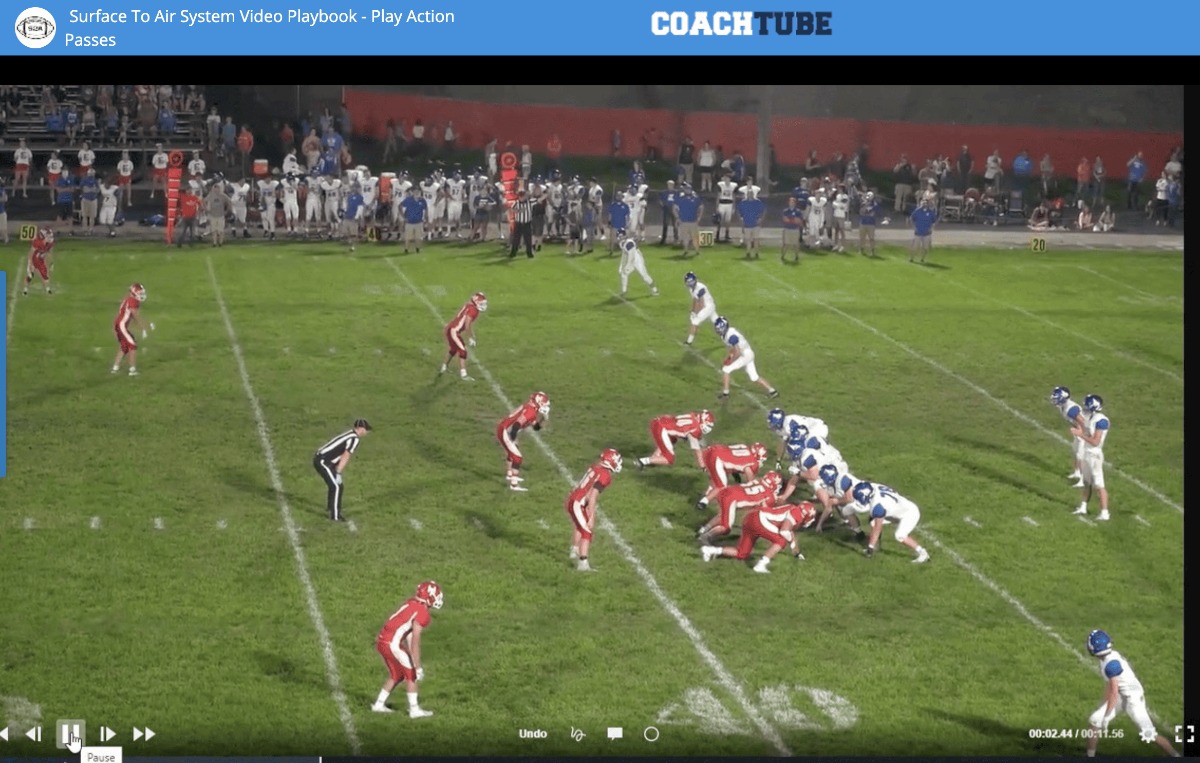
Rich Hargitt runs the Surface to Air System, and the whole point of his play-action game is that it doesn’t look like a separate menu. The play-action passes and the sprint-outs live, as he puts it, “all kind of in that same bag.”
Start with the Y-Sail, his strong-side flood concept and one of his most-called plays. He runs it from trips and from sprint-out protection, and the quarterback reads it deep to shallow to mid.
Hargitt walks a rep where the corner is 15 yards off the fastest receiver. He can’t go deep. Watch the shallow get jumped and double-teamed. So the quarterback throws the mid for a 15-yard gain. “That’s just high-quality football right there,” he says. It’s his foundational mid-range pass play, and he shows the read playing out clean rep after rep.
The version that sells the whole idea is what he calls go-go action: two backs to the same side, flash-fake one of them. Nothing fancy. But Hargitt tells you exactly where to look. “Watch all the linebackers’ feet.” All four step down on a simple little fake, and the three-level flood opens up behind them. How wide open that back ends up coming, on a fake that takes half a second to sell, is the part you have to see live on the snap.
Then he separates hard play-action from token play-action. Out of 22P he shows the hard version: X on the fade, the attached tight end on the sail, the fullback in the flat, and a hard fake to the tail. Same deep-to-shallow-to-mid read, more juice on the fake.
Here is the part that makes all of it work, and it’s the reason most coaches can’t just copy the routes.
Hargitt runs so much quarterback power and quarterback lead that even the tailback just shuffling and setting on the edge still works on the defense. So when the quarterback doesn’t feel the defense biting, he just checks the whole thing into a straight sprint-out and goes. To the naked eye it looks like a rollout. To a defense staring at that much quarterback run on tape, it’s one more thing they have to be wrong about. He shows two reps in a row where he checks Y-Sail into pure sprint game in the video.
Idea 2: Use Your Run Action to Manufacture One-on-Ones
Video: Joel Penner on Isolation Play-Action in the Gun Triple
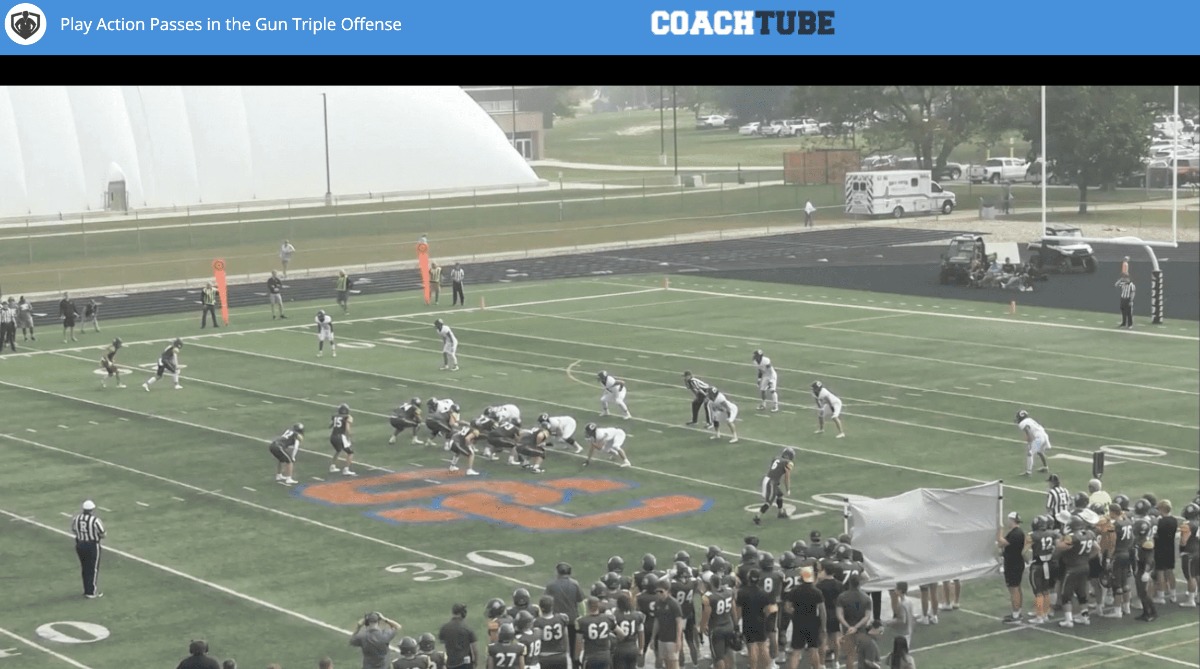
Joel Penner builds his play-action game out of the Gun Triple Offense, and he borrows the framework from basketball. “Sometimes in an offensive set, all the other players simply spread out and allow a good player to work one-on-one.” That’s the whole idea. Get your best player in space and isolate him.
The isolation shows up at the motion side, where the motion originated, with a lot of grass around it. And the quarterback’s read is about as simple as it gets: “Do I like my isolation? If not, work the backside tag.” First progression is the iso. If it’s doubled, a bad matchup, or the window’s gone, he comes off it to a backside tag you can build however you want (vertical by two and a dig by one, a comeback and a corner, whatever fits your system).
The route that makes it go is the glance, which Penner defines precisely: a slant that breaks at five steps instead of three. From a compressed tight end, he coaches the receiver to get width before he comes back in, press the corner, and let the safety vacate on the option fake. That opens the window back into the boundary.
And the reason any of it is available is the option itself. You are making the defense pay for playing the run the other way. Penner likes the concept against three-deep, four-under specifically because “there’s almost always a seam to find.”
Once you’ve run the glance enough, he tags a double move off it, an “ankle breaker” with the identical stem: five steps, three steps, two steps, then plant and turn out instead of breaking in. The corner who has started jumping the glance gets left standing.
But the coaching point worth stealing is what he does when the look isn’t there. If the safety doesn’t vacate and the iso is two-on-one, the quarterback has to be off it the instant he clears the mesh. Penner is blunt: the longer you hold the ball, the more risk you take, so the quarterback snaps his eyes to the backside dig and throws the seam the defense just vacated.
He shows the rep where that backside answer goes for a huge gain, and there is more on his max-protection menu (seven-man full slide, half-man half-zone six or seven man) in the clip.
Idea 3: Build Your Shots With a Checkdown Already Underneath
Video: Tyler Loftus on the Play-Action Dagger and Taking Shots
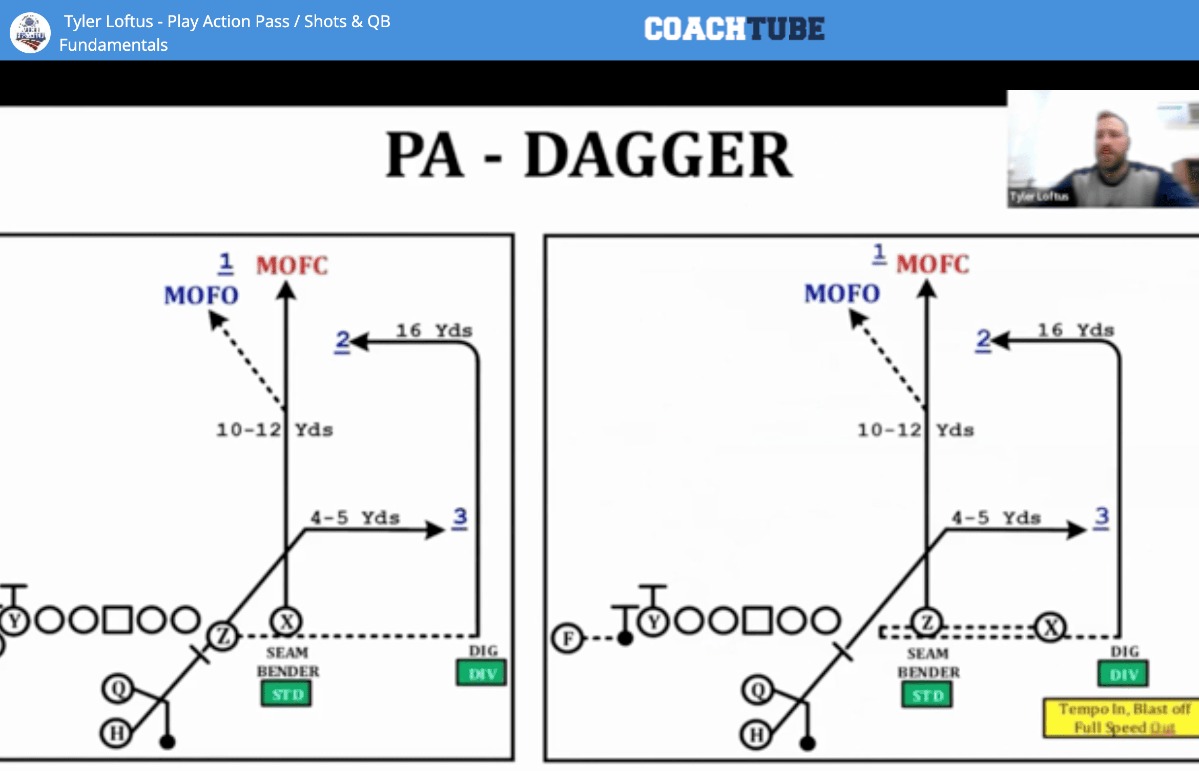
Tyler Loftus calls the play-action dagger one of his best plays of the season, and he runs it off two tight ends and outside-zone action. The thing that makes it a shot you can take in cold blood is that the answer is built in before the snap.
It all keys off the backside corner’s depth. If that corner is down low in the run fit, around six yards, the quarterback has the green light to throw the seam over the top. If he’s deeper than that, he will fly out of it, so Loftus reads it top-down instead, coming to the dig and down to the U on the check flat. Same play, two completely different answers, and the quarterback knows which one he is into before he ever opens up.
Number two carries the vertical: take it against middle-field-closed, bend it into the space against middle-field-open.
The part coaches will rewind is how he dresses the same play so it never looks the same twice. He studies NFL tape and steals the window dressing. He lifted a sprint-out motion off Tyreek Hill tape to create leverage against two-high, ran it again tempoed-in-then-sprinted-out, and short-motioned a receiver to a tight end wing before blasting him off vertical. One concept, three faces.
Then there is the quarterback teaching, which is its own reason to watch. Loftus coaches the shot game through his four S’s: Show, Shrink, Snap, and Set-up. Early in the year his quarterback did not trust the fake and rushed it, so they gave him a landmark: ride the fake and snap the ball off it right at the divide between the hash and the numbers, then blast vertical with a full head of steam, get off the press, and flip the corner’s hips before rolling it in at 16 yards.
He even has a bracket-beater built on the same idea. When he knew one receiver was drawing some version of bracket coverage every snap, he ran that guy on the backside vertical to clear it out and heated up the one-on-one on the other side. And he shows how the whole thing carries into seven-man protection, chipping the defensive end the way he saw Kevin O’Connell’s Vikings do it, with the tight end throttling vertical behind the chip.
Off play-action or out of seven-man pro, it’s the same shot wearing different clothes, and Loftus walks rep after rep of it on tape in the clip.
Conclusion
Three coaches, three systems, one spine: play-action is only as good as the run it’s lying about, and the best versions hand the quarterback an answer so he never has to force the shot. Hargitt hides it in his sprint-out. Penner uses it to isolate his best guy. Loftus builds the checkdown into the shot. Pick the one that fits what you already do, and rep it this summer.
Each of these is a full clinic, and the reps that didn’t fit here are where the systems actually live. Hargitt gets into the rest of the Surface to Air play-action tree (Y-Cross, Y-Chase, the Wheels, and the River/Lake and Ninja tags) and how each one attacks a specific coverage.
Penner walks his boot-pass mechanics and how he changes launch points off the same option action.
Loftus breaks down the full shot menu and the quarterback fundamentals behind the four S’s.
If one of these three ideas is going in your install, the clinic is where you get the rest of it.
Link: Rich Hargitt – Surface to Air System: Play Action Passes
Link: Joel Penner – Play Action Passes in the Gun Triple Offense
Link: Tyler Loftus – Play Action Pass / Shots & QB Fundamentals


