
Your defensive end beats the tackle off the ball. He’s got the edge. And then he runs himself right past the quarterback.
It’s the most common problem in pass rush, and Coach Corey Burns says the fix isn’t a better move. It’s a better system. In this clip from his clinic Efficient Defensive Line Play, Coach Burns breaks down the set line rush for defensive ends: the 70-degree tilt, how the tackle’s set point determines the move, and the phone booth concept that keeps your end in the play.
Video: Corey Burns – Defensive End Pass Rush Fundamentals
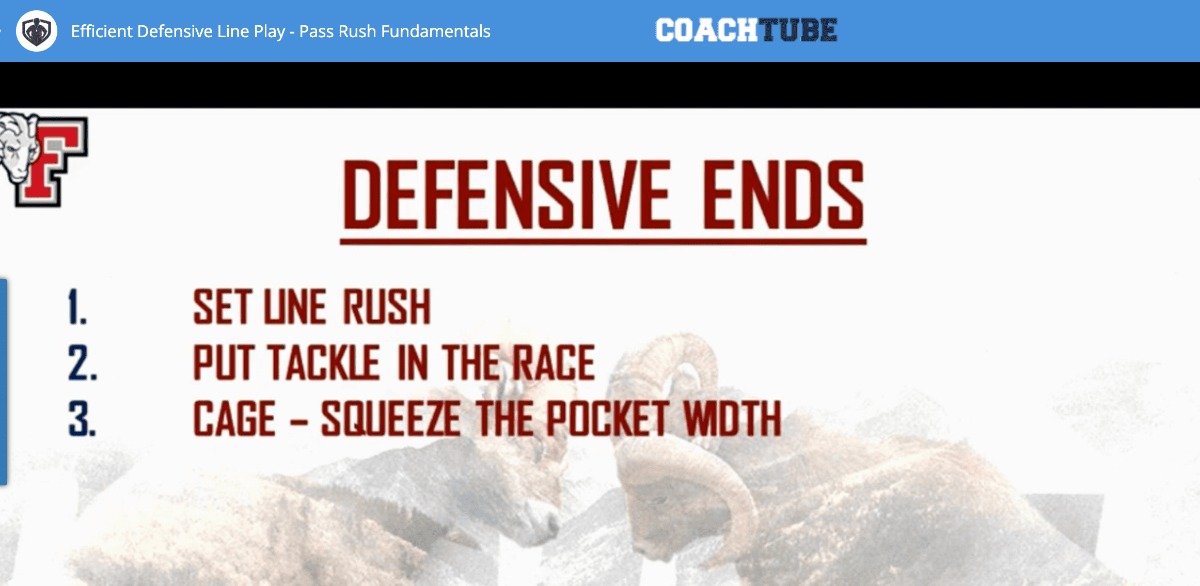
The Set Line Rush on a 70-Degree Tilt
Coach Burns starts with geometry.
The defensive end’s rush path is a 70-degree tilt to the quarterback. Not a straight line through the tackle. Not a wide loop. Seventy degrees.
Here’s why the straight line doesn’t work. The shortest distance between the DE and the quarterback runs directly through the offensive tackle. You can’t rush through a man. The set line solves that.
The set line is a point of intersection. Coach Burns defines it as the spot about two kick steps behind the tackle, roughly three yards deep. That’s where the tackle will be when the rush arrives. The DE’s job is to stress the tackle on a 70-degree angle toward that set line, putting the tackle in a race as he retreats.
The ball get-off starts the whole thing. The DE fires forward on that 70-degree tilt, and from there, everything is a reaction.
Three Reactions Based on the Tackle’s Set Point
This is the core of Coach Burns’ system. The DE doesn’t pre-plan his move. He reads where the tackle sets relative to the set line, and the tackle’s position tells him what to do.
If the tackle sets over the set line (too far outside), the DE comes under into the quarterback. The tackle has overcommitted to the edge, and the inside lane is open.
If the tackle sets on the set line, the DE plants his inside foot, raises, and hits a long arm speed-to-power through the tackle’s inside pec. That pushes the tackle’s alignment to the level of the rush. Then the DE tears off inside. Coach Burns walks through the mechanics of this move in the clip above.
If the tackle sets under the set line (too far inside) and the DE beats him with speed, the DE uses his speed moves over the top. The edge is there because the tackle hasn’t gotten wide enough to take it away.
Three reads. Three reactions. No guessing before the snap.
The Pitcher’s Toolbox
Coach Burns compares it to a pitcher. A pitcher only needs three pitches. A defensive end only needs a few moves in his toolbox.
The difference between a good pass rusher and a bad one isn’t the number of moves. It’s the sequence: ball get-off, react to the set line, finish. The DE doesn’t decide his move in the huddle. He doesn’t pick a side before the snap. He fires off the ball, reads the tackle’s set point, and the set point tells him which tool to pull.
That’s what makes the system efficient. You’re not asking your end to memorize a playbook of moves. You’re teaching him to read one thing and react.
The Phone Booth: Why the DE Stays on Level Rush
Coach Burns draws what he calls the phone booth around the quarterback. It’s a rectangle. The top of the rectangle is level rush. The inside lanes belong to the defensive tackles. Each defensive end owns his side.
The DE’s job is to stay on level rush. Never past it. There is never a point where the DE should be behind the quarterback in the man relationship between the line of scrimmage and the pocket.
Here’s why: if the quarterback escapes at a 45-degree angle, the DE on level rush has him. Coach Burns calls this the COVID. The end is already in position to contain the escape because he’s been disciplined about staying level the entire rush.
The moment a DE rushes past the quarterback, that 45-degree escape lane opens and there’s nobody home. Staying level isn’t just about finishing the sack. It’s about owning the edge of the pocket so the quarterback has nowhere to go.
Three moves. One read. Stay level. Coach Burns’ system for defensive ends strips out the complexity and gives your rusher a decision tree he can execute at full speed. The set line tells him everything he needs to know.
This clip covers the defensive end’s set line rush, but Coach Burns’ full clinic goes much further.
He breaks down position-specific techniques for defensive tackles and nose tackles, covers line games and coordinated pressure packages, and gets into opponent study and film preparation for building a rush plan.
If you’re looking for a complete pass rush system, the full clinic is below:
Link: Corey Burns – Efficient Defensive Line Play: Pass Rush Fundamentals


