
Last time, Coach Zangl showed you where the box lines up. This is what the box does the instant the ball moves.
Those tight alignments only pay off if the defender knows what to do with the block coming at him. That is block deconstruction, and Coach Michael Zangl teaches it as pure stimulus and response.
Video: Michael Zangl on Block Deconstruction in the Defensive Front
The Four-Man Front: Five Blocks, Five Answers
The offensive lineman’s first step is the stimulus, and every block picture has a named, drillable answer. The kid does not diagnose anything. He sees the block, he runs the response. Coach Zangl builds the four-man front off five pictures, and a lineman who owns the five has an answer for almost anything an offense shows him.
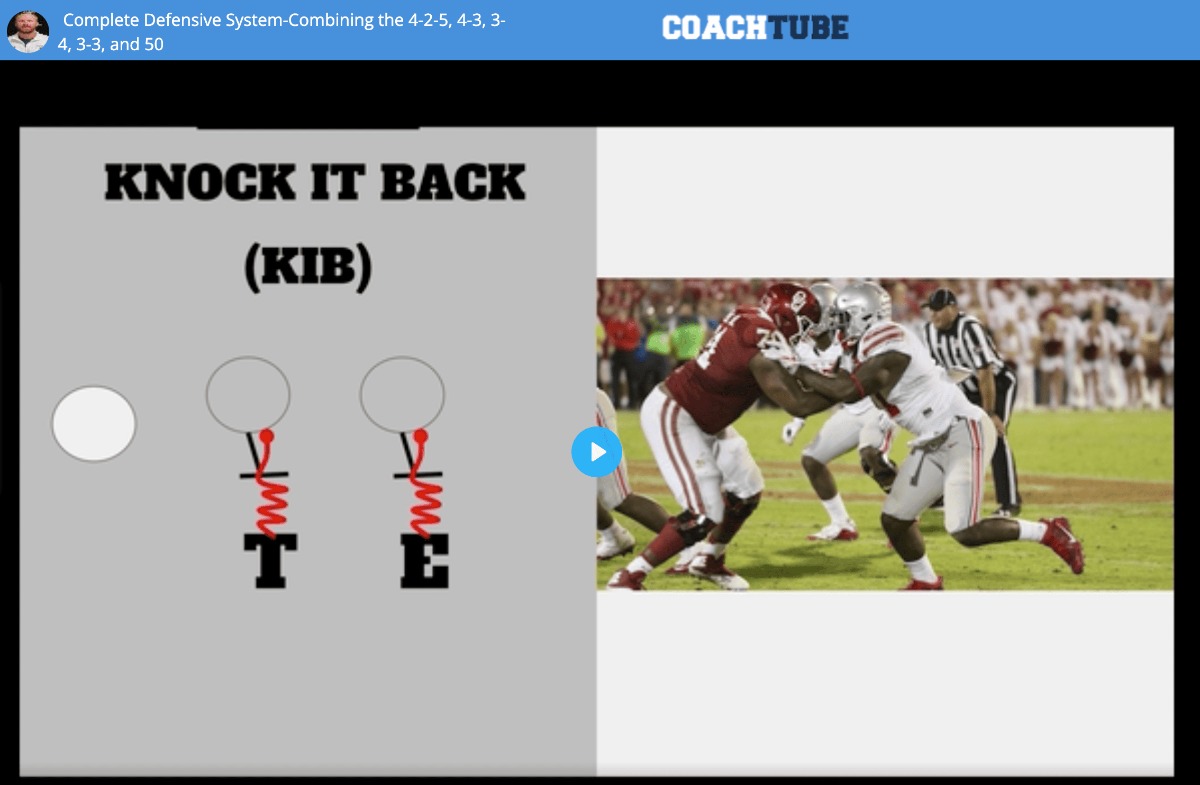
Knockback: The Base Block
The base block is a lineman stepping straight at you, a direct power step. The answer is to shock him and put him back.
Hand to the V of the neck, elbow in, thumb up. Other hand on the cuff, right at the base of the shoulder, so you control him. Then a six-point explosion: launch the hips, extend the arms, run the feet, and knock him straight back to establish the line of scrimmage. Escape off the block as needed while keeping your gap.
This is where that tight alignment earns it. The closer you are, the smaller the running lane you leave when you shock and shed. Coach Zangl freezes the hand placement and the hip extension on tape so you can see exactly where the shock has to land.
Squeeze: The Down Block or the Climb
When the lineman down blocks or climbs, you do not chase him. You squeeze the air out of the gap.
Get to his hip pocket, knock the tackle off his track, and sit in your gap. It is a short shuffle down the line, a collision on the hip of the offensive lineman, and you stay in that B gap. The whole time you are keeping that blocker off your linebackers so they play clean.
Coach Zangl is blunt about the prerequisite: “if we’re too wide in our alignments, we’ll never squeeze the air out of that gap.” The weak-side B gap is the soft spot against spread, which is exactly why the ends have to be tight. Tight ends squeezing that gap are what let the linebackers play the RPO and contain the edge. Watch how little ground he gives up on the squeeze rep in the video.
Water Ski: The Puller You Hang Onto
Against a GT counter or a wrap, the defensive lineman chases the hip and water skis it.
Picture a water skier. You grab, you pull, you hang onto the hip of the puller, and you ride him right down the line of scrimmage to the ball.
There is a wrinkle on the zone read. Instead of water skiing, Zangl will sometimes slow squeeze it and slow play the mesh to make the quarterback declare. Hand off, you stuff it. Keep it, you take your chances. Which pullers get the water ski and which get the slow play depends on the front, the alignment, and who is pulling, and Coach Zangl sorts that out in the clip.
Knockback to a Hippo: The Double Team
The double team is where young linemen get ruined, and the rule is simple. Never take on two blocks at once. As Coach Zangl puts it, “if you chase two rabbits, you’ll catch none.”
Take a 3-technique getting doubled by the guard and the tackle. The guard is his man, his eyes, so he knocks the guard back first. When the tackle’s pressure shows, he throws his right hip into the tackle, then escapes through the B gap: rip, swim, hand over hand, wrist over wrist, and back onto the line of scrimmage with the inside of the B gap still his.
The mistake he sees on film all the time is a kid putting one hand on the guard and one hand on the tackle. That player gets demolished. Knocking the first man back is what creates the gap and puts the two blockers on different levels, and that is the only thing that gives you a chance to handle both. Coach Zangl has the film of the demolished rep in the video.
Pull to Reset: The Interior Puller
When a nose or a 2i reads his guard pull, the answer is to pull to reset the center.
The eyes start on the guard. The guard leaves. The eyes redirect to the center, and the lineman knocks back and resets him. Phase one is a straight knockback. Phase two is knock back and cross face into the run fit, with the linebacker playing off that cross face. That one technique covers the trap, the wrap, the inside power, and the power read. Coach Zangl walks the eye progression from guard to center on tape.
The Three-Man Front: Same Blocks, One New Word
Move to the three-man front and almost nothing changes. The lineman is usually head up on the tackles or the center, sometimes in double 2s on the guards, and the same answers carry over. Water ski, the double-team hippo, and pull to reset all hold.
The knockback just gets a tighter look. Head up, screws to screws, elbows tight, both thumbs inside the shoulders, and you knock him straight back.
The Stab: Own the Inside Shoulder
The squeeze is the one that gets a new name. In the three-man front, with the end in a 4-technique, you stab the inside shoulder of the offensive lineman.
The reason is what it does behind you. Controlling that inside shoulder stops the lineman from climbing to the backers and occupies the gaps, almost like sliding into a mint front. That keeps the linebackers clean so they can read their guards and the second-level backflow key a lot faster. The front eats the blocker, the backers get to play. It is the same idea as the buddy call from the last email, pointed at a different front. Coach Zangl puts the stab next to the four-man squeeze on tape so you can see why it is one job with two names.
Read Feet, Not Shoulders
This is the cue most defensive line coaches will want to steal.
Some coaches teach reading the lineman’s shoulders. Some teach the hips. Coach Zangl keeps the eyes low and reads feet. A shoulder read gives you a false key too often. The feet do not lie.
So the lineman matches the footwork. The OL steps out, he matches the steps. Reach for reach. Down block for down block. Pull for pull. Every technique above hangs on reading the right thing first, and Coach Zangl explains why the feet are it in the clip.
Block deconstruction is the same stimulus and response for everyone near the line of scrimmage, not just the down linemen. The walked-up backers shock and shed off the exact same rules: lock on, launch the blocker off, throw him into the hip pocket, then rip, counter, or jab to the gap. And every one of these is a stand-alone drill. Knockback, squeeze, water ski, hippo, pull to reset. You can build a whole DL period off the list.
Where the box lines up is half the front. What it does with the block is the other half.
This article is the box-alignment layer. The full Complete Defensive System clinic is where Coach Zangl unpacks what the arrows and dashed lines on those box diagrams actually mean, the run-fit rules behind each front, and how every gap gets accounted for.
From there he matches coverage to front with pattern-match rules that hold no matter which structure is behind them, builds a universal blitz language so the pressure menu carries across all five fronts, and gets into the sim pressures and creepers that wear the same face as the base calls.
If you want the fits, the coverage marriage, and the pressure system that sit underneath the alignments in this article, the full clinic is the build.
Link: Michael Zangl – Complete Defensive System: Combining the 4-2-5, 4-3, 3-4, 3-3, and 50


