
The throws that kill you aren’t the ones the quarterback misses. They’re the ones he forces because he’s scared of what he didn’t see before the snap.
Joe Matheson builds that fear out of the play. He’s the offensive coordinator at Wisconsin-River Falls, where his offense led Division III in total yards at 555.5 a game on the way to a national title. The way he keeps quarterbacks aggressive is a concept he calls the PRO, and once you see it you’ll understand why three of his quarterbacks could run the same call three different ways.
Video: Joe Matheson on the PRO Concept (Pass-Run Option)
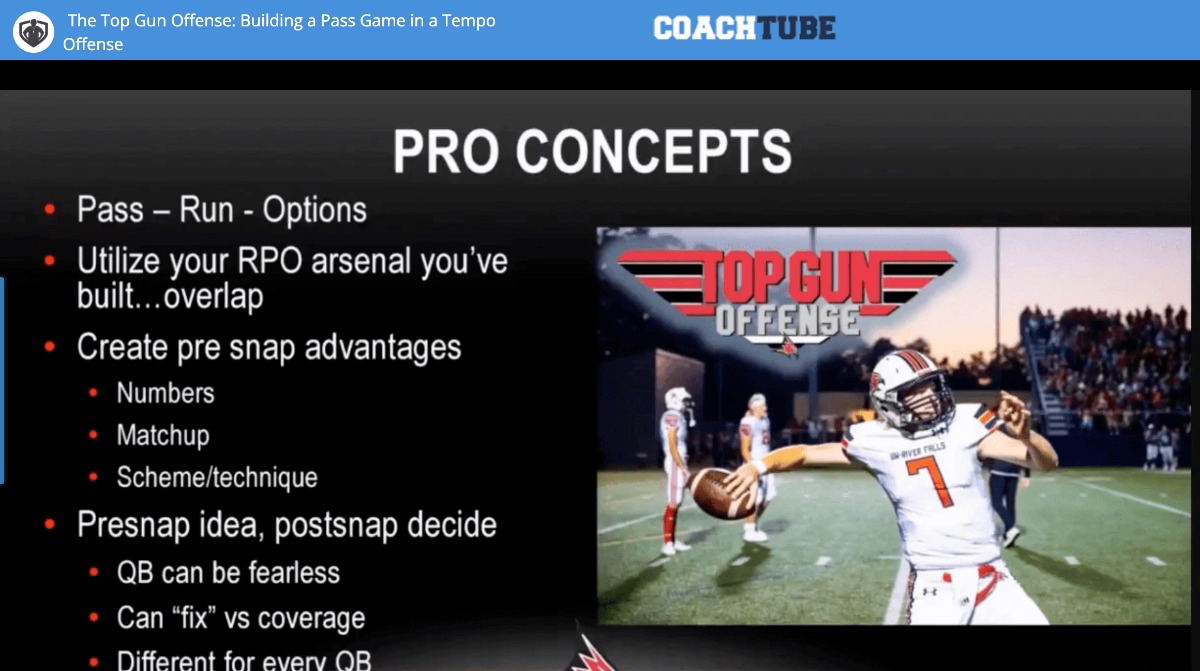
The PRO: A Pass-Run Option, Not an RPO
Flip the letters and you flip the priority. An RPO leans run with a throw built in. Matheson’s PRO is a pass-run option, and as he puts it, “it’s really quarterback draw stuff.”
Here’s the part that makes it free to install: you don’t add anything for your skill players. You take the RPOs you already have on the call sheet and run them exactly as they’re coached. “Your skill guys won’t know any different,” Coach Matheson says. “They’re just running their RPOs.” The change lives entirely at quarterback.
Now the quarterback’s job is to be ultra-aggressive against the look the defense hands him. He reads the same pre-snap indicators he always has. He hangs on the pass side. And the safety valve is the whole point: the offensive line is, in his words, “on account,” so if anything about the throw makes the quarterback uncomfortable, he tucks it down and runs the draw.
That built-in run is why his quarterbacks stop forcing throws. There’s no hidden coverage to fear, because there’s always an element of the play they can take advantage of. He doesn’t have to be right post-snap. He just has to find the part of the play that’s open.
Coach Matheson lays out the philosophy at the top of the clip before he ever rolls a rep.
The Compartments: Three Ways to Stay High-Percentage
Watch one rep and the structure becomes obvious. Coach Matheson motions the tailback to get four to a side, three-for-three on the edge, with his stud X isolated to the boundary working a double move off the glance he sells every snap.
The safety is the defender who tips the read, and the play has a compartment for wherever he goes:
– One-on-one on the X: work the double move. The matchup is the reason the play exists.
– Safety brackets, helps, or cuts and helps the X: get off it and throw the high-percentage screen. The numbers are now there.
– Wrong post-snap: the quarterback commits to the double move, the safety baseball-turns back to help, and the throw isn’t there. No problem. Tuck the draw. “Stick your foot and get north and south. Get vertical.”
Three answers, one call, and the quarterback can’t really be wrong. “We’ve got these different compartments to the play to help us stay high-percentage,” Coach Matheson says.
The protection piece bends to your design too. On a fade-flat version, he points out you can add the back into the protection or release him into the concept, your call. Coach Matheson walks the safety read and the screen-versus-double-move decision live in the video, and it’s worth watching where his quarterback’s eyes go on the snap.
Give Him the Keys: Three Quarterbacks, Three Decisions
This is the line that tells you how much freedom is baked in: “if you have three different quarterbacks repping this, you may see three different decisions, because each quarterback can kind of paint his own picture of what he wants to do.”
The versatility comes from the concept being deliberately interchangeable. The same four-by-one look that gave you a double move can be a five-step glance instead. Or a speed out. Or the screen. The quarterback rips whichever route the look invites, and the draw sits underneath all of them.
And none of it touches the guys up front. As Coach Matheson says, the skill kid doesn’t care whether it’s power or pin and pull blocked next to him. “He can just focus on doing what he needs to do to win and do his job.” You’re handing the quarterback the keys without adding a single rule for anyone else.
He runs through several of these variations back to back in the clip so you can see the same call wear different faces.
Passive Up Front, Aggressive With the Ball
The protection mindset is the same as the read mindset. “We’re going to be passive up front very quickly,” Coach Matheson explains, “but give the quarterback the opportunity to throw the football first.”
His best example is an empty set running a four-vertical concept against a quality defense. Five guys out. Everybody walled. Everybody sitting in windows. Nobody open. Against that picture a lot of quarterbacks hold the ball and take a sack hunting for a throw that isn’t coming.
His quarterback does the opposite. The moment the windows are covered, the decision maker speeds up, sticks his foot in the ground, and goes get north and south. “We didn’t get anyone we wanted. No problem.” A clean, efficient, explosive play out of a dropback that produced nothing in the air.
He shows the empty rep and a three-by-one-into-the-boundary version, where he can leave the tailback in for the draw or release him and throw it, in the clip.
The Coaching Point That Makes It Work: Stay North and South
Here’s the wrinkle most coaches will miss, and Coach Matheson calls it “the key to the play.”
When the quarterback tucks the draw, he cannot be lateral. “Where you can get into trouble,” he says, “is sometimes we see guys that are far too lateral with how they move on a draw play.” If he drifts sideways, the same defenders sitting in those windows, the ones who took the throw away, trigger downhill and get him. Sack, loss, disaster.
The benefit of the draw is precisely that those defenders bailed into coverage. Run straight at the space they vacated. Stay downhill. Move laterally and you hand the whole advantage back.
He’s blunt about who struggles with it: younger, mobile quarterbacks who were the fastest, most talented kid in high school and got away with running sideways. At the next level that habit gets coached out, hard.
And this is also how you punish the defenses that think they’ve solved you. Teams that are great at getting underneath your concepts and walling the windows are the exact teams the draw hurts. “Make them pay for it,” Coach Matheson says, “and run that draw right up the pipe.” The same logic marries the screen and the draw by numbers: when the defense floods the edge to take the screen, the vertical and the draw open up, and you can scheme a tall receiver into the middle of the field on the way. If you can’t get him there, no problem. Run the draw.
There’s more detail on the draw footwork and the lateral-versus-downhill habit in the video above.
The reason this keeps a quarterback aggressive is that aggression no longer carries risk. Hang on the throw, hunt the matchup, rip it when you love it. And when you don’t, the run is already there underneath, waiting. That’s how Matheson lets a kid play fast and fearless without a bloated call sheet behind him.
The PRO is one layer of Matheson’s tempo pass system, and the full clinic, The Top Gun Offense: Building a Pass Game in a Tempo Offense, is where the rest of the structure lives.
He builds the Bubble RPO progression that feeds the perimeter, the Lock Screen progression with its answers versus aggressive edge defenders, the Throwback Wheel he springs off defensive overreaction, and the Dash concepts that move the launch point to protect the quarterback.
He also gets into why he’s a 6-back team and how that personnel choice changes protection and matchups. If this email showed you how the draw keeps a quarterback fearless, the clinic shows you the whole streamlined attack it sits inside.
Link: Joe Matheson – The Top Gun Offense: Building a Pass Game in a Tempo Offense


