
You don’t have enough blockers. That’s the whole problem, and it’s the whole point.
Five-man surface, six in the box, and no way to account for all of them up front. Noel Mazzone has spent a career living in that math, and his answer is a quick game built directly off the run schemes you already call. He frames the entire RPO world around one decision: which defender you leave unblocked on purpose, and how your quarterback controls him.
Video: Noel Mazzone on Building Quick Game Off Your Run Schemes
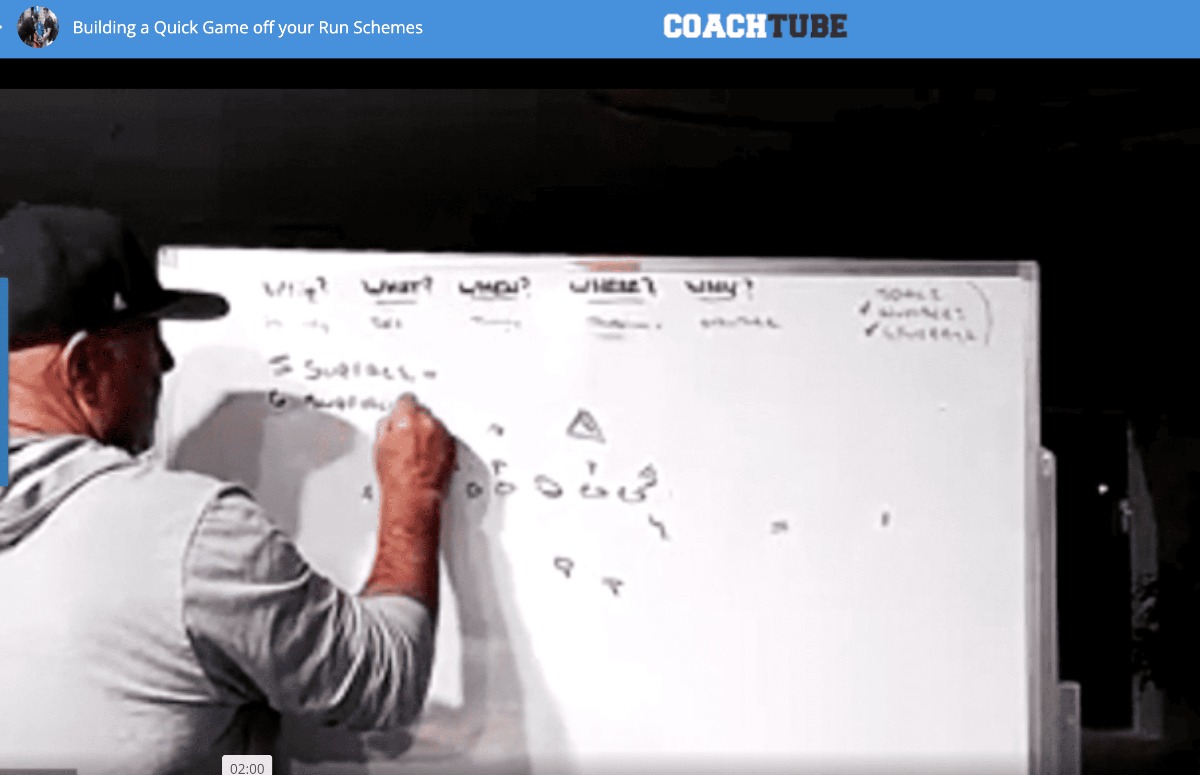
The Two Conflicts: First Level and Second Level
Start with the count. You can block five. The defense has tackle, tackle, and two backers fitting the box, so anytime you can’t account for all six, Coach Mazzone says you only have two choices. “Either block him and make the end a conflict player, or block the end and make him a conflict player.” You decide that inside your scheme. He keeps it in pure zone-read terms in the clip, but as he says, you match it to whatever your line coach likes: power, counter, lead, whatever.
That decision is what splits his RPO menu into two buckets.
– Five-man surface = first-level conflicts. The conflict player is at the line, the end or the box defender.
– Six-man surface = second-level conflicts. Bring in a sixth blocker and now you can handle the end and the backer. As Coach Mazzone puts it, “now my eyes are moving to the back end, to the nickels and the safeties.”
Here’s the part that keeps it teachable. The quarterback’s rules don’t change between the two. “He just knows that conflict player changes.” Same read structure, different defender. Coach Mazzone walks the look-to-look version of this in the video.
Find Your Two Defenders on Film
This is where the scheme gets narrowed down to something a quarterback can actually process.
When Coach Mazzone breaks down tape and sees a defense playing him a lot of under-four Joker out of trio, he’s counting run fitters.
“There’s a run-fit guy here and a run-fit guy there. That’s really the only two guys that can run-fit this, unless they corner-catch it.” So that’s the whole job. “I know I’ve got to have answers for these two guys. That’s who I have to have answers for when I talk to my quarterback.”
Then he hands the quarterback the structure the way he hands a player anything: the who, the what, the when, the where, and the why. The structure is block six. The mission is control the two. “The only way I can control him is with this guy and your answers.”
The film read of which two defenders matter is the part most coaches rush. Watch how he isolates them before he ever picks a route.
Match the Route to the Space the Run Creates
The answers themselves are a short list, and which one you call depends entirely on the run it’s attached to.
His core route answers off the conflict:
– A turn route or stop route at eight yards
– A glance
– A read that runs a five-step glance and converts to an inside box fade off the defender’s leverage
– The under route, which he admits he leans toward when it’s there
He even tags quarterback options under one call he labels Omaha: six-step out, seven-step stop, five-step glance, all game-planned in.
But the route has to fit where the ball is going. Run inside zone that shows like split zone and tag a glance into it, and “there’s like 80 bodies in there, the quarterback’s throwing it through guys’ arms.” So on inside runs he stays with the turn or the out. Run stretch and it flips: now he pulls the glance, “because these guys have to move,” and the backside fit opens the throw. As he says, “the RPO you put to your run is important. Where am I creating the space, and how do I fill it?”
There’s more in the clip on how he pairs specific routes to specific run actions, and which ones he refuses to put together.
The “Macho” Rep: Reading the Sixth Defender
Coach Mazzone runs a live example off a backside man tag he calls macho. Zone up front, macho the backside man, quarterback’s eyes on the sixth defender.
The read is clean. If that defender fills the gap and run-fits it, pull the ball and throw into the space he just vacated. The route the quarterback hits is dictated by the rest of the picture:
– Inside-zone action, throw the glance into the void, or the out
– Defender closes the cushion or presses, the glance converts to a box fade off him
– Defender sits deep and you don’t like it, you’re onto your A-to-B answer
That A-to-B piece is the safety net. “Everything is A to B. When do I come back to this?” Pre-snap they hand you straight cover three, and the quarterback’s first thought is the one Coach Mazzone wants drilled in: “free access, free access.” Whatever route you tagged, if he likes it, he takes it before the run ever has to work.
He points to the SIG out of Indiana as the film proof: inside zone and split zone all day, corners playing off, stop routes and hitch routes coming out the back of it, the out route off a tight split, the key route when the nickel cheats the box. Watch the rep to see exactly where the quarterback’s eyes go from snap to throw.
You’re Not Playing Eleven. You’re Playing Two.
Strip all of it down and this is the principle Coach Mazzone wants his quarterback to walk to the line with. “You ain’t playing against eleven dudes. You’re playing against one or two guys, and it’s your job to control them and make our running game go.”
And the priority never moves. RPO is run first, pass second. The quick game exists to protect the handoff, not replace it. “We want to run the football.”
He closes with the line he tells every quarterback, and it’s the whole philosophy in nine words: “The more you see of a defense, the less you see of a defense.”
This article is the framework. The full clinic, Building a Quick Game off your Run Schemes, is Coach Mazzone walking the install rep by rep: how he builds the first-level and second-level conflict packages side by side, the full route tree off each run action, the Omaha quarterback-option tags, and how he game-plans the weekly answers off what the tape tells him about a defense’s run fits. If this showed you which defender to attack, the clinic shows you how to build the whole menu that attacks him.
Link: Noel Mazzone – Building a Quick Game off your Run Schemes


