
Most kickoff return units tell the coverage team where the ball is going before it ever comes down.
The front line leans. Blockers set early to the call side. A tight end widens a step too soon. The coverage unit reads middle, right, or left and rallies to it before the returner has the ball.
Temple is built to give the opposite. Coach Dan Sabock lays out the responsibilities in his Temple Kickoff Schemes and Wrinkles clinic, and every one of them serves a single goal: when the ball is in the air, there should be absolutely zero key as to where the returner is going. The call is simple by design. Middle, right, or left. Not boundary, not field, no double teams.
Video: Dan Sabock on Temple’s Kickoff Return Responsibilities
Find the Fullback First, Not Your Man
The first coaching point flips the standard return rule. Most coaches teach the front line to keep their head on a swivel and find their man right away. Coach Sabock teaches a different first read.
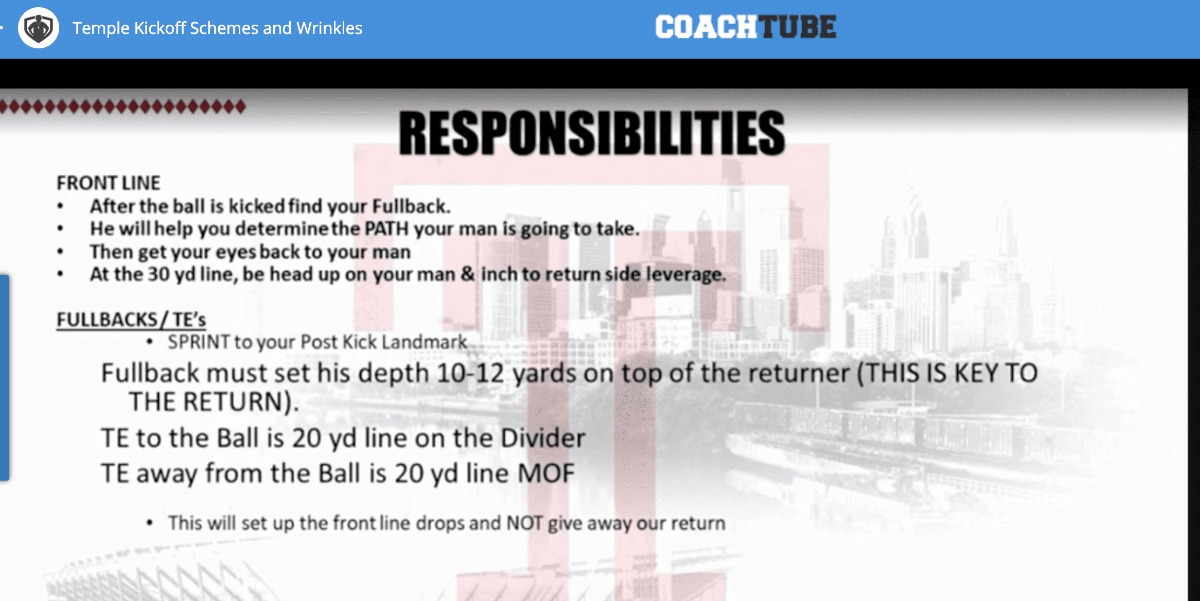
After the ball is kicked, every front line player gets his eyes to the fullback.
The reason is the twist teams. With your eyes hunting your man through traffic and stunts, you lose the ball and the path. The fullback solves it. He gets over the ball immediately, and where he goes tells the front line where the ball was kicked and the path the coverage man is going to take.
Once the front line has that read, they get their eyes back to their own man and find him. And Coach Sabock wants them to find him by something specific:
“I always like to pick something out on him. I don’t just say the jersey number, pick the cleats he’s wearing. Does he have a towel on so you can help identify him?”
Eyes to the fullback for the path. Eyes back to the man for the block. Coach Sabock walks the full progression on tape.
The 30-Yard Line: Head Up, Not Leverage
At the 30-yard line, the entire front line gets head up on their man. Not leverage. Head up.
Coach Sabock says it himself: this is “very, very weird because everybody always talks about leverage.” Every other phase of football coaches leverage. The kickoff return front line does not.
The six front line players are trying to create a line at the 30. Head up, six across, one wall. And that is the first piece of the disguise. A front line playing leverage tips the call. A front line head up across the 30 tips nothing.
Coach Sabock shows how that line forms on film, and what it looks like when a player cheats his leverage and gives the return away.
The Fullback Is the Key to the Return
Coach Sabock puts it in parentheses on his own diagram: the fullback is the key to the return.
His job is depth. He sets 10 to 12 yards on top of the returner, and he has to get there as fast as humanly possible.
“Get over the ball and make sure that everybody can see you doing it very quickly.”
The speed is not only about the fullback’s own block. It is the trigger for the timing of the entire return. The front line is reading him off the kick. The faster and cleaner he gets over the ball and sets his depth, the faster everyone behind the line knows where the ball is and where to work.
The Tight End Landmarks at the 20
The two tight ends finish the picture, and their rule is built off the hash.
The tight end to the ball, meaning the side the ball was placed on the tee, drops to the 20-yard line on the divider.
The tight end away from the ball drops to the middle of the field at the 20.
Coach Sabock gives the exact example: if the ball is on the right hash as the return team sees it, the left tight end drops to the middle of the field on the 20. Both tight ends work to the same depth off the same landmark, regardless of which return is called.
That is the last layer of the no-key design. The tight ends do not widen to the call. They drop to a landmark. Watch where they land in the clip and you will see why the coverage team gets no read off them.
The point underneath all of it is disguise through discipline. Middle, left, or right is already called, but the front line plays head up, the fullback sprints to a fixed depth, and the tight ends drop to landmarks off the hash. Nobody leans, nobody widens early, nobody tips the call. When the ball comes down, the coverage team is reading a return unit that looks identical on every call, and Temple gets the half-second of hesitation that springs the return.
This article is the responsibility chart. The full Temple Kickoff Schemes and Wrinkles clinic from Coach Sabock is the install.
He gets into the base alignment behind these rules, the specific middle, right, and left return calls and how the blocking changes on each, and the wrinkles and double teams he layers in once the base is sound, all reinforced with Temple’s own game film. If you want a return phase that hides the call until the ball is in the air, the full clinic is the build.


