
Most quarterbacks get coached to read coverage like a stack of flash cards. Name the coverage. Name the beater. Then the ball snaps, a safety spins, and the picture they memorized is gone.
Coach Todd Dodge teaches it the other way around. Before a quarterback sorts a single coverage, he reads the roof. One high or two high. That is the entire pre-snap job, and from there every defense narrows to two or three answers his quarterback already knows cold. It is the same system Dodge builds around the quarterback who is standing in the middle of the field in December, holding the trophy.
Video: Todd Dodge on Reading the Roof: QB Coverage ID
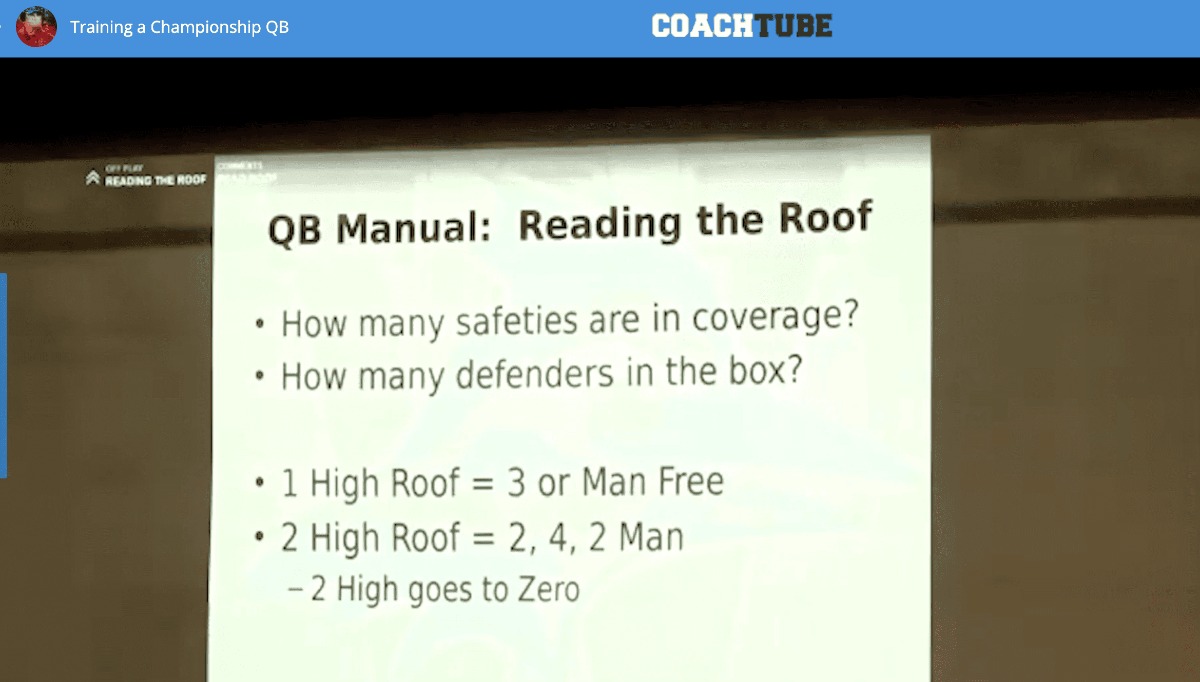
Start With the Roof, Not the Coverage
Dodge does not ask a quarterback to identify twelve coverages. He asks one question. How many high safeties?
One high roof” “You’re going to get cover three, or you’re going to get man free. I don’t know what else you’d get.” That is the whole conversation in a one-high roof. Two answers.
Two high roof: Cover two, cover four, or two man. Good old two deep, five under. He teaches the quarterback what two deep five under is, what a cover four is, but the bottom line never changes: two safeties up top, three coverages live.
Everything starts here. Read the roof first, and the field of possibilities shrinks before the quarterback ever looks at a defender.
Man or Zone: Watch Where the Underneath Eyes Go
A one-high roof still leaves Cover 3 and Man Free sitting on the same look. Same picture, different answer. Dodge splits them with one tell: the four underneath defenders, and where their eyes go.
He teaches it as a call and response. Roll the film, freeze it, ask the room.
– Defender’s eyes on the quarterback? That is zone.
– Defender’s eyes on the receiver, playing his inside leverage? That is man.
“Where are they looking? You’re looking at the quarterback. Man or zone? Zone.” Next clip. “The inside leverage, coach. You’re looking at the receiver.” Man.
Dodge is honest that a defense can fake the eyes. A coach in the room points out that the sky is the limit on disguise, and his answer is yes, they can, but you have to start somewhere. The eyes are where you start. He runs the reps where the tell holds and where it gets muddy in the clip.
Be the Best in the Building at Attacking 2-Man
Inside that two-high bucket sits two man, and Dodge has a strong opinion about it. His quarterbacks ought to be better at attacking two man than any other coverage they face.
The reason is simple. It is all of seven on seven. “Somebody locking up on these five guys and playing two deep behind it, and boom, here he goes.” That is the coverage they get the most live reps against all spring and summer, so that is the coverage they should own.
He even tells them when to go get it. On long counts. The cadence is part of the answer, and Dodge walks through how he uses it in the video.
The Spin: When Two High Becomes One High After the Snap
This is the part Dodge spends the most time on, because it is the part that breaks young quarterbacks. The defense he sees most plays good old-fashioned Cover 3. They just refuse to line up in it.
“They’re not lining up in it the chalkboard form.”
So the quarterback is staring at a two-high roof pre-snap, and he has to know it might be a lie. Dodge gives his quarterbacks an indicator he coaches all week, a pre-snap tell that a spin is coming. But here is the hard truth he hammers: you usually will not see the spin until after the ball is snapped. The two-high look rolls to a one-high look as the quarterback takes his first step.
The end result is still three deep, four under. Or three deep, three under if the defense is bringing pressure with the rotation. A two-high shell can even roll all the way to zero.
His teaching line for a seventh grader is the one to steal:
“If you ever hear the word spin in our terminology, you can be assured that when the ball is getting into your hands, and you’re taking that first step, they’re going to be in cover three. Because they are spinning to it.”
Strong Spin, Weak Spin, Cloud
Once the quarterback accepts that the picture will change, Dodge names the ways it changes.
– Strong spin: Rotation to the width of the field. The strong or free safety comes down to the field side.
– Weak spin: Rotation to the boundary.
– Cloud strong: A big-field cloud off a two-high look. The safety goes over the top of the corner. The corner squats and becomes the curl-flat player. The safety takes the deep third. The backside safety rotates into the middle of the field. The defense lands right back in three deep, four under. They have clouded.
Three rotations, one destination. Cover 3 out of a disguised start. Dodge shows what tips each one and where the quarterback’s eyes should go as the safety moves in the clip.
The whole system is built so a quarterback is never memorizing. He reads the roof, he expects the picture to move, and he knows the two or three answers that live under each look. One high is Cover 3 or man free. Two high is cover two, cover four, or two man. And when he hears spin, he already knows where the ball is going before the safety gets there.
Reading the roof is one piece of how Coach Dodge builds a quarterback. His full Training a Championship QB clinic is the rest of the build: his “3 camera” coaching point for teaching the throwing stroke and cleaning up accuracy, how he calibrates the passing game by matching the quarterback’s footwork to each concept, and the way he drills RPO execution rep by rep.
If you want the step-by-step on developing the quarterback standing on the field in December, the full clinic lays it out.


