
If your run fits break down, it’s usually not because a player got beat. It’s because someone didn’t know where to be or when to go. The Cyclone Defense is built to eliminate that problem. Every position has a clear rule, a clear gap, and a clear read that tells them when to trigger.
Coach Tom Miller breaks down the run-fit structure in the Cyclone Defense, starting with the D-line’s rail technique and working through the overhang responsibilities that tie the whole thing together. In the clip, he walks through alignments, gap rules, and real film showing how each piece connects.
Video: Tom Miller on Cyclone Defense Run Fits
D-Line Alignments and the Rail Technique
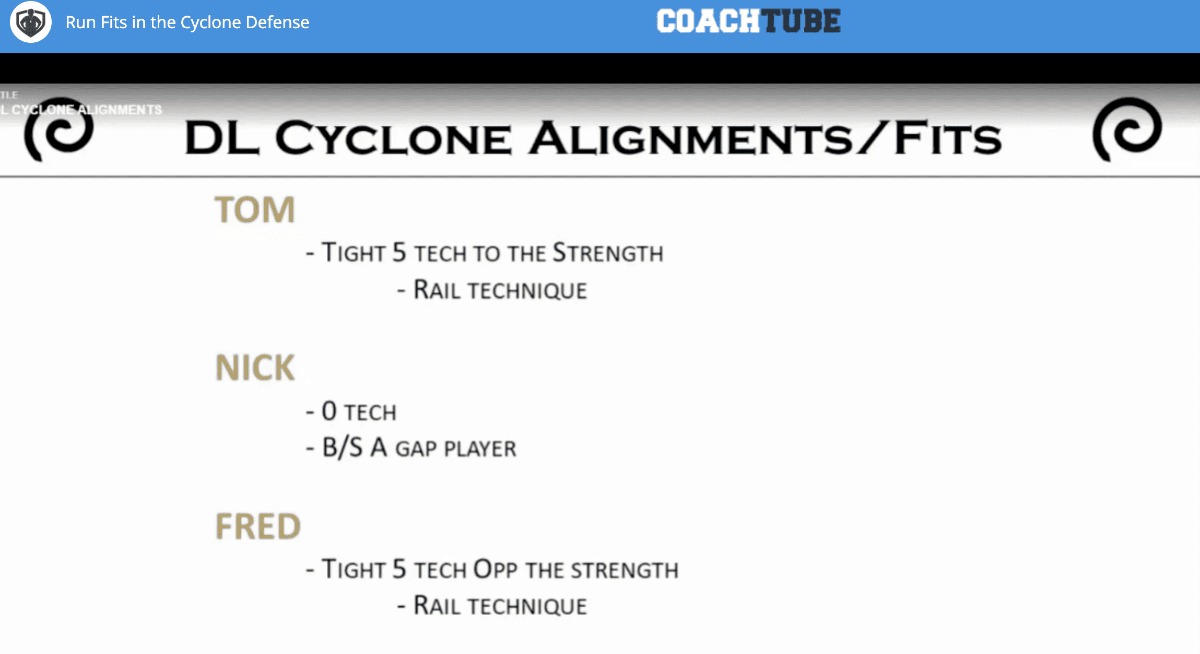
The Cyclone front puts three players across: the Tom (to the strength), the Fred (away from the strength), and the Nick (head up on the center).
Tom and Fred align in a tight five technique. Coach Miller describes it as face mask on the outside shoulder of the tackle, or inside leg splitting the crotch of the tackle. It’s a five, but it borderlines on a four. The key word is tight. In the film, Coach Miller points out that one of his ends was too wide, and it cost him. His feet got sloppy and he had to turn and run down the line instead of fitting cleanly. The other end, aligned tighter, played it right.
Both ends play a rail technique. Their hands go on the tackle. The tackle is their man. They are B gap defenders anytime that tackle comes to them or tries to reach them. Their hands stick to the inside shoulder of the tackle.
If the tackle goes down and doesn’t come to them at all, they squeeze to the outside shoulder, put their hands on it, and prevent a free release to the linebacker. If they get a puller or a swiper, they dig it out and play inside of it.
On a zone read where they’re being read, they keep their shoulders square, take away the C gap, and if the quarterback pulls it, they run flat down the line and chase.
The Nick is the backside A gap defender. He plays hands on the center. Whichever way the center goes, the nose plays the backside A gap, putting his hands to the backside shoulder. In the film, Coach Miller shows the nose doing exactly that on an outside zone flow, keeping his hands on the center and preventing the center from climbing to the linebacker.
That’s the whole point of the rail technique. Coach Miller walks through it on film: the D-end playing inside shoulder on the tackle keeps the guard stuck on him. The nose working his hands on the center keeps the center from getting to the second level. The front cleans up its gaps and the linebackers stay free. Coach Miller covers more detail on the technique in the clip above.
Overhang Responsibilities: Read the Back, Then React
The overhangs are a big part of the Cyclone Defense, and different players can fill the role. The chuck linebacker (your prototypical nickel) is usually one. On the backside, it’s typically a defensive back, either a corner insert or a safety insert. If the defense gets a slide call and the backer moves out of the box, the Will can also become an overhang.
The overhang’s assignment is built entirely around the running back’s alignment. Two scenarios. Two different jobs.
Back to the overhang’s side: Pause. Coach Miller means exactly that. The overhang sits, watches the mesh point, and does nothing until he sees the quarterback’s hands come out. If the quarterback gives the ball, the overhang folds into the run fit and adds himself to the box. If the quarterback pulls it, the overhang drops into his pass responsibility.
Back away from the overhang’s side: Trigger downhill immediately. With the back going away, the offensive line flow is almost always coming toward the overhang. He becomes the alley defender, fitting the C gap or D gap on the run.
The discipline here is what separates this from guessing. The overhang doesn’t read the offensive line. He doesn’t read the quarterback’s eyes. He reads the running back, and the running back tells him pause or trigger. That’s it.
The Pause on Film: How Patience Turned a Zone Read Into a TFL
Coach Miller shows a clip where both overhangs execute their reads perfectly, and the result is a coverage sack the offense can’t solve.
The boundary safety inserts as the overhang to the bottom of the screen. The running back is to his side, so he pauses. Coach Miller points out the patience: the safety doesn’t move his feet. He just sits and watches the mesh. This was a true freshman in the clip.
On the other side, the chuck linebacker has the back away. As soon as he sees the mesh, he triggers downhill and starts taking away the C gap.
Here’s where it comes together. The quarterback pulls the ball and wants to throw. The boundary safety, who was patient through the mesh, reads the quarterback’s hands and snaps out to the number one receiver. He breaks downhill, gets underneath the RPO throw, and takes it away.
The quarterback has to eat the ball. The defense gets an easy sack.
Coach Miller also points out the front doing its job on the same play. The D-end to the right gets his hands on the tackle and works to the inside shoulder, fitting the B gap. The nose plays the backside A gap cleanly. Rail technique working exactly how it’s supposed to while the overhangs handle the second level.
Every player in the Cyclone run fit has one read and one job. The ends play rail technique and own the B gap. The nose takes the backside A. The overhangs read the back and either pause or trigger. When everyone does their job, the offense runs out of answers.
Coach Miller’s full clinic, Run Fits in the Cyclone Defense, goes beyond what’s covered here. He breaks down the full defensive structure, including linebacker fits, fallback fits against multiple personnel groupings, pursuit angles, and the communication adjustments the defense makes when formations change.
If you’re looking for a complete run-fit system built on gap integrity and clear rules at every level, the full breakdown is below.


