
Most coaches install spacing as a catch-it-on-the-run concept. Will Stein doesn’t coach it that way.
In his words, spacing is “not a movement, catch the ball on the run route concept. It’s a run after the catch. It’s stationary routes.” The receivers stop. The play starts the second the ball arrives. That one reframe changes how he installs it, how he reads it, and how he drills it.
Stein delivered this lecture at the THSCA convention when he was the offensive coordinator at UTSA, before he took over as head coach at Kentucky. This clip is the 3-man spacing concept, the foundation everything else in his passing attack hangs off.
Video: Will Stein on the 3-Man Spacing Concept
The Build: A Three-Man Bunch and Three Stationary Routes
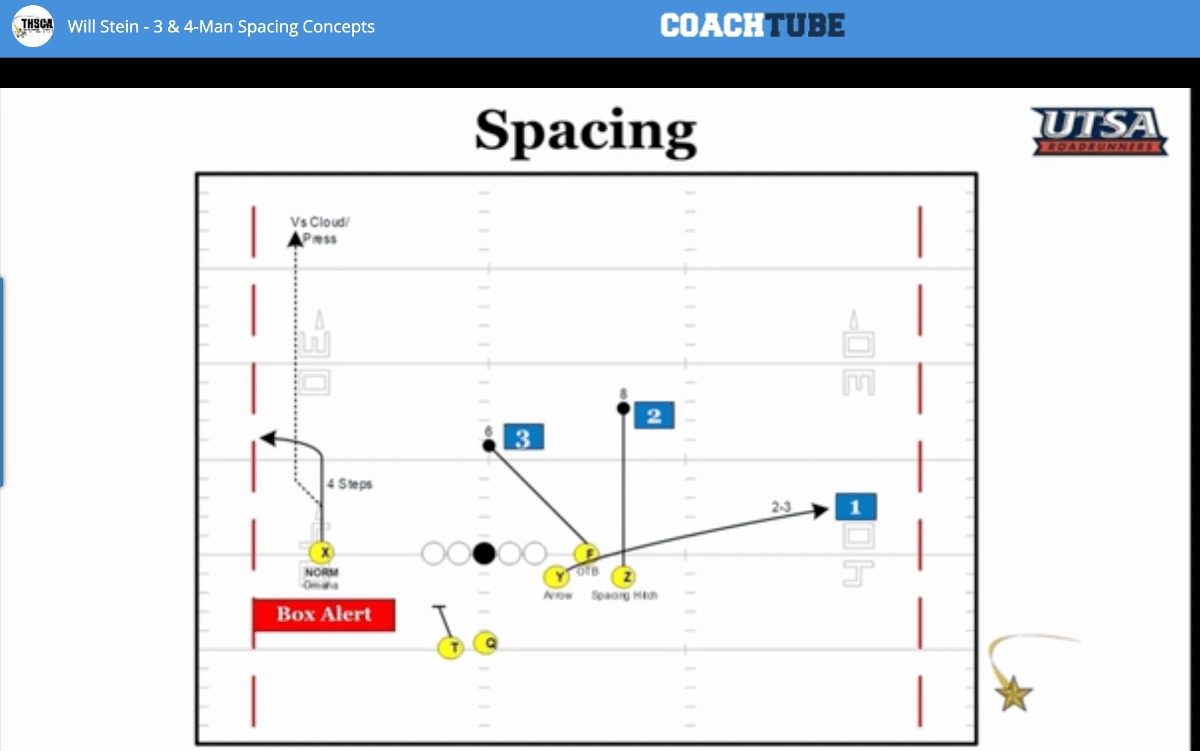
Stein runs spacing out of a three-man bunch, usually tight to the formation.
The route distribution is fixed. The number one receiver to the field, the Z, runs the spacing hitch at eight yards. The number two, the F, sits over the ball at six. The Y runs an arrow to the field, aiming for two to three yards on the sideline.
The Y’s job is where the coaching lives. When he gets to the numbers, Stein wants him to get friendly to the quarterback: turn and show his numbers instead of sprinting for the boundary. He’s blunt about the alternative. “The kids want to run all the way out of bounds and catch the ball and toe tap for like one yard. I’m like, dude, what are you doing?” Present your numbers, make it an easy throw.
The base call isn’t locked, either. Stein runs spacing with different route tags week to week depending on the coverage, and he’s gravitated to letting the quarterback signal the route he wants. He calls “spacing blank” and the quarterback fills in the route. “That’s when you got it the best,” he says. Coach gets into how he hands the quarterback that freedom in the clip.
The Read: Outside-In, and the Box Alert That Tells You Pre-Snap
The read on spacing is one phrase. Outside-in. Say no to the flat, yes to the spacing hitch, and work it from there.
The pre-snap picture can hand you the answer before the ball is snapped. Stein shows a bunch-to-the-boundary look where he had a one-on-one up top. How did he know? The boundary safety was way off the hash, the field safety was in the middle of the field, and the Sam was tucked in the box. One-on-one to the boundary is a box alert. “I’m taking it all day.”
That’s the part worth slowing the film down on. Coach points out exactly which defenders he stacks up to confirm the one-on-one, and where his quarterback’s eyes go to get there. The leverage tells are in the clip.
Run After the Catch: “When I’m in Trouble, I Double”
Because the routes are stationary, the yards come after the catch. So Stein drills it like a run play.
He credits Joe Price with the run-after-the-catch work and says there’s nobody better in the country at coaching it. The mentality is a phrase the whole room shares. Attack one, split two. When I’m in trouble, I double. Two defenders split in front of you, attack one and break the other, use the offhand as a weapon, and get north and south. Don’t waste time dancing.
The standard is cultural. “We don’t have soft receivers here at UTSA,” Stein says. His receivers finish going down the field in bounds. They don’t drift out unless the situation, two-minute or a clock rule, demands it. Off the shoulder it’s thrown, attack one, split two, fight for the extra yards.
Coach has the live reps and the way Joe Price builds the drill in the video. The cue fits on one hand. The carry-over is the whole point.
Spacing Across the Board: Pairing It With Two-Man Concepts
Here’s where spacing stops being a single concept and becomes a complement to everything else you throw.
Stein loves running the spacing hitch across the board with a two-man route concept to the other side. Against a Memphis look he ran spacing to the field with a concept he calls bite into the boundary: a swing or a rail with a snag route. Great versus one-high, great versus man. The quarterback keys the boundary safety, plays the foundation when in doubt, and still reads spacing outside-in. The protection there is scat, five-man with the back checking through.
The pressure answer is the one most coaches will want. Out of a wing twins look, Stein tags the spacing side with double slants as an alert. Two over two, and against pressure it’s a great answer. The quarterback works it inside-out to the double slant, and if he doesn’t like it or gets hung up, after a quick one-drop he goes across the board, over the ball, spacing hitch to the back. He leans on a Graham Harrell line here: “If you could throw slants and fades, you’ll have a dynamite passing attack.”
The pairings are open. An MOR or an outcut, slant-arrow, two hitches. “Spacing is a great complimentary route concept to go across the board,” Stein says, “especially if you’re a progression passing team.” He even shows it as a secondary play for a big mesh team, the same backfield action, except now the guys stop instead of crossing the formation. Coach runs several of these looks back to back so you can see the same concept wear different formations.
The thing that makes spacing work isn’t the routes. It’s the standard underneath them: stationary routes, an outside-in read, and a receiver room that treats every catch as the start of a run, not the end of one. Build that, and a three-man bunch turns into one of the most reliable answers on your call sheet.
This article is the 3-man spacing concept. The full 3 & 4-Man Spacing Concepts clinic is where Stein builds the rest of it: the Full Field Read that ties the progression together, his 4-man concepts Spoon and Flag, and the scat protection bonus that keeps a five-man pass game clean.
He installs the drills that train it too, the Window Drill and the Drop Step plus Stiff Arm for the run after the catch. If this email showed you the foundation, the clinic is the whole high-octane attack it sits inside.


