
You can’t rep a live punt block.
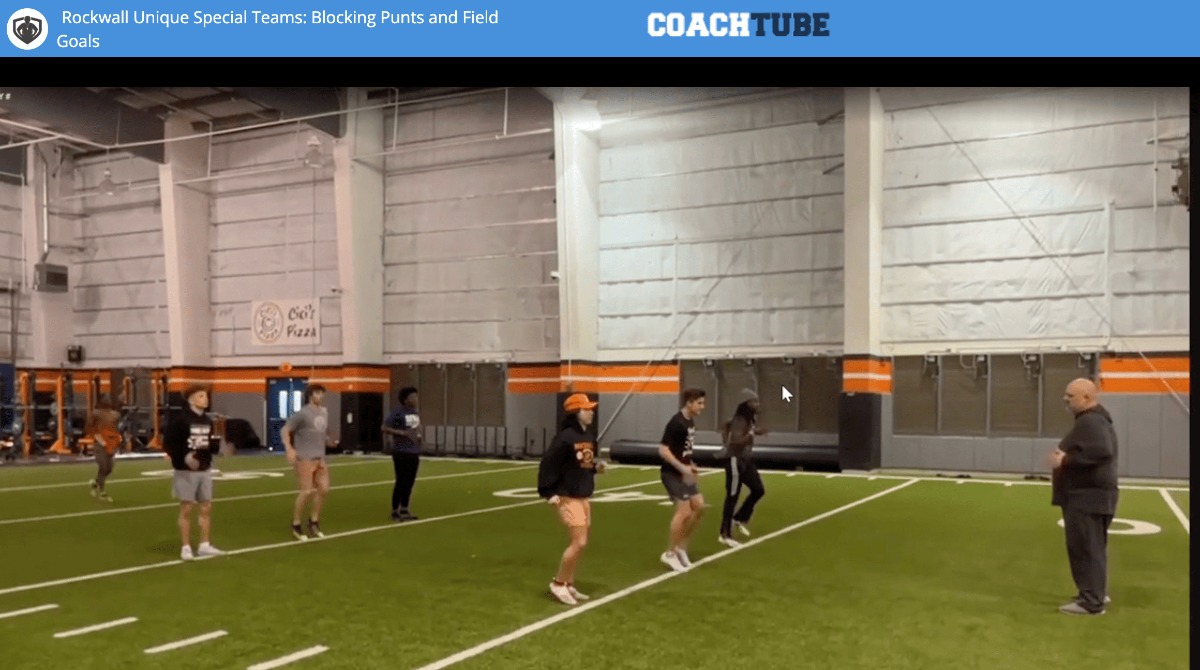
The ball is too hard, the get-off is too fast, and the ten minutes you get for team special teams disappear before anyone learns to take one off the toe. So Coach Brent Young stopped teaching it live. He built a Tuesday specialty period where every candidate to block a punt reps the whole thing on volleyballs, and he walks the entire menu, eight to ten drills, in his Rockwall Unique Special Teams clinic.
Video: Brent Young on Punt and Field Goal Block Drills
Why Volleyballs, and Why Tuesday
The block team doesn’t live in the team period. It lives in specialty. Every Tuesday, every kid who’s a candidate to block a punt comes, and that’s where the entire menu gets repped. The team minutes are too valuable and too dangerous to teach technique in.
The volleyball is the reason the whole thing works. Coach Young is the first to admit he’s not much of a kicker, and a volleyball is easy for him to put in the air. It’s round, so it doesn’t roll all over the place for the scoop-and-score man the way an oblong ball does. And it’s soft, so a kid can throw his hands and his face at the block point without flinching. That last part is the point. The volleyball builds the confidence to attack the ball, because it can’t hurt them.
Coach Young runs the rotation so nobody stands around: a block line on one side, a scoop-and-score line on the other, and they switch sides every rep. He shows how the rotation flows in the clip.
Hands and Get-Off: Cross, Run, Then Hit
It starts with the hands, standing still. The kids just cross their hands at the block point. Coach Young over-coaches the cross on purpose. “Most of the time they’re going to be a little bit farther apart than what you tell them anyway,” so he tells them to cross all the way knowing they’ll naturally end up wider than that.
Then he adds movement. The running hands drill is what it sounds like: run in place, and on his “hit” call they cross the hands. Run and run and cross.
The get-off is a straight D-line drill. “Hut, hut, hut,” inside foot up, push hard off that foot, and no false step. He calls out a kid on tape for a small false step on the get-off, because that wasted step is the difference between blocking the punt and arriving a beat late.
Then he adds a blocker. The blocker gets his hands on the rusher, and the rusher has to dip and run through a hand to hold his track. Coach Young schemes the block to get at least one man free, but he’s honest about it: you might still have to run through a guy on your way to the ball. Watch how he wants that dip to look in the clip.
The Shield Drill: The Block Point Is Behind the Shield
This is the drill that teaches the block point itself.
A man holds a shield and does not move. Coach Young always works to get a rusher tight off that shield, and the rule is to throw the hands down at the block point, which sits two to three yards behind the shield. Not at the shield. Behind it, where the ball actually comes off the foot.
The cues are all hands and eyes. Hands low, not high. Extend through it with a long lever instead of short-arming it. And do not swim. Coach Young catches a kid swimming on the rep and kills it: the swim takes a little extra time, and time is the one thing a punt blocker doesn’t have. Eyes to the ball, hands down, foot on the line.
The three-man version stacks the same teaching. He gets a volleyball, has the kids show a long lever, and tosses it up like a punt so they learn to throw the hands down and take their eyes to the ball on a live toss. He flags the same mistake again on tape, a kid throwing his hands real high, and shows what the clean toss-and-block looks like instead.
The Field Goal Edge Block: Tight, Then Bend
The field goal block changes the picture. Now there’s a wing, a tight end on the edge, and the block is designed off him.
When Coach Young blocks off the edge, he sends a man hard at the wing to force him to block down. Once the wing blocks down to the tight end and everybody blocks down, the next rusher runs right over the wing’s outside foot and goes to block the kick. If that man doesn’t block down, the rusher takes him instead. The picture he wants is a rusher running right over the outside foot on a tight, bending track.
The mistake he’s coaching against is width. “You never block it like that,” he tells the kids who get out too wide. Going wide is just distance, and distance means the rusher arrives too late. The answer is to line up as tight as you can and then bend to the block point.
There’s a second governor on it: don’t get too deep either. Coach Young keeps his rushers from running too deep so one man doesn’t slip through and collide with the man behind him. He explains where that depth line sits in the clip, and it’s the part that keeps the rush from blowing itself up.
Up the Middle: One Hand, Off the Toe, Ships in the Night
Up the middle is a different technique, and it starts with a no-step block. The kid crosses the hands, looks the ball down, and takes it right off the toe without taking a step. Off the toe, not reaching up at it. Coach Young keeps catching the same error, a kid reaching high at the ball, and brings it back down: lower, and take your eyes to it.
Then he turns it into the up-the-middle rush, and this is the wrinkle most coaches miss. When the angle isn’t right to block it cleanly, the rusher doesn’t square up and turn into the kicker. He takes it off the toe with one hand and runs right by. “Like ships in the night.”
The reason is the flag. Coming straight up the middle, it’s almost impossible to avoid a roughing or running-into-the-kicker penalty if you square up and miss. The one-hand technique lets the rusher attack the ball low and keep running past the kicker instead of into him. Right hand, right foot when he’s coming from that side.
Underneath it is a ball-security rule. The one thing Coach Young will not accept is not having the ball at the end of the play. It’s a judgment call: if a kid beats the ball and is a hundred percent sure, he can block it with everything he’s got. If he’s not sure, he takes it off the toe with one hand and runs by. He coaches the same kid through a bad rep and a clean one back to back in the video.
Scoop, Score, or Peter
The last piece is the full-speed block, and Coach Young is honest that it’s a little scary. The block point is set at nine, a kid or another coach handles the get-off, and he steps up and punts the volleyball live. Done right, the blocker is never in danger. By his own count he’s only been run into a couple of times.
The rotation builds in the recovery. One man blocks, the other scoops and scores, the ball comes back, and they switch sides. And the rep teaches the two rules every block team has to own:
– Behind the line: scoop and score. A blocked punt behind the line is a live ball, and the scoop-and-score man takes it to the house.
– Past the line: “Peter, Peter, Peter.” If it crosses the line, the scoop-and-score man yells Peter and waves everyone off, because the rules change the instant the ball gets past the line.
Coach Young has the film of why the second rule matters. A kid once caught a partially blocked punt out of the air, turned around, and took it back for a touchdown. He files it under negative success: it worked out, but it’s the exact situation the Peter call exists to prevent. He tells the whole story in the clip.
The thread through every drill is the same. Hands down, eyes to the ball, block point two to three yards behind the line, and never finish a rep without the ball. The volleyball is what lets a kid rep all of it at full speed without flinching, and the Tuesday specialty period is where it gets built one drill at a time.
These drills are the technique layer. The full Rockwall Unique Special Teams: Blocking Punts and Field Goals clinic from Coach Young is where the schemes live: how he attacks different punt and field goal formations with the block-down forces and free-rusher designs, the statistical case he makes for why special teams swing games, and how he organizes the player roles and the practice plan around the unit.
If you want the schemes that turn this volleyball progression into actual blocked kicks, the full clinic is the build.
Link: Brent Young – Rockwall Unique Special Teams: Blocking Punts and Field Goals


