
Most sacks don’t happen because the defender was better.
They happen because the tackle turned to face him.
The instant a lineman opens his hips to square up the rusher, both gates swing open. The inside gate gives the rusher a free path to the quarterback. The outside gate hands him the short corner. And in the worst case, the brace leg disappears entirely. The defender turns it into a bull rush, and the tackle is the one delivered to the quarterback.
Coach Chris Bober played offensive line for 19 seasons, 8 of them in the NFL, 4 with the Giants and 4 with the Chiefs. He learned the position from Hall of Fame teammates and Hall of Fame opponents. The pass protection framework in his O-Line Dominance: Pass Protection Tech & Drills clinic is built on one non-negotiable: stay square. The Two Gates rule is how he teaches it.
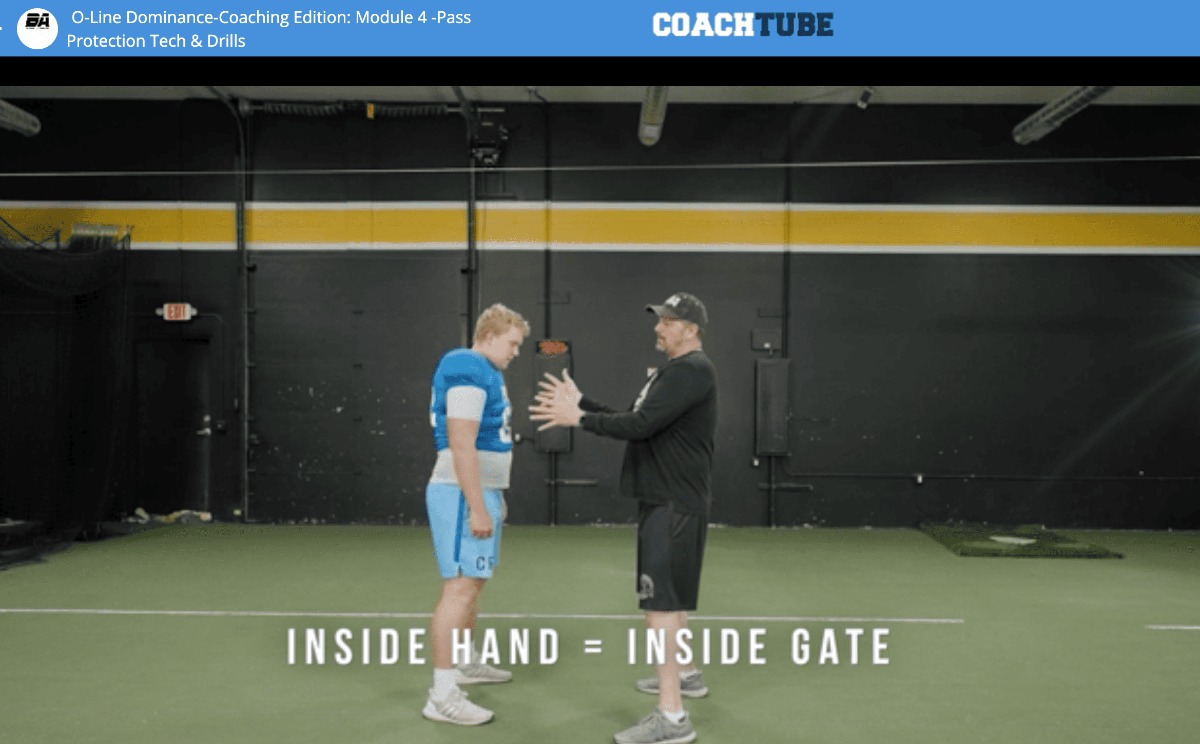
Video: Chris Bober on the Two Gates and Staying Square in Pass Pro
Width Is Your Friend
The first thing Coach Bober wants his linemen to hear is that width is force. Run blocking or pass blocking, the lineman who keeps his width is the lineman who keeps his power. The lineman who narrows his base loses both the ability to take ground and the ability to hold ground.
Most pass protection problems start when the lineman gives up his width to chase the rusher. Coach Bober wants the rusher to come to him. The picture should look the same on every rep. Square. Wide. Loaded.
The Two Gates: Inside Hand, Outside Hip
This is the visual Coach Bober uses to teach where the rusher is and isn’t allowed to go.
Picture two parking garage gates. The kind that lift up and slam back down.
Inside gate: The lineman’s inside hand. The rusher should never get past it. If the rusher beats the inside gate, he’s inside the lineman and on a straight line to the quarterback. The only recovery is to slide inside and re-establish position with the defender back in the outside quadrant.
Outside gate: A bar that runs through the middle of the hips and out through the outside hip. The job is to keep the rusher inside this bar, on the outside half of the body, where the brace leg can do its work.
Perfect position is specific. Coach Bober teaches it as the inside two-thirds of the defender, nose right down the middle of the inside number. Not centered up. Not square to square. Inside two-thirds, nose on the inside number, defender stuck in the outside quadrant between the two gates.
He walks the picture in the clip. The shoulder, hand, and eye relationship is the part that makes the rule live.
What Happens When You Turn
The temptation on a pass set is to square up the rusher. Face him. Get chest-to-chest. Coach Bober calls it out as the thing that hurts the lineman the most.
The moment the lineman turns, the inside gate swings open.
The rusher takes it. He’s inside, on a clean line to the quarterback, and the only thing the lineman can do is turn the rest of the way and try to wash him past the spot. Coach Bober is direct in the clip. That’s how most sacks happen.
If the lineman also opens the outside gate as he turns, the picture gets worse. The rusher now has a shorter corner. Less distance to the quarterback. The lineman has lost the ability to widen him. When he tries to displace, he isn’t pushing the rusher away from the quarterback. He’s pushing him back toward him.
Both gates open. No quadrant left to defend. The rep is over before the punch lands.
The Worst Case: Losing the Brace Leg
The third thing that happens when a lineman turns is the one that ends drives.
The brace leg disappears.
In a square stance, the outside leg is the brace. It’s the post that lets the lineman hold the defender off. It’s the leg that lets him displace without getting moved himself.
When the lineman turns, the feet go parallel. Perpendicular to the force. There is no brace left. The defender feels it instantly. Coach Bober describes what happens next in one sentence in the clip. He’s going to turn this into a bull rush, and he’s going to push me.
There is no posture left to absorb it. The lineman gets blown back. He arrives at the quarterback with the rusher attached to his chest.
Three ways to lose the rep. Inside gate open. Outside gate open. Brace leg gone. All three are the same root cause. The lineman stopped being square.
Coach Bober shows the breakdown live on his own stance in the clip and gives the cue he uses to know when a lineman has lost his squareness before the punch ever fires.
The teaching underneath the whole talk is that pass protection isn’t about reacting to the rusher. It’s about denying him the picture he wants. Stay square. Keep both gates closed. Keep the brace leg loaded. The defender stays in the outside quadrant, the quarterback stays clean, and the rep ends with the rusher widening past the spot instead of running through it.
This article is the staying square rule. The full O-Line Dominance: Pass Protection Tech & Drills clinic from Coach Bober is the install.
He walks through the target, the pass set angles that hold the inside two-thirds against any front, and the progressive striking drill series he uses to coach the punch from a square base. The drills are the part that teach a lineman’s body to refuse to turn even when the rusher tries to bait it.
If you want a pass pro install that traces back to NFL technique and works at every level, the full clinic is the build.
Link: Chris Bober – O-Line Dominance: Pass Protection Tech & Drills


