
To the defense, this play looks exactly like the one you just ran.
Same presentation. Same backfield action. The defensive end reads it the way he read Kick, squeezes to spill, and feels good about it. That’s the moment Coach Brandon Murdock pulls the ball and runs the quarterback around him.
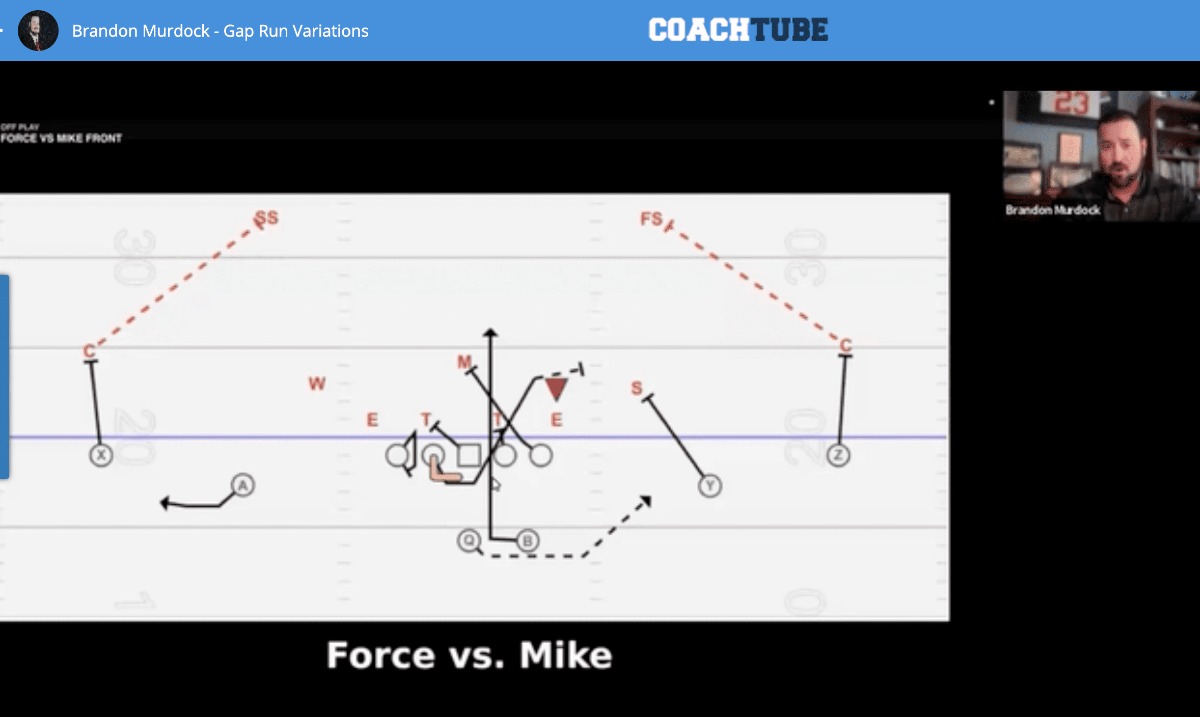
He calls it Force. It’s gap rules with the same look as Kick, except now the quarterback is reading the defensive end. Same-side mesh with the back, eyes on the end. Think inverted power read. As Coach Murdock puts it, “It’s basically veer from the shotgun.” It’s been productive for his spread offense going back to 2016, and in his Gap Run Variations clinic he draws it up as a template and then runs it live against a team that did exactly what he wanted.
Video: Brandon Murdock on Force: Reading the Edge Off Your Kick Play
Force Is Kick With a Read
The two plays are built to be twins. To the defense, Kick and Force show the same picture, which is the whole point of running them together. Coach Murdock keeps the same-side mesh, the same backfield track, and the same foot pattern up front. The only thing that changes is the quarterback’s job.
On Force, the quarterback reads the defensive end. If that end squeezes to spill, the quarterback pulls the ball and has a protected keep to the perimeter of the play. The end committed to the dive, and now he’s wrong. The give-or-keep is the same math the end thought he’d already solved on Kick.
Coach Murdock shows the quarterback’s eyes on the snap in the clip. Watch where the read starts and how fast the pull comes once the end tips his hand.
The Guard Reads the End Like He’s the Quarterback
Here’s the wrinkle that makes the whole thing work. It’s gap rules for everybody on the line except one man. “I teach the guard to read the defensive end like he was the quarterback,” Coach Murdock says. The guard’s eyes go to the same defender the quarterback is reading, so the block and the read can never disagree.
The path comes off what the end does:
– If the end is square-shouldered, surfing the down block, the guard gets outside.
– If the end is squeezing to spill, the guard is out running. Now he’s an extra hat to the perimeter for the safety, exactly where the quarterback is taking the keep.
– If the end is wide or up the field, the guard is downhill, inside-out, for the Mike. “That right there is Mike,” he says, pointing at the linebacker his gap rules already account for.
So when the end takes the quarterback, the guard becomes a runner to the perimeter and there’s a hat on the safety. When the end widens off to take the pitch, the guard turns downhill to the Mike and the ball stays inside. One read, two answers, and the guard is never guessing. Coach Murdock walks the guard’s track on the rep in the video.
Why He Loves It Against a One-Linebacker Surface
Coach Murdock prefers Force, and Kick, against a Mike front, and against a stack front in some cases. The rule he gives himself is simple: “Anytime it’s a one-linebacker surface inside the box, we love Force. We love Kick.”
The reason is the pairing. “The two complement each other perfectly, because to the defense they look the exact same.” Kick is the give. Force is the give with the keep built in. The defensive end is the conflict defender, and the offense gets to read him with the quarterback while the guard reads him too. Squeeze and you get kept on. Widen and you get run through inside. He breaks down why the two calls sit on top of each other in the clinic.
The Quarterback on the Perimeter
The other reason Coach Murdock runs this: it puts the quarterback on the edge with the ball and blockers in front of him. “Blocking the perimeter is huge for success in the run game,” and getting the receivers to do it is the priority. The outside receiver stays a little more square here, and the keep is protected the whole way.
The quarterback doesn’t have to be a home-run hitter to make it pay. “He can get what he can get and step out of bounds, hopefully not take any shots.” Coach Murdock has had quarterbacks who were very handy with it, and 2020 was the first year he turned it loose.
The Film: Feeding the End the Cheese
The rep ties it together. Mike front, pressure coming off the field. The foot pattern is the same as Kick: cheat one-two by the play side tackle, play side guard down, center choking, and the backside tackle driving B to C because the edge pressure is showing.
Coach Murdock knew this team. From how they’d played gap schemes on film, he knew the end was going to squeeze and spill. “There’s the squeeze. There’s the squeeze and spill.” So the guard knows he’s the extra hat, out running the perimeter. The quarterback gets the pull read. Protected keep down the sideline, and a good gain.
That’s the design out loud. He’d have had Kick called the same way, run at the same end, the end who feels like he has to squeeze and spill. “Now we’re going to feed him the cheese and get out to the perimeter and run with the quarterback.” Bait him with the look he’s seen all night, then take what he gives up.
The defensive end on the edge is the one defender the offense can’t block clean. Force doesn’t try to. It reads him, and the guard reads him, and whatever he chooses is the wrong answer to a picture that looked identical to the last snap. Veer from the shotgun, off a play he thought he already had figured out.
This article is one variation. The full Gap Run Variations clinic is where Coach Murdock builds the rest of the system around it: the Kick play this one is meshed to, the hard and fast gap rules that travel across every personnel grouping, and the gap identification that tells your line who to count and who to leave.
He’s after one thing with all of it, creating the rep where the sideways arm tackle is the only defender left who can make the play.
If Force made sense, the rest of the gap run game is how it multiplies.


