
Here’s a number worth sitting with: 48% of Jacob Wertz’s run game has a tag attached to it. Not just RPOs. Non-RPO tags too. Read tags, slash tags, crack tags. Ways to account for numbers, punish overfitting linebackers, and give the quarterback a built-in answer when the defense takes something away.
Jacob Wertz, Offensive Coordinator at Long Creek High School in New Braunfels, Texas, runs a 12 personnel system that’s averaged just over 7 yards per carry and nearly 37 points per game across two seasons at a 66-34 run-to-pass ratio. In this clip, he breaks down the three core run schemes that drive everything, the tags he layers on top of them, and the RPO concepts that turn base runs into full-field problems for the defense.
Video: Jacob Wertz – Run Game RPO Tags and Schemes
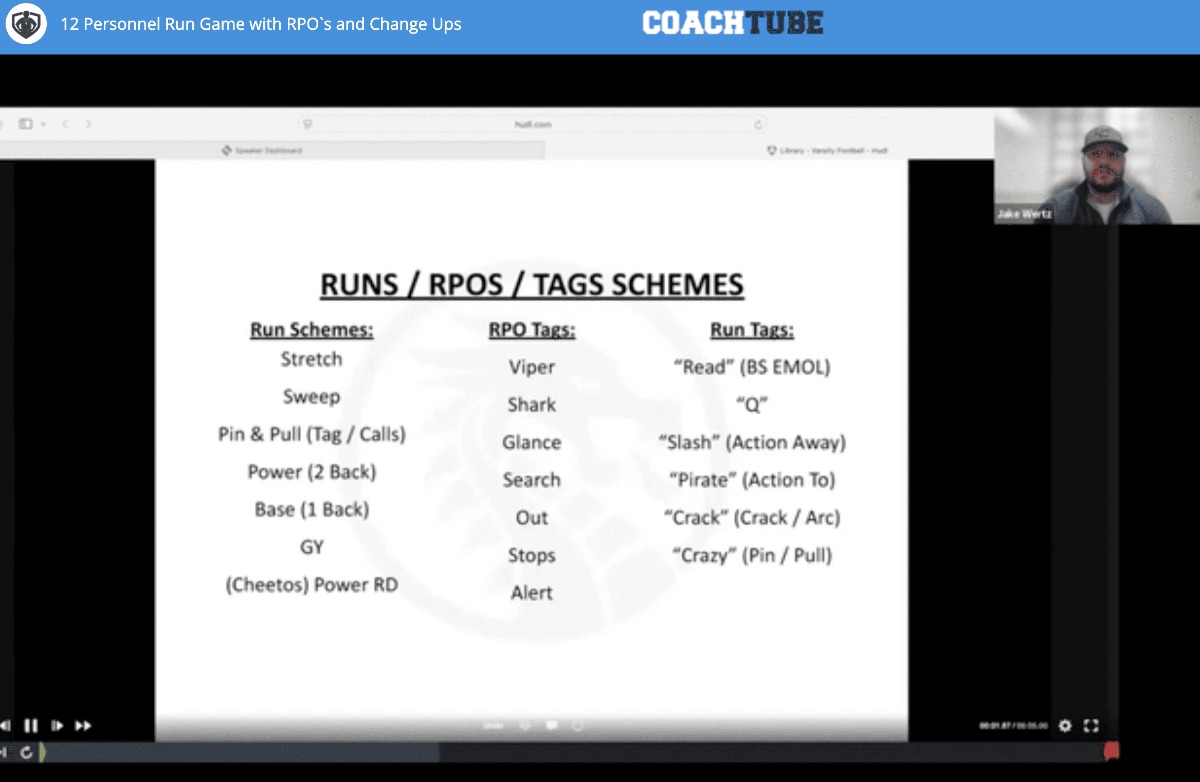
Three Schemes That Run the Show
Of 369 run plays last season, three schemes accounted for the overwhelming majority:
– Outside zone (stretch and sweep): 89 carries
– GY counter: 82 carries
– Two-back power: 77 carries
Coach Wertz carries other schemes. One-back power, which he’s manipulated to look nearly identical to his GY counter but functions as a counter insert. Pin and pull change-ups off outside zone. But those three are the base. Everything else branches from them.
Outside Zone: Stretch, Sweep, and Why It’s Not Wide Zone
Coach Wertz makes a distinction here that matters. This is outside zone, not wide zone. The goal is to capture the edge and circle the numbers, not to stretch the defense laterally and cut back.
Stretch and sweep are the same play up front. The offensive line’s rules don’t change. The only difference is the action in the backfield. Stretch comes from behind the quarterback in their base pistol set. Sweep comes from a sidecar action, whether that’s a jet sweep look, backs aligned to the side in a gun set, or a near/far alignment they move around.
The blocking philosophy is where Coach Wertz’s approach gets specific. They don’t combo a lot of things in their outside zone. It’s a covered/uncovered system. They want their guys running, not processing double teams and working to the second level together. Instead, they coach eyes. They drill their linemen on reading different looks and snapping their hat back inside once they’ve reached the second level and passed off the defender who’s overtaken their block.
That emphasis on eyes becomes important when tags enter the picture. Coach Wertz walks through the specifics of how they coach their linemen to see it in the clip above.
Pin and Pull: The Built-In Change-Up
Pin and pull isn’t a separate scheme for Coach Wertz. It’s a toolbox option inside the outside zone framework. It can be called as a tag or built into the game plan.
The idea is straightforward. If the defensive linemen are too good to reach, stop trying. Pin them. Take advantage of angles and pull the covered lineman instead of trying to run past a defender who keeps winning the edge.
Coach Wertz also introduced a tag this past season he calls “crazy.” Pin and pull to the extreme. Not just the front side. Everybody who’s covered is pulling. They coached eyes with it, ran it out of 11 and 12 personnel looks, and it gave them another layer of run game variety without installing a new scheme.
The Non-RPO Run Tags
This is the 48% number in action. Nearly half of Coach Wertz’s run plays carry a tag that changes something about the play without changing the base scheme. Here’s the toolbox:
– Read: The quarterback reads the backside end man on the line of scrimmage. The rule is simple: first thing head up to outside the backside tackle. This is their version of the classic read option.
– Q: The quarterback keeps the football. If you’re going to play quarterback at Long Creek, you’re going to be an athlete. Coach Wertz loves to run his quarterback.
– Slash: Action away from the run call. Out of gun or near/far sets, they slash the back opposite the run direction.
– Pirate: The opposite of slash. They slash the back to the call side. This one has been especially useful against teams that take away power read. If defenses are keying the back, pirate gives them a plus number in the GY scheme by getting that back involved on the play side.
– Crack: This talks to the outside of the formation. The outside receivers crack the first defender inside their alignment, and the tight end (or first box player) arcs to the first thing outside, usually the corner. Most of the time they’re reaching and running with this tag, not pinning and pulling.
Each of these tags takes a base run play and turns it into something the defense has to account for differently. The scheme stays the same up front. The quarterback or the skill players just have an additional job. Coach Wertz goes into more detail on how these tags look on film in the clip.
The RPO Layer
On top of the non-RPO tags, Coach Wertz layers true RPOs onto his run game. He uses two primary tags:
Viper is a bubble screen. Shark is a now screen. Both give the quarterback a pre-snap or early post-snap throw attached to a base run play.
Then there are what Coach Wertz calls window throws. These are glance routes from the number one or number two receiver. The quarterback identifies a window of grass the defense is giving him. If he likes it, he throws it. If he doesn’t, he hands the football off.
The rule is simple: if the quarterback feels comfortable taking the grass the defense gives in a post-snap picture, he throws it. If not, he gives the ball and the offense runs. When those RPO throws connect, they’re explosives. When they don’t trigger, the offense still gets a base run with 5.5 yards per carry on the ground.
Three base schemes. A tag system that modifies nearly half the run game without changing the blocking rules. RPOs layered on top that turn handoffs into full-field decisions. Coach Wertz has built a system where the same five or six core concepts give the defense a different look on almost every snap.
This overview covered the framework of Coach Wertz’s run game and how the tags and RPOs attach to it.
The full clinic goes deeper into the operational side of how he installs and reps all of it: his high-tempo “Mesh Drills” for ball security and fundamentals, his dedicated RPO drill periods, and the quarterback school structure he uses to develop decision-making.
If you want the day-to-day installation process behind a system that averages 37 points per game, the full course is below:
Link: Jacob Wertz – 12 Personnel Run Game with RPOs and Change-Ups


