
The offense knows a blitz is coming. They’ve scouted it, they’ve practiced it, they’ve got an answer. The question is whether they know who’s bringing it.
John Grayson, Defensive Coordinator at Fenwick Football and a five-time state champion, built his 3-3 Stack pressure system around that exact problem. The blitz looks the same. The coverage looks the same. But the player bringing it and what’s behind it changes snap to snap.
Video: John Grayson on 3-3 Stack Straight Blitzes
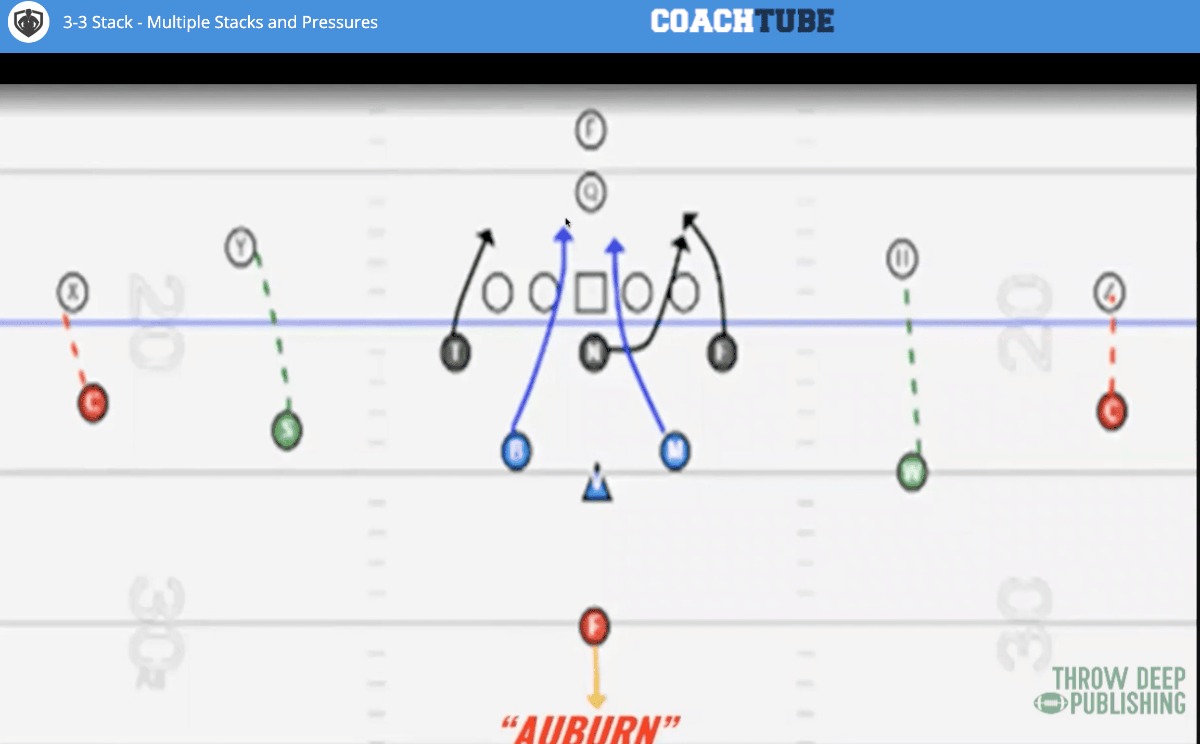
Naming the Blitzes: Cities, Towns, and Why It Matters
Grayson calls these “straight blitzes.” No stunts involved. The pressure is clean and direct. The one exception is Auburn, the inside linebacker A gap blitz that Grayson addresses in the clip.
Before he gets into the mechanics, he explains a decision that changed how his defense operated.
When he arrived at Morton as a first-year defensive coordinator, he inherited a numbering system. Linebackers were numbered one through five, so a blitz involving linebackers two and four was called “24.” It made technical sense. It didn’t work.
Too many blitzes were run incorrectly. The confusion showed up in the film. Grayson’s response was to look inward.
“I could have been stubborn and said, ‘This is how it’s supposed to be run.’ Or I could look internally and say, ‘How do we fix this?'”
He chose to fix it. Every blitz in the system is now named after a city or town in the state of Illinois. Auburn is the one that didn’t fit the theme, but it survived the rename. Grayson explains why in the video.
The lesson underneath the scheme detail: your system only works if your players can execute it. If your call structure is creating confusion, the problem isn’t your players.
On A gap pressure, Grayson’s nose does a long stick. He steps away from the A gap instead of diving into a double team, freeing the gap for the blitzing linebacker behind him. As Grayson tells it, every nose thinks they’re a better athlete than they are. The long stick gets them moving and gets them out of the way.
Coach walks through the specific blitzes and film on each one in the clip above.
Video: John Grayson on Creating a Pressure Package
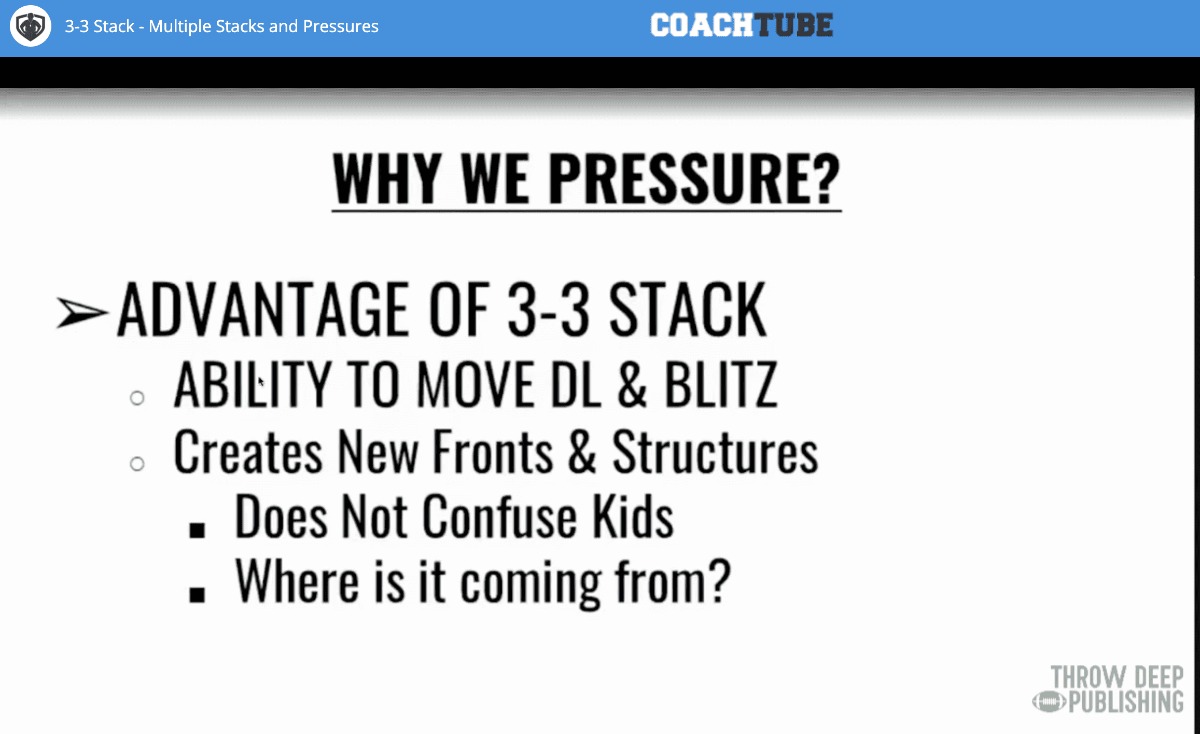
One Blitz, Eight Different Faces
This is where the 3-3 Stack separates itself.
Take a single edge pressure. Call it Rip Viper. That same structure can come from your Sam, your Mike, your Buck, your corner, your free safety. Technically, Grayson says, you can bring it from eight different players.
“It’s the same blitz, same edge pressure. But it’s coming from eight different places.”
From the offense’s perspective, they know a fourth rusher is coming. They don’t know which of eight players is bringing it. That’s the confusion Grayson is selling. It’s not about exotic designs. It’s about multiplying the same concept through different personnel.
And none of that multiplicity touches his own players. The call is the same. The movement is the same. Only the assignment changes based on which player’s name is attached to the call.
The Coverage Disguise: One Shell, Two Coverages
The pressure is one layer. The coverage behind it runs on the same principle.
Grayson wants his corners up at three to four yards, showing a one-high shell every snap. Doesn’t matter if it’s Cover 3 or Cover 1. The shell looks identical pre-snap.
Here’s what that creates. The quarterback identifies the blitz and remembers that the last time Grayson showed this look, the corner bailed into Cover 3. He makes his decision. He’s wrong. This time it’s Cover 1. The corner stays. The receiver is bracketed. They get a pick.
As Grayson puts it: “You don’t have to fool the coach on the other sideline. You have to fool the 16 or 17-year-old kid taking that snap.”
Same pre-snap picture. Different answer post-snap. The quarterback is solving last game’s problem.
Coach goes deeper into the full pressure package in the clip above, including how the one-high shell holds up against different formations and how he combines the coverage variations with his blitz calls.
The 3-3 Stack pressure system is built on two things. One well-designed blitz multiplied through eight different personnel so the offense can never pin down the source. And a coverage structure disguised well enough that the quarterback is guessing, not reading.
That’s not complexity. That’s leverage.


