
Your linebackers don’t need to make every tackle. They need to send the ball where the defense wants it. In plug fits, that means spilling everything to the safeties and trusting the system to finish the play.
Daryl Ely, former Defensive Coordinator at Mount Union and current assistant DB coach at UConn, walks through how plug fits work in the Mount Union four-man front. In the clip, he covers gap rules, the spill-or-box decision, and how the safety connects to the linebackers on film.
Gap Rules in the Four-Man Front
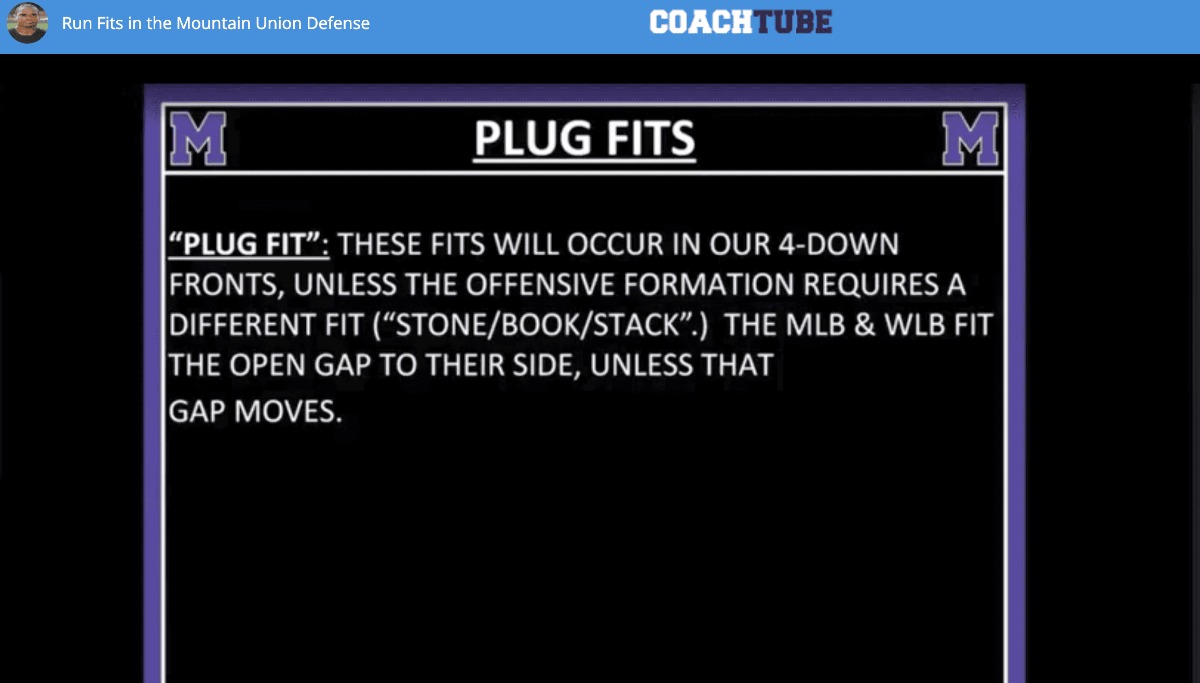
Plug fits are the run fits the Mount Union defense uses in its four-man front. The Will and Mike linebacker each take one open gap. The front dictates which two gaps are open, and those two gaps belong to the two linebackers. That’s the entire assignment.
When the front sets weak (away from the tight end), the Will takes the open A gap to his side. The Mike takes the open B gap to his. Ely shows this across multiple alignments in the clip, and the rule holds every time.
The one exception: if the alignment shifts their gaps, the linebackers move with it. And certain two-by-two formations will whip the Will outside the box, which changes the fit entirely. But in standard plug fits, both linebackers are inside the box with clear gap responsibilities.
Spill Inside the Box, Box Outside
This is the core of plug fits and the key distinction from 30 fit.
When both linebackers are inside the box, they’re spill players. They understand they’re spilling everything to the safeties. That’s the deal in a Cover 4 or Cover 1 defense with plug fits. The linebackers don’t try to make the play in the hole. They redirect the ball carrier and let the safety finish.
In 30 fit, two linebackers were outside the box. A linebacker outside the box becomes a box player. He contains and forces the ball back inside instead of spilling. Plug fits are different because both backers are inside. Both are spilling. Every time.
That means the safeties have to be ready to play force. The plug fit system only works if the safety is triggered and coming downhill when the ball gets spilled to him.
The Safety’s Read and the Force Fit
Ely walks through several clips showing how the safety ties into the plug fit structure.
In a 3×1 formation, the backside safety cross-keys the number three receiver, which in this case is the tight end. When the tight end smacks or stacks, the safety becomes the force player and fits downhill.
On an ISO play, Ely breaks down the sequence. The fullback comes through to block the linebacker. The linebacker spills the ball to the safety. The safety, keying the second back to his side, reads ISO action and triggers downhill to make the play.
In the specific clip, the offense didn’t actually ISO the linebacker. They left him free. But Ely explains what the fit should look like if the fullback does block: the linebacker spills, the safety fills. He points out the good fit by the safety coming down and the clean run-through by the linebacker. Ely covers the full details of the safety’s role in the video above.
How Plug Fits Handle Pullers
When the offense pulls a lineman, the linebackers don’t abandon their gap rules. They see the puller and work over the top.
Ely shows multiple clips of this. Both linebackers see the pull, work back over the top, and keep spilling the ball to the safety. In one clip, the linebacker outside the box becomes the box player on the second back while the Mike sees the puller and runs to the football.
On another play, Ely points out that the defender should stay inside and play the quarterback rather than chase the ball carrier. The linebackers and five-technique are already running to the football. The spill player stays disciplined in his fit and lets the other defenders do their job.
The principle doesn’t change just because a lineman is pulling. The linebackers adjust their track, but the assignment stays the same: spill to the safety.
Gap rules tell the linebackers where to go. The spill-or-box decision tells them what to do when they get there. And the safety’s key ties the whole thing together.
Every player has one job. That’s what makes plug fits work.
Coach Ely’s full clinic, Run Fits in the Mount Union Defense, covers the entire run-fit system beyond plug fits.
He teaches 30 Fit, Eye Lag Fits, Lag Fits, Stack Fits, and Yoda Fits, along with the adjustments the defense makes against split and stack formations.
If you’re looking for a complete gap-discipline system with clear rules for every front and formation, the full breakdown is below:


