
The RPO read is a math problem, and the offense wins the math when your conflict defender has to guess. You already know that. What most defenses never get cleanly explained is how to structure a two-high shell so that the guess disappears, the conflict defender has a real job, and the quarterback ends up reading a defender who is actively wrong for him.
Coach Adam Gaylor teaches this out of a framework he credits to Dante Bartee and Kyle Kogan. He calls it slinging the fit. The system defines who fits and who hangs based on the location of the back, then adjusts the apex defender based on the type of RPO the offense is running.
Video: Adam Gaylor – Defending 12 Personnel RPOs
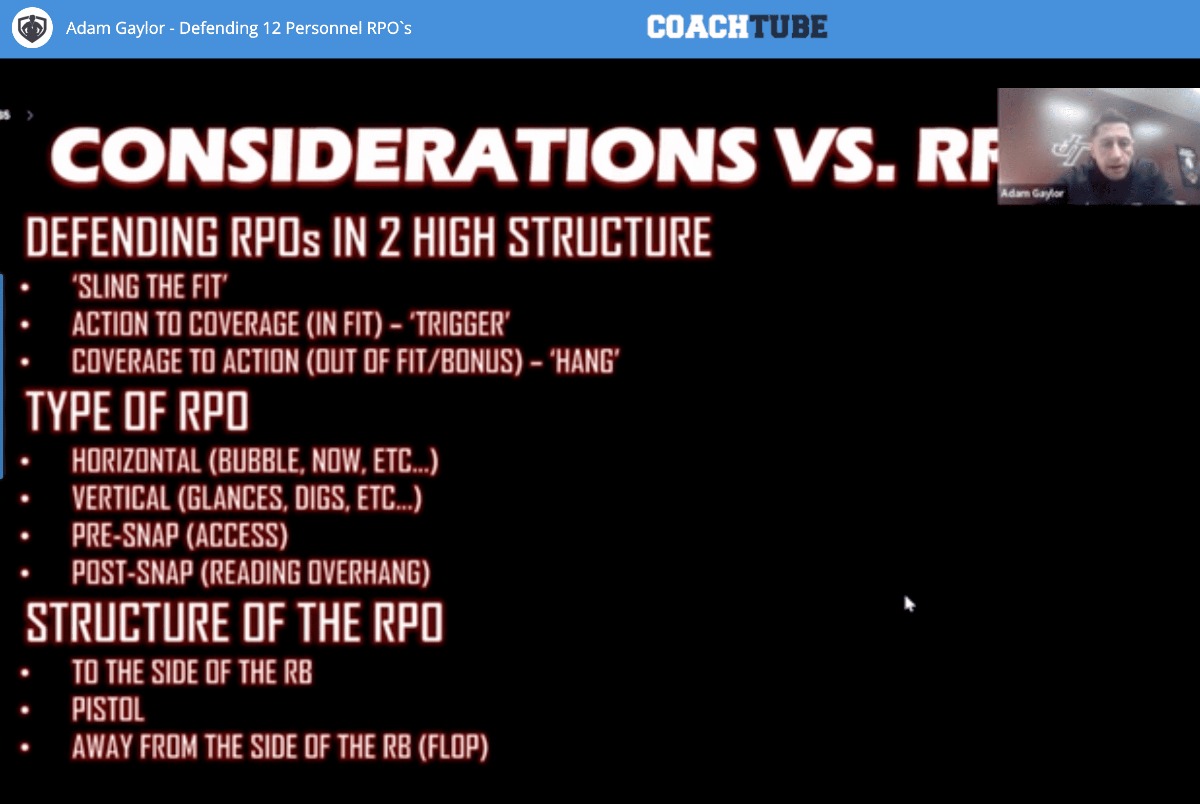
Slinging the Fit: Action to Coverage vs. Coverage to Action
In two-high structures, Coach Gaylor sets the fit off one rule: where the back is.
The overhang away from the back is in the fit. The overhang to the back is out of the fit. Those two assignments are what let him play RPOs without stranding a conflict defender on an island.
He labels them cleanly:
– Action to coverage: The back’s action runs toward you. You are out of the fit. You are the hang player, the bonus fit guy.
– Coverage to action: The back’s action runs away from you. You are in the fit. You are the trigger player, and you can trigger because the RPO is not to your side.
The trigger player has the easier job. The back is gone, the RPO is not his problem, and he fits the run like normal. The hang player is the one who has to operate under pressure, and his technique is where Coach Gaylor spends the detailed coaching.
The Hang Player’s Job: Pop, Hang, Force the Handoff
Coach Gaylor is specific about what the bonus fit player does:
“He’s going to pop his feet. He’s going to hang. He’s going to force the handoff. And if the quarterback pulls it, he’s going to end up being the outside half of the quarterback player.”
That sequence is the whole assignment. Feet pop to stay square. Hang to keep the eyes on the mesh. Force the handoff by making the quarterback believe the back has nowhere to go. If the quarterback pulls and keeps, the hang player becomes outside-half-of-quarterback and widens him into the sideline.
The front fits to match. Coach Gaylor has the 4i or 5 technique (depending on whether it is a four-man or five-man front) pop and squeeze. He calls the technique surf. That defender becomes outside half of the back, inside half of the quarterback. The overhang plays outside half of the quarterback. The quarterback runs out of clean reads: hand it off into a squeezed front, or pull it into a defender already waiting for him.
The rules work cleanly against traditional zone read. Coach Gaylor is honest that triple option adds a coverage layer he has to build answers into, and he walks through the fix in the clip.
Apex Placement Changes Based on the RPO Type
This is the part most defenses get wrong. Coach Gaylor breaks RPOs into two categories, and each one demands a different apex alignment.
Horizontal RPOs
Bubbles. Nows. Perimeter screens. The offense is spinning the ball out and trying to win with leverage in space.
Against that, Coach Gaylor is comfortable playing palms coverage or true quarters with the apex defender inside. The apex linebacker, nickel, or star sits in a tighter alignment and the coverage can read the horizontal concept without opening a vertical window behind it.
Vertical RPOs
Glances. Digs. Slants. Now the threat is inside and behind the apex, not out on the perimeter.
Here Coach Gaylor flips the structure. Move the apex defender over the top of the end, which puts the nickel or star head up to outside of #2. The conflict player, the overhang, becomes the safety at depth. He is fitting downhill from the roof, not from the line of scrimmage, and he is sitting in the glance window.
The hang player’s feet and the apex’s alignment are two of the smallest details in the defense. They are also two of the details that decide whether the quarterback has an open read or no read at all. Slinging the fit doesn’t eliminate the conflict defender. It gives him a job that matches what the offense is actually doing.
Coach Gaylor walks through his complete one-high and two-high structures against 12 personnel, including quarters, man-match, and pressure adjustments. He covers the light fit, solo fit, and max fit and when each one is the right call against different backfield sets.
He teaches the built-in practice drills he uses to install the hang player technique and the apex movement, and he breaks down his game-plan process based on quarterback run game and offensive tendencies.
If you are building your RPO answers for 12 personnel this spring, the full clinic is a full playbook.


