
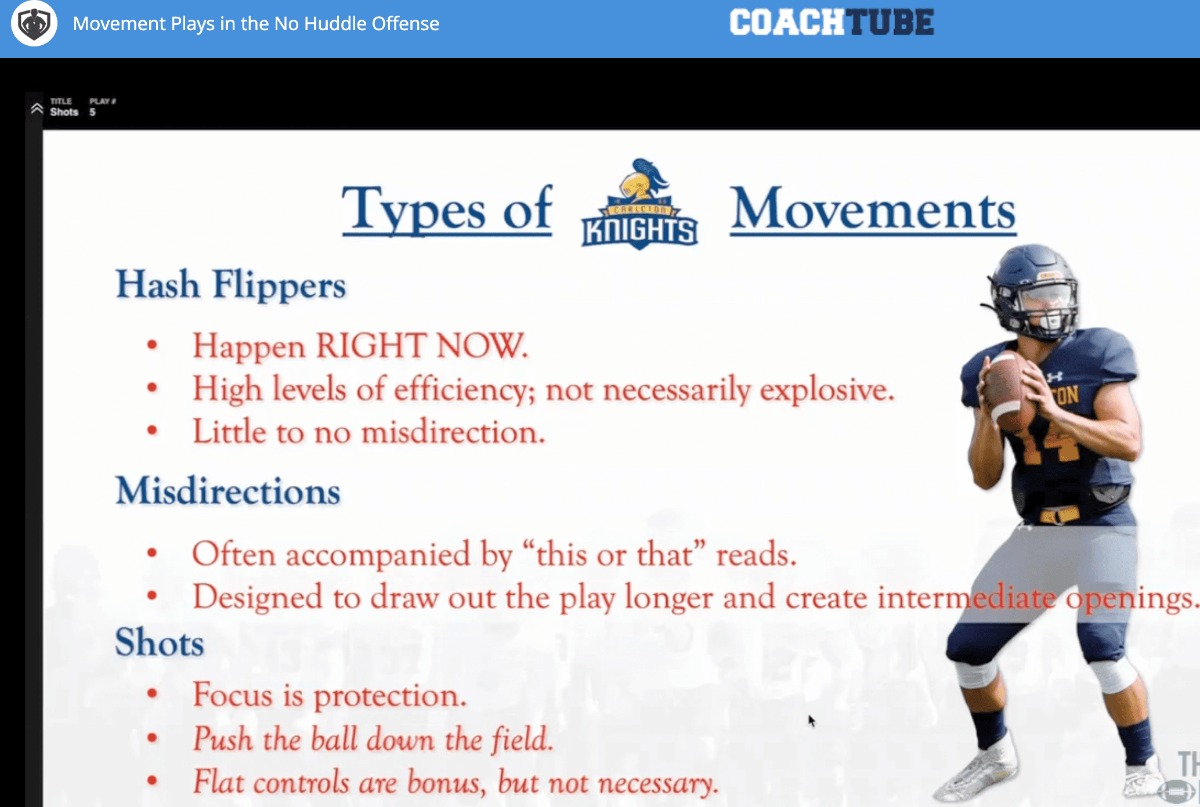
Movement plays aren’t just about flipping the hash and tiring the defense out. That’s part of it. Sprint outs, speed sweeps, swing screens. Those plays keep the chains moving and make every defender on the field run. But Coach Davies teaches three categories of movement plays, and the one that changes games is the shot.
Coach Bob Davies breaks down how he uses movement to push the ball down the field without asking his offensive line to hold up for four seconds in a static pocket. The trade-off is simple: you might only get three routes out instead of five. But if you’re throwing the ball 40 or 50 yards down the field, three routes is plenty.
The Logic Behind Movement Shots
Most shot plays ask the quarterback to sit in the pocket and wait. Coach Davies goes the other direction. He gets the quarterback moving, changes the launch point, and uses that movement to buy time and displace the defense.
The trade-off he accepts: you’re not getting five routes distributed across the field. You might only get three. But Coach Davies makes the case that when you’re pushing the ball deep enough, it doesn’t matter. Football is a one-on-one game at that depth. You don’t need to move flat defenders around underneath if the ball is going 60 yards down the field. You just need to beat one guy.
That’s the whole philosophy. Secure the protection, get the quarterback into space, and let your receiver win his matchup deep.
Sprint Out Shots: Same Protection, Bigger Plays
Coach Davies starts with what his offense already does well: sprint out. His hash-flipping sprint outs use smash concepts, quick throws to the flat and the corner. Efficient, safe, easy for the quarterback.
The shot version uses the same sprint out action but changes the intent. Instead of sprint out smash, it’s sprint out hitch and go. The quarterback gets extra depth on his sprint to give the route time to develop. The receiver sells the hitch, the defender jumps it, and the throw goes over the top.
He shows another variation where the sprint out sets up a wheel route. Same movement, same protection feel. But instead of throwing to somebody on the flat, the quarterback lets the flat defender bite and throws the wheel behind him. Only three routes are out, but the ball is going down the field and the defense is chasing.
Coach Davies also shows a bootleg action where the sprint out turns into a post corner. The protection is a man slide with the tailback securing the edge. The quarterback gets out into space, and number 11 runs a double move back to the post corner. The protection is solid because the movement handles the rush. No one is asking the offensive line to hold up for four seconds.
That’s the principle Coach Davies keeps coming back to: instead of sitting in the pocket and getting upset when the line can’t hold, get on the move. Get the quarterback into space. Make people chase. Then push the ball down the field off the same protections your offense already runs.
Half Rolls and Outside Zone Fakes: Changing the Launch Point
The second group of shots Coach Davies teaches aren’t full movement plays. They’re what he calls half movement plays. The quarterback doesn’t sprint to the sideline. He displaces just enough to change his launch point and set up in a different spot than where he started.
Outside Zone Fake
Coach Davies shows a play out of pistol where the quarterback fakes outside zone one direction and continues on that path, setting up his new launch point in the middle of the field. He’s well off his original spot, but he hasn’t fully rolled out.
The run fake sucks the safeties up. The quarterback only gets a few routes out, but the ball is going deep, and the safety help is gone. Coach Davies goes back to his principle: if you’re pushing the ball far enough down the field, it’s all one on one. You don’t need five routes distributed across the coverage. You need to beat one defender.
True Half Roll
The other variation is a straight half boot. The quarterback starts two or three yards off the hash and half boots to the opposite side. It’s a movement play that buys time without asking for a full sprint out. On film, Coach Davies shows the quarterback buying just enough time with the half roll to let a deep route develop. The ball goes down the field off a clean launch point with the rush behind him.
He also shows a variation with receiver motion coming into the half roll, flooding the zone on one side. Three routes out, zone flooded, ball pushed deep. Coach Davies walks through several more examples in the clip above.
Movement shots work because they solve two problems at once. The quarterback gets out of danger and into space. And the defense has to defend the deep ball against a quarterback who has time and a clean launch point, not a quarterback standing in a collapsing pocket trying to survive.
You don’t need five routes to throw deep. You need protection, movement, and a receiver who can win one-on-one. Coach Davies builds his shot package around that idea.
The complete clinic covers all three categories: hash flippers for efficiency and field-flipping, misdirection concepts for attacking immediate areas of the field, and the shot plays covered here.
He also goes into the Hitch Naked concept with detailed installation segments, 2×2 formation variations, footwork and timing breakdowns, read progressions, and protection adjustments. If you’re looking for a complete movement-based system to layer into your no-huddle, the full clinic breaks it all down with extensive film.


