
You ran mesh three times last week.
The defense charted it. They watched the film. By the second quarter this Friday, they’re going to drop the safety on the crossers and dare you to throw something else.
Most coaches throw something else.
Coach John Bear, offensive coordinator and quarterbacks coach at Indiana State, doesn’t. He runs mesh again. He just tags it.
Specifically, he tags the post. And the post is the exact route designed to punish the safety who thought he was being smart.
Video: John Bear on the Mesh Post Tag
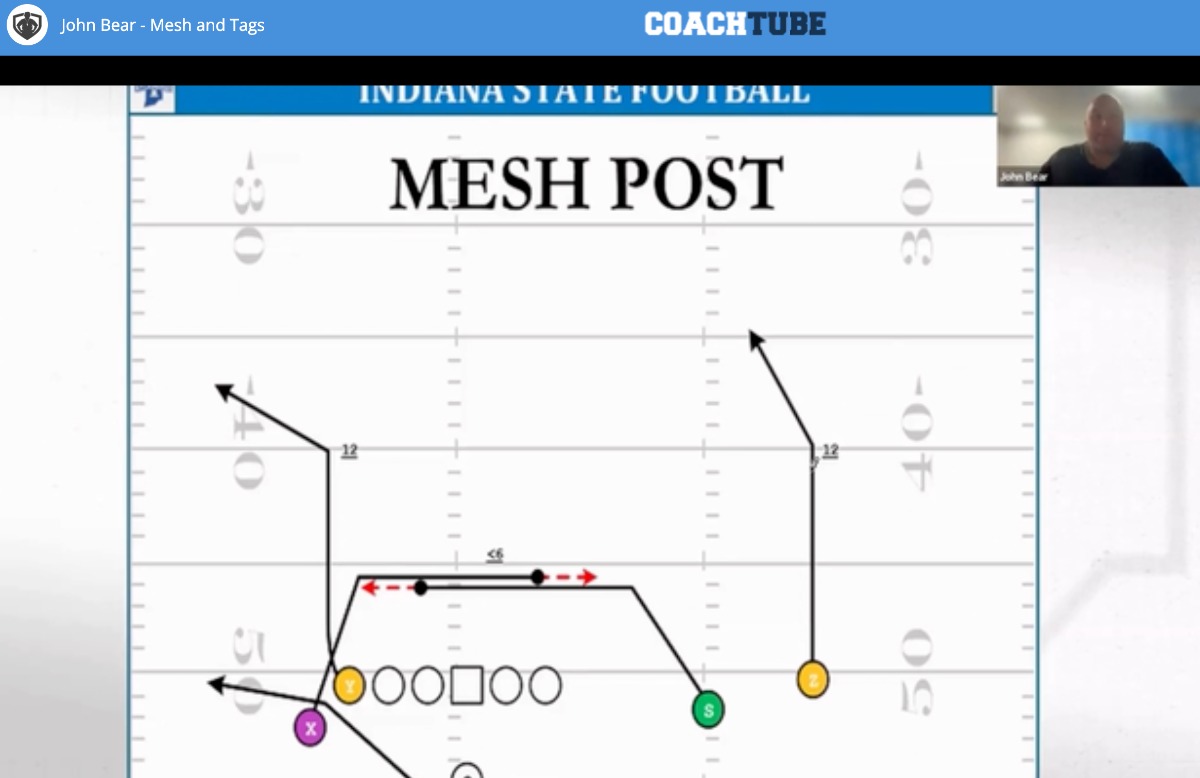
Two Tags in One
The base post tag is simple. Run it to either outside receiver in a 2×2. Coach Bear installs it first because of what it does to the safety.
But the version he likes most isn’t a single tag. It’s two.
The outside receiver runs the mesh. The inside receiver runs the corner. Same call. Different leverage.
Why does that work?
When the safety has inside leverage and plays soft, the corner from an inside alignment gives you a free release outside. The inside receiver wins that route before the safety can recover. The outside receiver, now on the mesh, holds the second-level defenders the way the original mesh always did.
One play. Two looks. Coach Bear walks through both in the clip above.
What the Post Tag Beats
The post by itself is the answer to three coverages.
– Man: The two crossers create natural rubs. The post is the third route the defense can’t cover.
– Zero: The hot throw built into the play is the post.
– Bracket quarters: This is the one that matters most.
That last one is where the tag earns its keep.
Coach Bear shows a clip from a game where they’d hit mesh on tape going in. The film is out. The bracket quarters team has seen it. The safety’s job, on tape, is to drive down on the under crosser.
So Coach Bear tags the post to the Z.
The safety drives. The post runs behind him. Touchdown.
Coach Bear says it directly in the clip. “It’s a really good answer for these quarters brackets teams or quarter, quarter, half teams.” The exact teams that have spent all week game-planning your mesh are the ones the post tag is built to beat.
Red Zone: Where the Post Tag Hurts the Most
If the post tag works in the open field, it works double in the red zone. The reason is in the geometry.
In low red, defenses pack the box. They condense. They double-bracket the routes they think you’re running. And they overplay the crossers because nobody wants to give up an easy mesh in tight space.
Coach Bear shows a low red clip. 11 personnel. Short motion by the tight end to set the coverage and change landmarks. Cover zero look. Tagged post to the outside receiver on the left. Hot throw. Touchdown.
His exact words on the clip: “The nature, especially in the red zone, of double crossers really can help open up the back line of the end zone for some tall post balls.”
That’s the slippery slope of the play. The defense compresses. The crossers bring the linebackers and the safety down. The back line opens up. The post drops in over the top.
He shows multiple motion variations. Short motion. No motion. Exit motion to start a receiver tight and bunched and send him out wide. The leverage you create off the formation dictates which side the post comes off of, and Coach Bear gets specific in the video about how he picks.
The Depth Rule You Probably Aren’t Using
This is the detail that separates the install from the execution.
Most coaches teach a post at one depth. Coach Bear teaches it at three.
– Seven-step post: Standard.
– Five-step post: When the safety has to be beaten faster.
– Three-step post inside the 10: Basically a slant.
The route name doesn’t change. The protection doesn’t change. The progression doesn’t change. The depth changes because the field changes, and Coach Bear’s quarterback knows the depth based on the situation.
That’s how you keep the install simple and still have the right answer at every spot on the field.
Coach Bear walks through how he coaches the receiver to read the safety on the way to the breakpoint in the clip.
The defense is going to adjust to your mesh. You can install a new concept every week to stay ahead, or you can install one tag that punishes every adjustment they make. Coach Bear picked the second option. The post tag is what turns a mesh team’s biggest weakness, the predictable look on tape, into the exact reason the touchdown is there.
This article covers one tag off the mesh concept.
The full clinic is the complete system. Coach Bear installs mesh top to bottom: timing, spacing, how to create the natural rubs that beat man, how to find open grass against zone, and how to adjust the concept versus rotating coverages.
He covers more backside tags, more red zone variations, and the practical drills and teaching progressions that make it executable for your players. If mesh is, or is going to be, a foundation concept in your passing game, the full clinic is the install document.


