
Fourth quarter. Semifinal of the 2024 Texas 6A playoffs.
Vandergrift calls one pass concept. The receiver swaps inside on a tag, gets his hips open, and runs by the defender. Touchdown. They go on to win the state title.
The concept is Deep Choice, and Coach AJ Woolley, the offensive coordinator behind that title run, builds the entire install around one principle: the receiver reads the safety on the way out and decides what the route is.
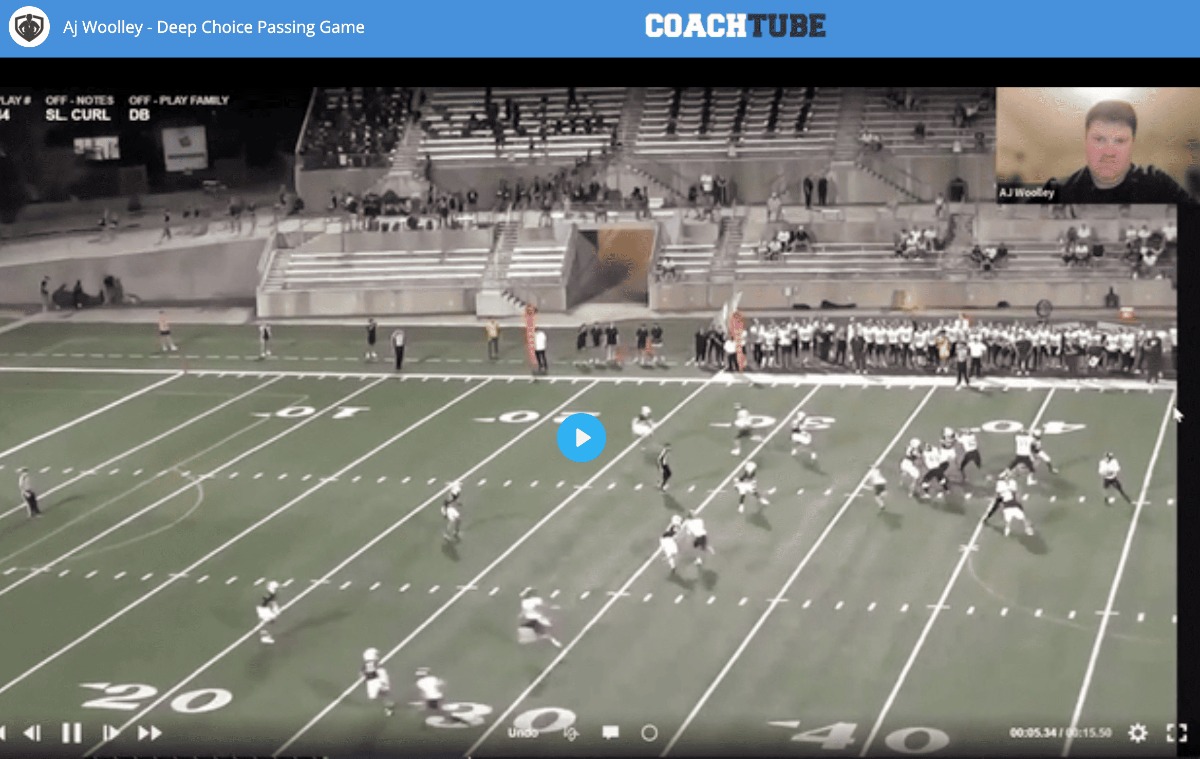
Video: AJ Woolley on the Deep Choice Passing Game
The Pre-Snap Read That Decides the Route
The base rule is short enough that the receiver memorizes it on day one:
– Safety stays high and over the top: Curl it.
– Safety opens the umbrella: Run past him.
That’s the read off the safety’s depth and leverage. If the safety stays over the top, the comeback turns into a curl in the soft window underneath. If the safety widens to help the corner, the umbrella opens and the receiver runs into the space behind him.
Coach Woolley is direct about who this concept is built for:
“We want to run this stuff for guys that trust their speed and think they can run past guys. When in doubt, do that.”
Default answer when there’s any doubt is to take the shot. This is not a possession concept.
When the Defense Watches the Film
Here’s where the concept earns the name.
Out of a trip stack look against SFA, Vandergrift motioned a receiver across to make him the #1, which turned the on-the-ball receiver into the #2. The defense opened the umbrella. The leverage was exactly what the call was designed to create. The throw is on, the ball comes off the receiver’s hands, and the play doesn’t finish, but the picture is clear: this is what the umbrella opening looks like.
Same opponent, later in the season. Same look on tape.
This time the safety stays over the top. Why? They watched the film.
So the receiver curls it. Easy completion. First down.
The defense’s adjustment is the cue. Coach Woolley shows both clips back to back in the video and walks through what he wants the quarterback’s eyes to do on each.
The Tags That Bend Leverage
The Deep Choice base call gets tagged based on what the formation gives them. Two of the tags are worth the install on their own.
Swivel
Out of a stacked or bunched alignment, the swivel tag rotates who is who. The original #3 bumps all the way out to become #1. The #1 becomes #2. The #2 becomes #3. There’s a switch release component built in.
The point of the tag is to drag a nickel or sam linebacker who has declared to a specific receiver out of position before the snap. Coach Woolley shows a clip where the swivel pulls the nickel sam all the way out, the curl opens up underneath, and the quarterback rips it for a third-down conversion.
Swap
The swap tag swaps the #2 and #3 in their alignment so the Deep Choice runner gets a free release with his hips already turned upfield.
This is the tag on the semifinal touchdown. Same Deep Choice. Swap. Receiver runs by the defender. Vandergrift advances to the state championship.
The very next week, the defense has the swap on tape and tries to bracket the route. Coach Woolley has a bigger tight-end body type running it that game. The bracket plays underneath. The quarterback puts it up top. Tight end goes up over the bracket and makes the catch, takes a hit, gets up, and the next play breaks for another big completion.
Same call. Different personnel. Different answer.
How the Quarterback Is Coached
The backside of the concept is generally a smash concept. If there’s a single detached receiver to the backside, Coach Woolley runs him on a vertical or what he calls a “banana route” (a bent vertical that flexes inside or outside based on coverage). The backside can be game-planned off, and Coach Woolley says directly that they will change it some weeks based on the matchup.
But the quarterback’s eyes don’t move. He is coached to work one side:
“The quarterback is coached to work one side because we feel like we have answers to whatever is going on over there.”
That’s the line that should reset how you teach this concept to your quarterback. He is not surveying the whole field looking for the right answer. He is locked into the front side, which by design has a built-in answer to every coverage rotation. The backside is a constraint, not a read.
Multiple Formations, One Picture
Coach Woolley shows the concept run from a trip stack look, from a tight bunch, and out of bunch exit motion that starts a receiver compressed and sends him out wide before the snap. The formations shift. The route concept doesn’t.
That is the install advantage. The receiver and the quarterback are reading the same picture every rep regardless of how the offense is dressing it up. The defense never sees the same alignment twice, which is exactly the point with a film-study opponent.
Coach Woolley walks through the formation menu and the bad-look reps he gives the quarterback in practice, including the check-down progression when the safety doesn’t tip his hand, in the video.
The defense will eventually take away one answer. Deep Choice gives the receiver three, and the receiver picks the one the safety is giving him. Coach Woolley’s case in the clip is that you do not beat two-high with a new concept every week. You beat it with a concept your receiver can adjust live, and a quarterback who knows exactly which side has the answer.
This article covers the read and two of the tags. The full clinic is the complete install.
Coach Woolley walks through the receiver coaching points for reading DB body language and leverage on the way out, the drill progressions that teach the curl-or-go decision, the quarterback’s footwork and rhythm tied to each version of the route, the full formation menu (trips, stack, bunch, exit motion) and the personnel groupings he uses when defenses start to bracket, and the practice reps he uses to feed his quarterback bad pictures so the live read holds up on Friday.
If you are looking for one passing concept that adapts to any defense and lets your best athletes win the route, the full course is the install document.


