
The release happens in less than a second.
Your receiver wins the line or he doesn’t. He gets to his route on time or he’s washed off it by yard three and the timing of the play dies. The DB is going to put hands on him. The only question is whose hands get inside first.
Coach Jafar Williams teaches the hand combat and shoulder reduction that win that exchange. The cues are specific, the drills are short, and the carry-over to one-on-ones and Saturday game reps is the entire point.
Video: Jafar Williams on Hand Combat and Releases at the Line of Scrimmage
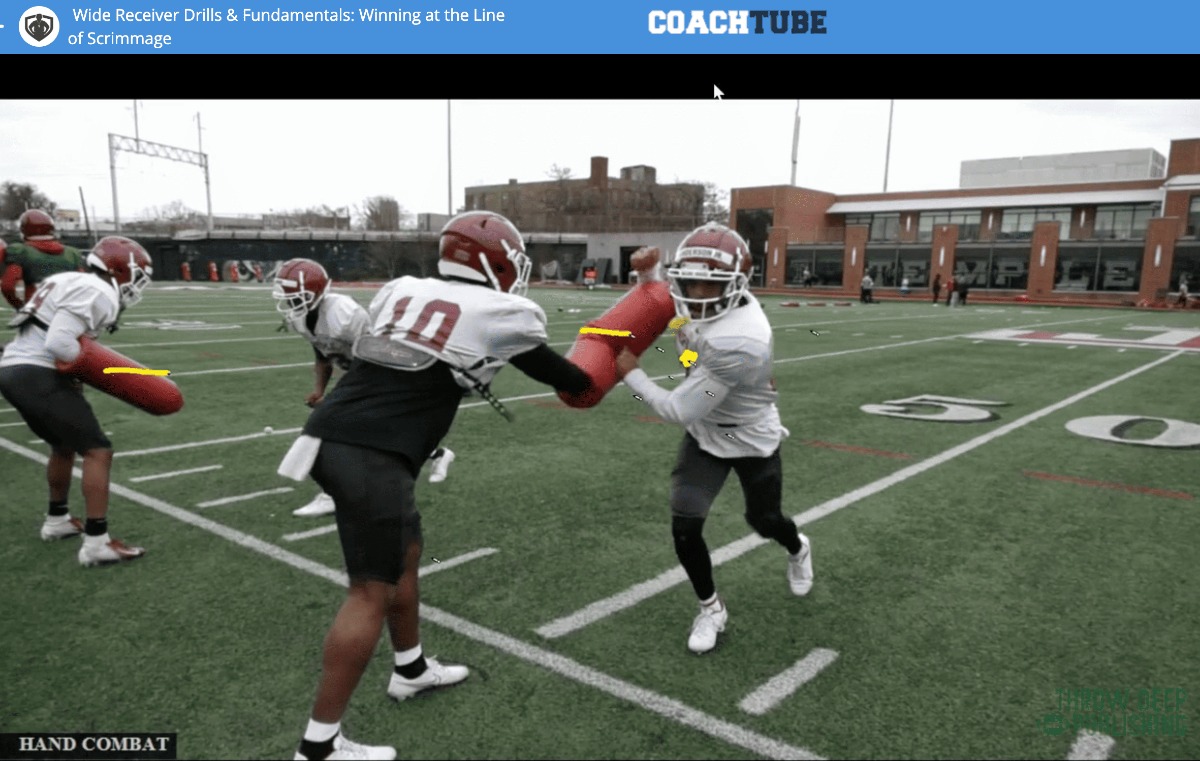
Closed Fist, Clear the Chest, Break it Down
Coach Williams switched from open hand to closed fist a few years ago. The reason is simple. It’s more violent.
His test for any coach who doubts it: hold your arm in front of you, smack your forearm with an open hand, then close the fist and hit the same spot with the same force. The fist wins.
From there, the hand combat sequence is two arms with two jobs.
Arm one clears the chest: The defender is shooting a hand at the receiver’s chest. The outside arm gets there first and gets it off.
Arm two breaks down: The second arm finishes the work, drives the defender’s hands down, and clears space to step through.
The detail most coaches will want to slow the clip down on is the surface area. Coach Williams isn’t asking his guys to target the wrist or the elbow the way it used to be coached. “It’s the whole surface,” he says. From the receiver’s hand all the way to his forearm. You can’t miss. The whole forearm is the contact surface, so the rep can’t fail on a near miss.
Coach Williams walks through the rep on tape and points out the receiver on the right who’s using open hands and still missing. That’s the rep he uses to show why the closed fist standard moved.
Elbows Tight, No Wind-Up, Step Through
The body has to be in position for the hands to win.
Coach Williams’s cues are tight. Arms tight to the body. Don’t expose too much area. Keep the elbow below the shoulder. Step through the rep so the receiver tries to hit the hip with the defender after he clears.
Then the rule that gets most receivers beat at the line.
Never wind up. The time a young receiver takes to load up his punch is the same time the defender uses to get his hands inside first. Coach Williams frames the release the way most coaches frame a stalk block. It’s a race to inside hands. The receiver who winds up loses the race before the punch ever lands.
There’s a coaching point Coach Williams credits to his old head coach Coach Drayton that changed how he runs the drill. Receivers don’t stand still in a game. They attack the defender. So the drill has to start with momentum. The receiver works to the defender, and the punch fires when the defender hits handshake distance. Coach Williams shows the rep on film with the momentum built in. The change is subtle. The carry-over to one-on-ones is not.
He shows a Julio Jones clip too. First hand clears the chest. Second hand breaks down. The urgency on those hands is the part Coach Williams wants his receivers to feel in the drill.
In-Route Hand Combat: High Hand Wipe, Low Hand Break
The release isn’t over at the line. The defender’s hands are coming again on the stem.
Coach Williams’s in-route hand combat cue is one of the cleanest pieces of teaching in the clip. Low hand, break it. High hand, wipe it away. Windshield wipers on the high one. A break down on the low one.
The reason it gets coached is the problem he sees on young receivers. They get into the in-route hand position and freeze. Three, four, five, six yards go by and they’re doing nothing. By the time the receiver remembers to move his hands, he’s washed off his line and he’s not getting up the field.
Urgency is the cue. The hand has to come off the receiver the second it lands on him. Coach Williams runs the drill stagnant on the sideline before he takes it into a moving stem. He has a coach face the receiver, shoot hands, and let the receiver get back on his line. Then a second coach takes over downfield from the same back-to-back position so the rep extends and the receiver has to hold his line.
He goes into the line work and the specific positioning of the two coaches in the clip. The setup is what makes the drill carry over.
The Shoulder Flash and the Plunger Drill
The other side of the release is the body.
Coach Williams calls it dip and drive. Other coaches call it shoulder reduction. The cue he gives his guys is the same. Hide that shoulder. Keep the core of the body straight up the field. The only thing that should move is the shoulder.
The plunger drill is how he trains it. Plungers in the ground, receiver releases past them, and the shoulder has to flash to clear the surface. The drill works without plungers too. A bag, a coach holding a shield, anything that forces the receiver to reduce the surface area he gives the defender to grab.
The standard is specific. The chest should turn parallel to the sideline. The reduction has to be fast. Coach Williams shows a rep where the receiver is just swinging his arms with no real shoulder turn, and contrasts it with the rep where the chest gets all the way around. The difference is what lets the receiver get past a defender who’s trying to wall him or grab cloth on a vertical release.
He frames the second-level version of the same rep as a separate teaching point. The linebacker walling a crosser or a deep over is the same press scenario as the corner at the line. **Create a new line of scrimmage** is how Coach Williams says it. Same shoulder flash. Same hand combat. New spot on the field.
Then there’s the ball cue at the end. Coach puts pressure on the receiver’s shoulder. When the receiver fires, the shoulder reduction should make the coach’s hand fall off. Sometimes Coach Williams puts a ball there instead of a hand. The ball keeps the receiver in low posture as the rep extends, because the defender doesn’t stop at the line either. He continues to work the receiver up the field.
Coach Williams flags one detail on a rep that isn’t as clean as he wants. The correction is the part most receiver coaches will want to watch twice.
The whole release sequence reduces to two ideas. Win the race for hands with a violent, short, no-wind-up strike on the whole forearm surface. Hide the body with a quick shoulder flash so the defender has nothing to grab. The drills are short. The cues fit on one hand. The carry-over to a Saturday one-on-one is what Coach Williams is trying to get every rep.
This article is the hand combat and the shoulder flash.
The full Wide Receiver Drills and Fundamentals: Winning at the Line of Scrimmage clinic from Coach Williams installs the rest of the release toolkit. He works through the full release menu against press, the footwork patterns that build deception into the stem, and the 1-on-1 clip analysis where each technique gets graded on live reps.
The situational reads that tell a receiver which release to pick before the snap are in there too. If you’re building a receiver room that wins the line of scrimmage, the full clinic is the install.
Link: Jafar Williams – Wide Receiver Drills and Fundamentals: Winning at the Line of Scrimmage


