
Most multiple defenses break at the install. Five fronts means five sets of rules, and the kid lining up is a half-step late because he’s thinking instead of playing.
Coach Michael Zangl puts the multiplicity somewhere the player never has to carry it. His box is any defender within a yard of the offensive tackle, and he aligns it with a handful of one-word calls that change the picture for the offense while the job underneath barely moves. Nitro, Turbo, Bangles, Rhino, Radar. Different faces, same install.
Video: Michael Zangl on Box Structures and Front Alignments
The Divorce: Your Box Call and Your Secondary Call Are Separate
Every alignment that follows hangs on one organizing idea, so start here.
In Zangl’s split-field system, the box and the secondary are divorced. They do not share a strength call. The box gets a left or right call. The secondary gets Roger or Lucky. Run strength and pass strength get set independently, play to play. Some staffs use Rip/Liz or strong left/strong right. Zangl keeps the box on left/right and the secondary on Roger/Lucky so a player never confuses the two.
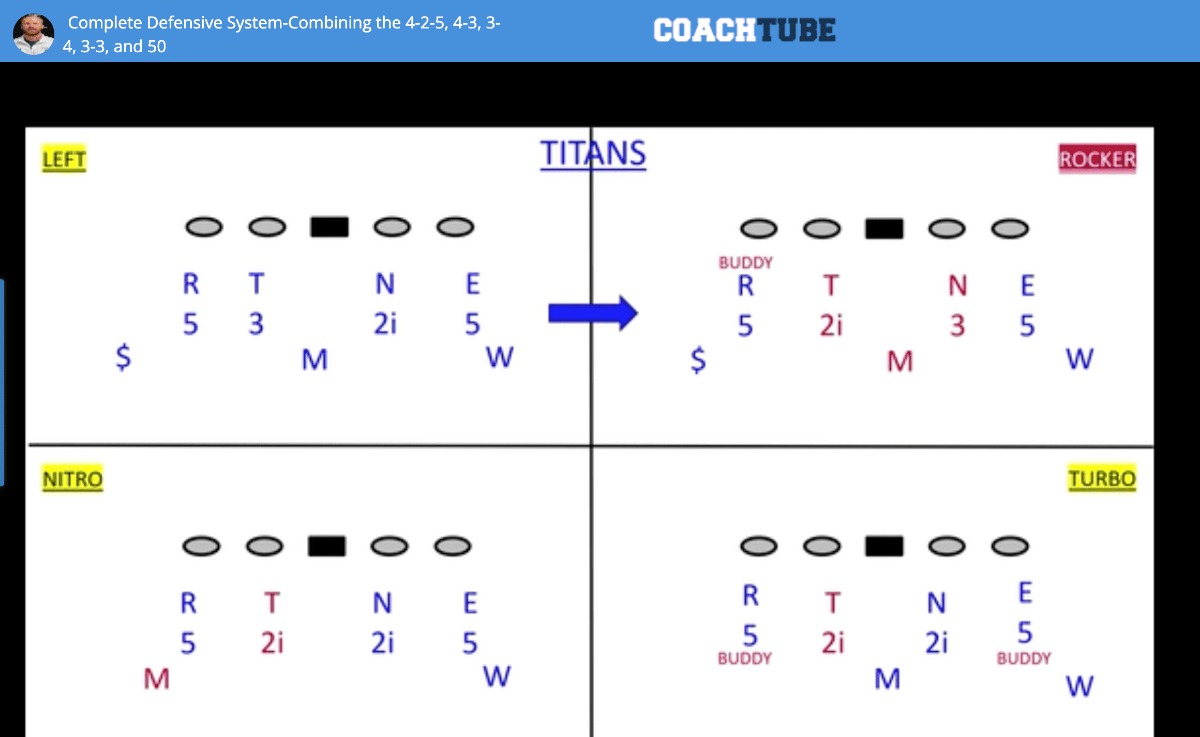
The base four-man picture against 10 personnel shows what that buys him. He plays a 2i with the nose, on purpose, for a cleaner read on down blocks and the ability to pull and reset. The 3-technique goes to the strength, the rover and end sit in 5-techniques, and the Mike plays a 10. The strong safety aligns off the receiver, the linebackers play 2 from the receiver, which is five yards off and two inside, and the Will is plus-one or plus-two with the B gap.
That is the chassis. Everything else is a named adjustment to it. Coach Zangl walks the base alignment and the apex rules for the strong safety in the clip.
The Rocker: Adjust to Motion Without Flipping a Single Lineman
This is the piece that makes the whole thing survive motion.
When the offense motions or trades a surface, most fronts have to flip the line. Zangl does not. He calls a rocker, which works like a stem: the line slides and the run strength resets without anyone learning a new job. The defender keeps his technique and shifts his spot.
You can see it cleanest on a tight end trade. Instead of flipping personnel, the rocker slides everyone one gap over. The end becomes the 6i, the nose becomes a 3, the tackle becomes the 2i, and the rover becomes the 5. Same five defenders, same techniques, new alignment, all off one word as the tight end crosses the formation.
Coach Zangl shows the rocker answering motion live in the video, and it is the mechanism that lets every call below survive a moving picture.
The Buddy Call: Take the B Gap Off Your Apex Player
Here is the call that protects your overhang against the RPO.
A buddy tells the rover or the end that he is now two-gapping. He knocks back the base block and crosses face into the B gap. The reason is the apex player, whatever you call him, the strong safety, the Will, the star. Zangl does not want that defender having to fold into the B gap on a run read, because that is exactly the conflict an RPO is built to punish.
So the buddy call gaps the front out from the inside, lets the apex defender set the edge, and cuts down on gap exchange. The overhang plays clean. The front handles the dirty work.
That single mechanic shows up everywhere in the menu below. Watch how often a named call is really just a buddy applied to a new surface.
The Four-Man Front Menu
Same chassis, situational faces. Each one is a formation or personnel answer.
Nitro and Turbo: The Empty and Single-Back Answers
Nitro is the empty call. Double 2i’s with double 5’s, and because it is three receivers one way and two the other, the Mike and Will sit plus-one right outside the tackles. The Mike walls 2, the Will walls 3, the front owns the A gaps with the rover and ends in their 5s.
Turbo looks like Nitro with a wrinkle: double buddy calls by the end and the rover. The Mike plays his 10, the Will is plus-one. Zangl pulls this out against under-center single-back looks that threaten quick zone, quick traps, and the straight dive. The nose and tackle control the guards, the double buddies cross the end and rover into the B gaps, and the Mike becomes a free runner who can scrape over the top if it bounces or if they pull. That is the buddy call doing the heavy lifting again.
Crash and Deuce: Two Ways to Handle the Tight End
Run strength always goes to the tight end, and Zangl has two techniques for the rover on him.
– Crash: the rover plays a 6i to control the tight end’s shoulder and squeeze the C gap. He uses it when the strong safety or star is already outside playing robber, because you cannot stack that overhang in a 7 or 9 and also have the rover out there. The 6i keeps the C gap clean underneath the robber.
– Deuce: the rover two-gaps the tight end, attacks him, and crosses face into the C gap, the buddy mechanic again. He reaches for Deuce when he is in cover 3 or wants to keep the strong safety in the box.
The full reasoning behind picking one over the other, and how it ties to what the safety is doing behind it, is in the clip.
Bangles, Rhino, Transfer: The Heavy-Surface Answers
Three more calls for the tight bodies and extra gaps.
– Bangles is the bear front. Slide the nose to a 0, double 3-techniques, the Will walks up on the line in a 5, the rover on a 5. Zangl likes it against 20 personnel and sniffer looks that want to insert or run counter. He is daring them to run counter into a loaded box and getting his front off the ball to blow it up.
– Rhino answers a nub wing or tight end wing surface. The rover moves to a 6 head up and crash techs it, the front carries the 3, the nose drops to a 1, and the end plays a heavy technique, head up on the tackle, stabbing the inside shoulder, able to contain on pass. It shades the front toward the heavy side where the run is coming.
– Transfer is the one exception in the whole system where the Will lines up to the run-strength side. The nose moves to a 1. The point is to protect the bandit and let the defense play robber on the tight end or wing, so the corner keeps his normal rules instead of rolling to a two-look, and the free safety and Will play it two-for-one.
Coach Zangl explains why Transfer breaks his own Will rule, and it is worth hearing him say it.
The reason a 160-pound mismatch or a green sophomore can run this is that the multiplicity lives on the chalkboard, not in the player’s head. The box gets a left or right. The secondary gets a Roger or Lucky. The rocker answers motion, the buddy answers the RPO, and the named calls are just the same techniques pointed at a new surface. What it looks like to the offense and what it asks of your kid are two different things.
This article is the box-alignment layer. The full Complete Defensive System clinic is where Coach Zangl unpacks what the arrows and dashed lines on those box diagrams actually mean, the run-fit rules behind each front, and how every gap gets accounted for.
From there he matches coverage to front with pattern-match rules that hold no matter which structure is behind them, builds a universal blitz language so the pressure menu carries across all five fronts, and gets into the sim pressures and creepers that wear the same face as the base calls.
If you want the fits, the coverage marriage, and the pressure system that sit underneath the alignments in this article, the full clinic is the build.
Link: Michael Zangl – Complete Defensive System: Combining the 4-2-5, 4-3, 3-4, 3-3, and 50


