
The option doesn’t give you time to think.
The mesh, the read, and the pitch all happen in about a second, and a quarterback who is processing instead of reacting is already late. So you don’t fix it on game day. You build it on a drill you run every single day, until the backfield can run it in their sleep.
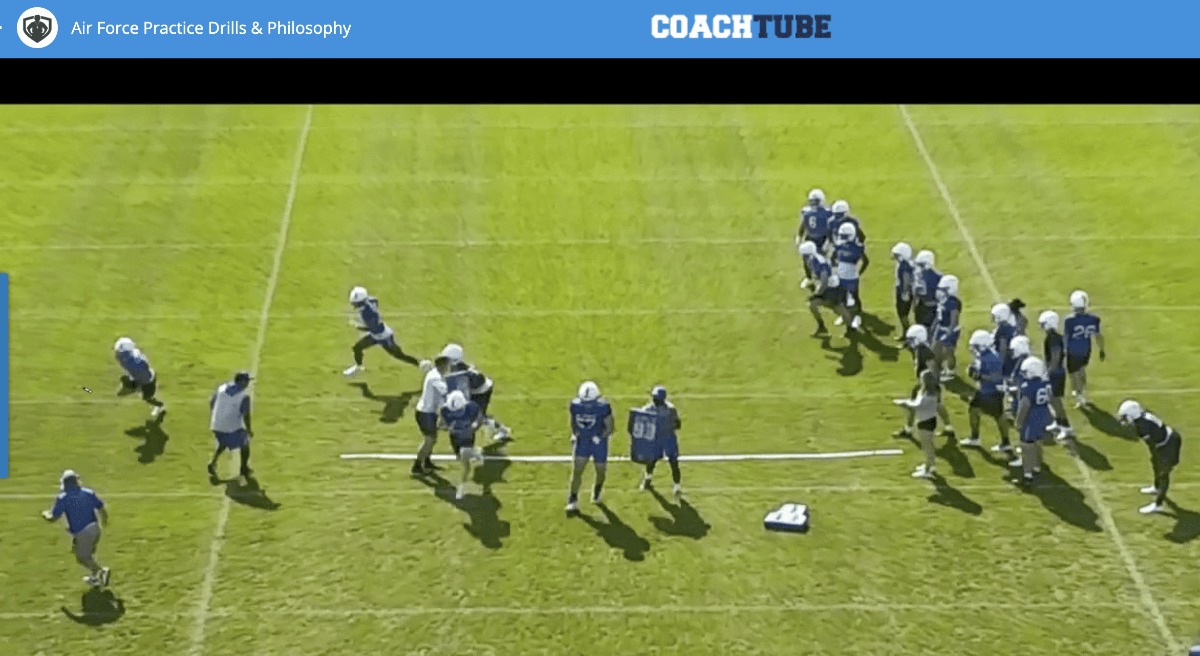
Coach Jake Campbell calls his Ride and Decide, one of the option-development drills in his Air Force Practice Drills & Philosophy clinic, and it gets the quarterback, center, fullback, and two slots repping the mesh and the pitch on both triple and double option.
Video: Jake Campbell on the Ride and Decide Option Drill
Ride the Fullback, Then Decide
Five players in the rep: the quarterback, the center, the fullback, and the two slots. Coach Campbell sets a couple of stand-ins out front as a read key and a pitch key, just to give the quarterback something to look at as he works the mesh and then the pitch.
The name is the rep. “We’re going to ride the fullback,” Campbell explains, “and now decide whether he’s got to run it or pitch it.” Ride is the mesh. Decide is the read off the pitch key.
Two things he’s grading on every rep: separation and pitch relationship. He wants the quarterback pitching the ball out, not back. When the separation is right, the pitch key stops mattering. “There’s no way a pitch key can turn and run and run this guy down when he’s got that kind of separation.”
Get the fullback path, the quarterback’s steps, and the pitch back in phase, and the rep is clean. Campbell shows what good pitch relationship looks like against a closing pitch key in the clip.
Make the Rep Harder Than the Game
Here’s the part most option coaches skip.
Air Force doesn’t rep this with a clean, dry football. They put a blue sleeve on the ball first. It’s slick, it’s slippery, and it doesn’t feel like a real football, so the backfield has to focus on handling it. Then it gets harder: the head coach walks the line spraying water on the ball between reps.
The logic is simple. “Not just going to handle a nice, easy, clean, dry football. We’re going to make them handle a wet football.” If the mesh and the pitch hold up with a slick, wet ball on the practice field, the dry one in the game handles itself. Campbell walks through how he works the sleeve and the water spray into the rotation in the video.
The Fullback Path: Vertical, Then Bend Is a Collision
This is the rep he’s pausing the film on.
Watch the fullback’s track. When he runs it wrong, “you see him go vertical and then bend, which is bad.” On that rep, the quarterback is sticking the ball out on the mesh and the two of them almost collide, because the fullback’s path took him right into the spot the quarterback needs.
The fix runs against what a wide fullback wants to do. Campbell is blunt with the kid who carries it too wide: “You got to get going vertically so you can clear that quarterback so he can make a good pitch.” The fullback’s job on the ride isn’t only to sell the dive. It’s to get out of the way so the quarterback has a clean pitch lane. Campbell puts the bad rep and the corrected one side by side in the clip.
Move the Keys, Change the Scheme
Once the base rep is clean, Campbell starts manipulating it.
He’ll tell the front-side slot to pin the backer, then change the read and pitch key on the quarterback mid-drill. Now the quarterback has to feel it: ride, and get out to a different pitch key. Sometimes that calls for an early pitch, because this pitch key turns and runs the pitch back down if the quarterback holds it a beat too long. He’s repping pitch timing against different leverage, not one static look.
Then he changes the scheme off the same setup.
Counter toss option.
When the quarterback turns his back on counter toss, the pitch key is already closing. “You better turn around and be ready to pitch the ball. You ain’t going to have time to run up on them. If this guy’s closing on you, you’re going to get smacked in the face.” A young quarterback feels that urgency in the rep and learns to get rid of it fast.
Double option works off it too. The quarterback learns to pitch, fall inside, and bring the pitch key to him. Two stations running, both ways, a big rotation, every single day. There’s more in the clip on how Campbell rolls the schemes through the same drill.
The option happens fast, and it happens in traffic. Ride and Decide is how Air Force makes the mesh, the separation, and the pitch automatic before the game ever speeds it up. Build the rep harder than the game, grade the path and the pitch relationship on film, and the backfield stops thinking and starts reacting.
Ride and Decide is one drill out of Coach Jake Campbell’s full Air Force Practice Drills & Philosophy clinic. The clinic walks the rest of the practice structure the Falcons build their option on, including the ball security circuit that runs right before this drill and the daily reps that make the mesh and the pitch second nature. If you run any option football, the full clinic is the practice plan the drill lives inside.
Link: Jake Campbell – Air Force Practice Drills & Philosophy


