
The snag isn’t a spot. It’s a window.
Most coaches install it as a sit-down route at five or six yards and leave it there. Coach Tilford Myers coaches the snag runner to read the linebacker apexed over him and slide to wherever the window actually opens. Same route on the call sheet. Completely different teaching.
It’s one of his favorite quick game concepts, and he runs it as a straight concept read. No RPO. It lives in his Quick Game: Fast Answers, Easy Completions clinic, the package he uses to stay ahead of the chains and hand the quarterback simple, high-percentage answers against multiple coverages.
Video: Tilford Myers on the Snag Concept
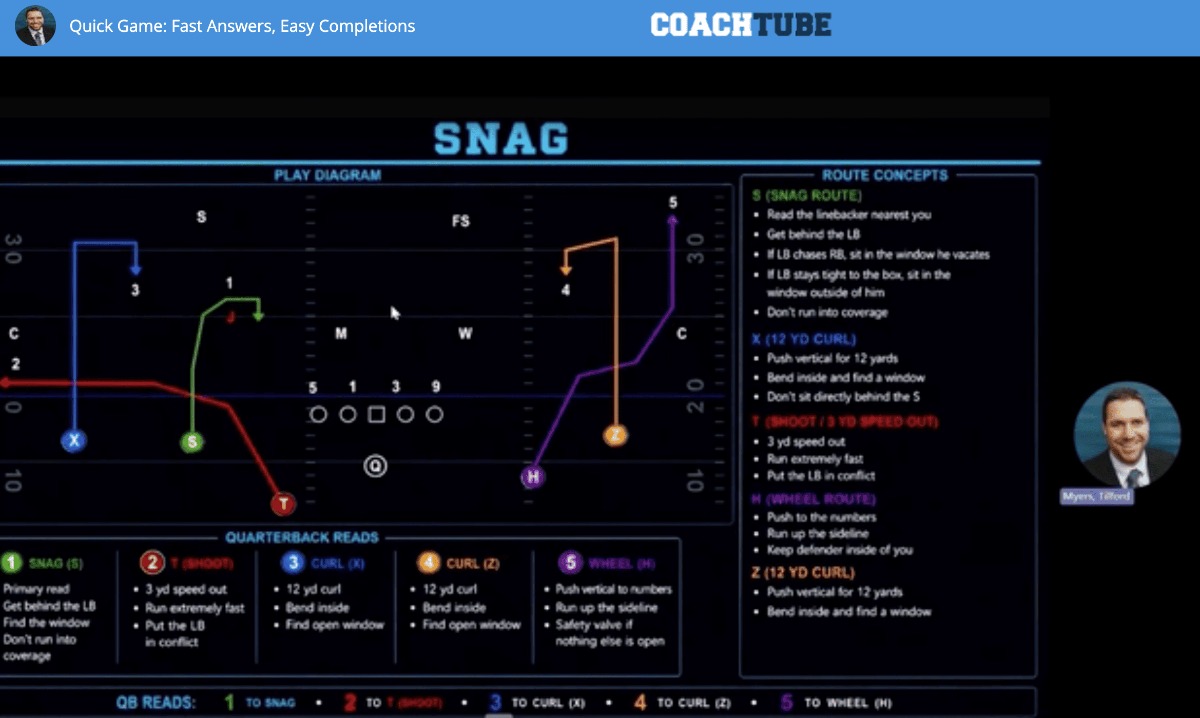
The Snag Is the Engine: Read the Apex Backer, Slide to the Window
Myers runs it out of doubles, a 2×2 set. To the snag side, X is the outside receiver and S is the slot. To the backside, Z is outside and H is the slot. The back, the T, releases to the snag-side flat.
The S runs the snag, and as Myers puts it, “He’s the one that makes it go.”
He pushes vertical, gets behind the linebacker apexed over him, and finds a window to sit in. The window is not a pre-determined spot. It’s whatever that linebacker gives him, read live off the snap:
– If the backer stays inside, the snag sets up outside in the open window.
– If the backer flies out to take the shoot route underneath, the snag works over to the next window and sits.
– If the mike then works out to that same shoot route, the snag keeps working over to the next window.
That’s the whole point Myers is making. The snag runner is not running to a landmark. He’s reading the coverage drop and settling in the first window the linebackers vacate. The rep where the snag slides from one window to the next is the one to slow the clip down on. It’s the difference between a route that gets covered at the spot and one that’s always open by design.
Shoot, Not Bubble: Move the Flat Defender Faster
The back, the T, runs a shoot route to the flat, and it has a job beyond being a checkdown.
Myers will tell you that you can bubble him instead. He doesn’t. “We like to shoot because it’s faster and it attacks this linebacker quicker.” The shoot gets to the flat defender sooner, which forces that linebacker to declare sooner, which is exactly what springs the snag’s window behind him.
So the shoot and the snag are tied together. The faster the back pulls the flat defender, the cleaner the window opens for the snag working over the top of him. He’s the number two in the progression too, so the same route that moves the linebacker is the next read if the snag is covered.
Coach gets into the timing of the two routes in the clip, and why the extra tick of speed on the shoot versus the bubble shows up as a completion on the snag.
The Curl Rule: Don’t Let X Hide the Snag from the Quarterback
The outside receivers, X and Z, run the same thing: push vertical for 12, curl inside, find a window.
Then comes the spacing detail most coaches never teach. You never want X to get stacked behind the S in the quarterback’s vision. If the curl ends up directly behind the snag, the quarterback can’t see him, and you’ve turned a three-level read into a guessing game.
So the curl adjusts off the snag:
– If the snag works inside, the curl sets up more outside.
– If the snag works outside, the curl curls in further to find its own open window.
Either way, the two routes stay separated in the quarterback’s eyes. Myers walks through how he reps that spacing so the curl never washes into the snag, and it’s a fix you can install tomorrow without changing a single route on the play.
One Read, No RPO: Snag, Back, Curl
The quarterback’s progression is a straight three. The snag is one. If it’s open, he hits it. The back is two, on that shoot to the flat. The curl is three.
That’s it. No conflict defender to read, no give-or-throw math. Myers wants the quarterback playing fast on a three-step rhythm with a clean front-side picture.
On the backside, the H runs a wheel and the Z runs his curl. The quarterback mostly stays play side with the snag, but if he sees something pre-snap he likes, he can flip and work the backside wheel-curl instead. The pre-snap tells that send him there are the part Myers details in the video.
Make Every Receiver Learn the Snag
The snag is a tag, not a position.
Myers calls it X snag, Z snag, S snag, whatever the matchup or formation asks for. “We just make all our receivers learn the snag concept and how to read the open windows.” Every receiver in the room learns the window read, so the concept can travel to whichever side, whichever player, gives you the look you want that week. One concept, called five different ways, with nobody relearning their job.
The snag completes because it’s a read, not a spot. The shoot moves the flat defender, the curl stays out of the throwing lane, and the snag runner settles in whatever window the linebackers vacate. Give your quarterback that picture and one clean progression, and “find the open window” beats “run to the landmark” every rep.
This article is the snag. The full Quick Game: Fast Answers, Easy Completions clinic from Coach Myers is the rest of the package. He installs Spot, Hawaii (his Smash concept), and Ohio (the verts-and-outs concept), with the quarterback reads, receiver technique, tags, and variations for each. He also gets into how he uses the quick game to protect the run game and complement his vertical passing attack, all of it off game film.
If you want a quick game that gives your quarterback a fast, high-percentage answer against any coverage, the full clinic is the build.
Link: Tilford Myers – Quick Game: Fast Answers, Easy Completions


