
Most tunnel screens don’t die at the catch. They die a beat later, when the receiver drifts too far inside and every retracing defensive lineman and rat player gets a shot at him.
Texas Tech OC, Coach Mack Leftwich has a catch landmark that fixes that, plus the full rule set around it. He’s coached the play from both chairs, as a quarterback and as an offensive coordinator, and his offense invested heavily in the screen game last season and got very good at this exact concept. This is his true tunnel screen: the set, the landmark, the blocking trade, and who actually earns the right to catch it.
Video: Mack Leftwich on the True Tunnel Screen
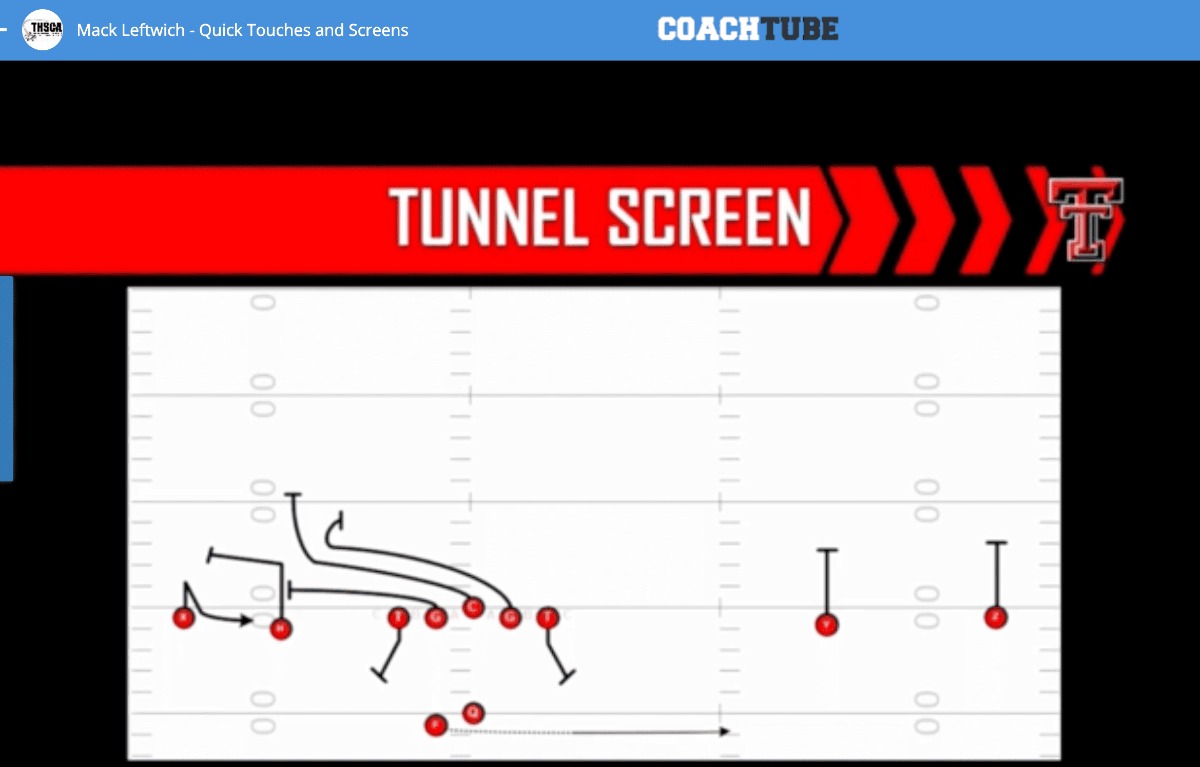
The Set: Two Counts and Three Jobs
Coach Leftwich sets the tackles because he wants the defensive ends up the field. Let them win. The further they rush, the bigger the tunnel.
The interior three take a two-count pass set, and the rule is blunt: don’t block any blitzers. Then they release with three defined jobs:
– Play-side guard, first man out: the flat.
– Center: the alley.
– Backside guard: the rat.
Three landmarks, same every snap. Coach Leftwich shows the timing on film, including one rep where the line’s release is so clean he stops to grade it: show hands, set, get out to your landmark.
Top of the Numbers: The Landmark That Keeps the Play Alive
The receiver goes three steps vertical and retraces his stem back inside. Where he catches it is the part Coach Leftwich calls pretty critical: in the boundary, at the top of the numbers.
The landmark solves both failure modes at once. Catch it there and you’re close enough to the tunnel that it doesn’t take long to get inside. But you’re not so far inside that the rat players and the retracing defensive linemen catch you from behind.
From the catch, the path is inside out. Coach Leftwich wants the ball carrier making that corner “run the hump,” and he wants the ball on the outside arm the whole way.
Most Dangerous: The Trade Between the Slot and the Guard
The number two receiver blocks most dangerous, and the definition changes with the corner:
Corner down and able to make a play on the screen: number two goes to the corner and blocks him.
Corner lifts into bail Cover 3: the slot comes over and blocks the overhang player instead. As Coach Leftwich puts it, that’s how you get the party started.
The best rep in the clip is the one where the read gets murky.
The corner is off at seven or eight yards and pedaling, so the slot feels it and takes the flat player. The play-side guard feels that and works to the kick out. Nobody called anything. They just traded responsibilities on the fly.
The coaching point Coach Leftwich attaches to that rep: you have to be flat first on screens. Get flat first and you keep your inside-out leverage. Get vertical too early and one missed fit turns a touchdown into a gain of eight. He walks the rep back frame by frame in the video.
First Level First: Where the O-Line Actually Goes
Here’s the rule that separates Coach Leftwich’s screen from the one where three linemen sprint past everybody chasing the safety.
He would rather his linemen take care of the second-level players than hurry to the alley. Take care of the first level first. That’s the linebacker rolling to the ball. The safety? Coach Leftwich will take his ball carrier one-on-one with a safety all day.
There’s a backside layer to the play too: push motion sends two receivers to the field blocking for the running back, and the quarterback reads the pressure picture. On the film, it’s third and long against a double mug look. The front bumps, the quarterback feels it, and the ball works back to the tunnel in the boundary. Coach Leftwich walks through the read in the clip.
Bosu Balls: Making Screen Practice Honest
Coach Leftwich names the thing every offensive coach has watched in a screen drill. The linemen are fired up because they finally get to run. So they run. Knee braces flying, every 300-pounder convinced he’s an athlete, and not one of them touches a soul. Then Friday night comes and they have to block somebody.
His fix came from the screen draw drill Coach Riley runs at Clemson, with Bosu balls. The balls force the linemen to break down and be athletes in space instead of just getting out. He credits that drill as a real reason the screen game hit for them last season.
And the last rule is a roster decision, not a scheme one. These tunnel screens are all about who you throw the ball to, and it’s not every guy. It takes some guts to get in the tunnel, trust the blocks, and stay inside out. Coach Leftwich’s guy checked both boxes: he’d just won the Sun Belt in the 100 meters as a 10.2 sprinter. Throw tunnel screens to guys who can run like that.
The play never changes. Two-count set, top of the numbers, most dangerous, first level first. The only question Coach Leftwich leaves open on game day is who’s standing in the tunnel.The tunnel is one piece of Coach Leftwich’s full quick-touch system.
The complete clinic covers the perimeter screens, bubbles, and quick-game throws he uses as drive starters and get-back-on-schedule calls, how he structures the reads so the quarterback stays simple while the ball still finds the best athlete in space, and how tempo and spacing turn easy completions into a defense playing on its heels for four quarters.


