
You can’t let centers get comfortable on third down. They watch the nose work back weak on film all week, because that is how most teams balance out the rush, and by kickoff they think they are trained to expect it.
The Ton stunt is built to cash in on that education.
Coach Barry Hoover calls it the best bang-for-your-buck stunt in his entire BOSS front package (Bigs On Same Side), and he goes further than that: if you do not run BOSS fronts, he would tell you to install them just for this one stunt.
Video: Barry Hoover on the Ton Stunt
Why the Center Buys the Fake
The Ton starts with a lie the center has every reason to believe.
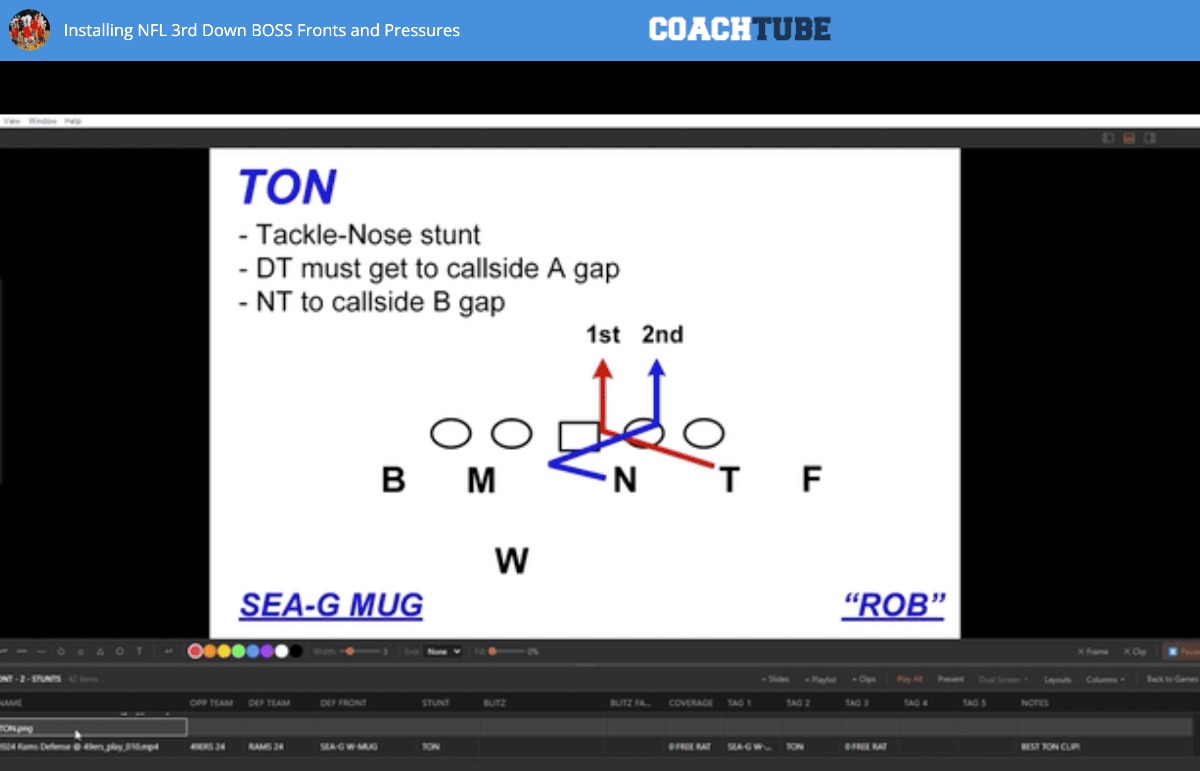
The nose steps out like he is running the nose stunt, working back toward the weak side. That is a stunt Hoover’s nose actually runs quite a bit, which is what keeps the fake honest. The center sees the weak-side start, matches it, and commits.
Then the picture flips. The tackle comes first, ear-holing the center while the center is still occupied with the nose. The nose comes back around second, and the two of them end up in the A and B gaps. The BOSS alignment is what makes it work: with three bigs on the same side, the center, guard, and tackle all have to work out on them, and the stunt gets angles a balanced front never gives you.
Tackle First: The Rep That Sets the Tone
The first rep on film is Seattle G with a mug call. The nose sells the nose stunt, the center works on him, and the tackle, aligned in a 5-technique, ear-holes the center and gets upfield. The quarterback is lucky to get the ball off.
What Hoover loves about this rep is not the pressure. It is the violence from the tackle. His point: the offensive line should not be the only unit giving out punishment. The defensive line should be handing it out too, and these stunts are a great way to do it. Watch the collision on the clip and you will see what he means.
Both Ends of the Stunt Can Get Home
The next rep is Oakland G, with the nose in a 2i. Oakland means the bigs are set opposite the running back.
Same mechanics: nose starts like he is working the nose stunt, center engages him, tackle ear-holes the center. Except this time the tackle keeps going and finishes the sack himself.
Hoover’s coaching point off that rep: it is not always the second guy through who gets the sack. The tackle coming first has just as good a chance to get home as the nose does.
And when the tackle does not finish it, he is still setting the table. On the Oakland G up rep, both linebackers are walked up, the tackle works upfield and gets to the center, and the guard locks onto him and turns all the way to carry him. Hoover’s line on that guard: once that guy turns all the way, he’s dead. The nose comes through free for the sack.
One tag on the up call worth stealing: the film has it marked “W up,” but if you are calling the defense it is just up, because it is always a weak up. One less word in the huddle.
The Flip Tag: A Faster Body on the Center
One of the sack reps carries a flip tag: flip the tackle and the defensive end so a faster guy is the one slamming the center and getting after the quarterback.
On film the end smacks the center, gets right at the quarterback, and the guard is fully engaged on him because he is worried about exactly how fast that guy is. Which means the nose, wrapping in behind it all, already knows he is getting a sack. Coach Hoover runs it back twice on the clip so you can see the end’s hit on the center both times.
The last rep is another sack, and it shows the stunt’s floor. The tackle coming through barely touches the center, but he busts upfield with the guard’s full attention and ends up in the quarterback’s face anyway, with the nose and the opposite end there to clean it up.
The Ton does not win with a scheme trick. It wins with a tendency the center taught himself all season, pointed back at him on third down. As Hoover closes the segment: the Ton stunt, you’ve got to run it.
The Ton is one stunt out of more than three hours of film and diagrams in the full clinic.
Coach Hoover walks the whole BOSS front install with the concise call language behind fronts like Seattle and Oakland, the alignment tags that create matchup advantages before the ball is even snapped, and his naming system that makes any 3-man stunt one word.
Then he builds up from there: creepers and simulated 4-man pressures, 5- and 6-man pressures that use BOSS fronts to manipulate the protection, and the coverages tied to all of it, including man and zone variations, 2 and 3 Fire Zone, and Hot 3.
Link: Barry Hoover – Installing NFL 3rd Down BOSS Fronts and Pressures


