
Most quarters installs teach the secondary exactly what to do. The corners know their leverage. The safeties know their calls. But the two inside linebackers? They get a vague zone drop and are told to figure it out.
That’s where things break down. The back leaks out and no one has him. A crosser runs through the middle untouched. The quarterback scrambles and the contain player was supposed to be… someone.
Coach Tom Miller doesn’t leave that to chance. In the Cyclone Defense, each inside linebacker gets a named role with specific rules. One owns the quarterback. The other owns the running back. In the clip, Coach Miller breaks down both jobs and shows the whole system working on film.
Video: Quarters Coverage Install in the Cyclone Defense
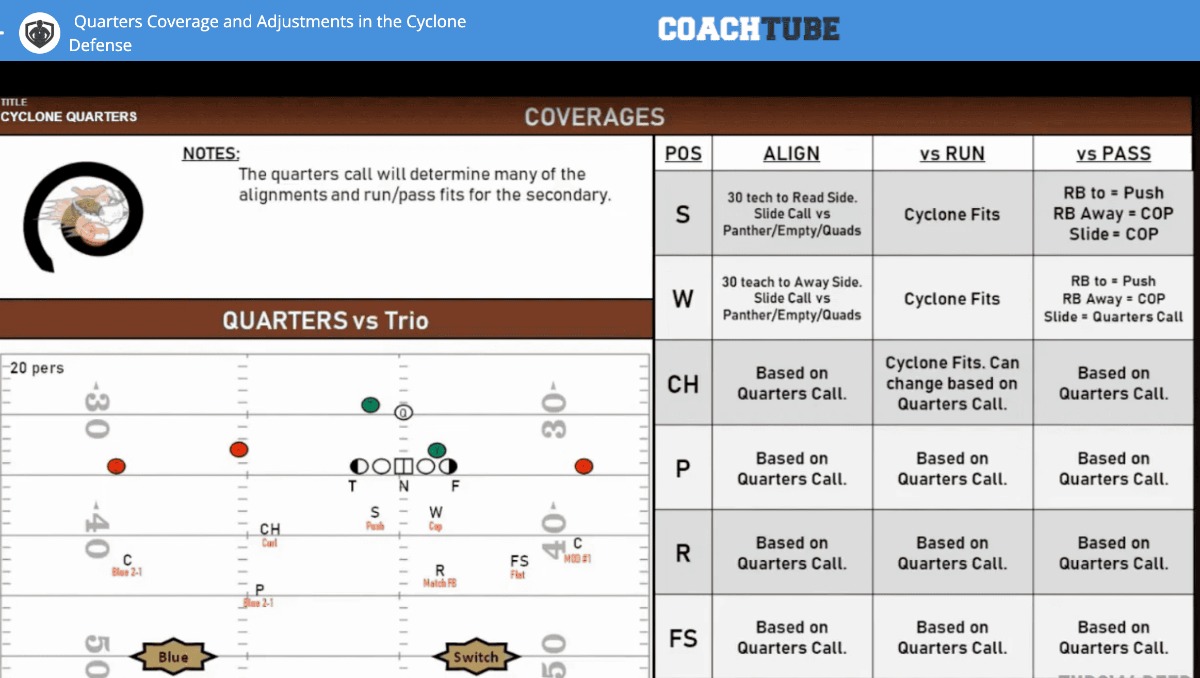
The COP Player: One Linebacker Owns the Quarterback
Coach Miller calls one linebacker the COP player. COP stands for “contain, outside pass rush.”
His job is to mirror the quarterback. If the QB gets flushed out of the pocket, the COP player chases him down. If the QB sits in the hole, the COP player sits too. Crossers leaking through the middle? He’s right there. If the quarterback steps up and there’s a clean alley to him, the COP player can take it. Otherwise, Coach Miller teaches patience. Don’t rush until the quarterback gives you a reason to.
No guessing. No reading the D-line’s rush to figure out if contain is covered. One guy has it. Period.
And that’s what frees the D-line. Because the COP player owns contain, the ends get a two-way go on every pass rush. If the end wants the B gap, he takes it. If he wants to speed rush the edge, he takes it. Coach Miller points out why this matters: when an offensive tackle knows the end can only go one direction, all he has to do is funnel him there. The two-way go takes that advantage away. Coach Miller goes deeper on the pass rush freedom this creates in the clip above.
The Push Player: One Linebacker Owns the Back
The other inside linebacker is the push player. He has the running back.
If the back check releases or leaks up the middle late, the push player stays on him. Straight man responsibility. No one else has to worry about a late release out of the backfield.
But if the back flares or pushes out quickly, the push player makes a “push call” to the nearest overhang. In Coach Miller’s example, the Sam linebacker makes the call to the chuck. The chuck takes the back. The Sam replaces the chuck in the curl.
That replace is automatic. Push players are always taught they’re replacing in the curl when they push. The defense doesn’t lose a coverage player. It just swaps who’s where. Coach Miller notes there are certain calls where the push player stays man to man on the back, but for the most part, the system runs on the push principle. He gets into the specifics in the clip.
On Film: Both Jobs, One Play
Coach Miller shows a trips formation with a “switch” call to the top of the screen. The safety goes out to number one. Watch the linebackers.
The backer away from the running back is the COP player. He mirrors the quarterback and waits for the flush. Coach Miller says he jogged it a little too casually on this rep, but the discipline was right. He didn’t crash early. He waited.
The other backer is the push player. The back stays in to block, so the push player tracks him patiently. Once the back commits, he starts adding himself as a rusher.
Now look at the D-line. The end to the bottom takes his two-way go inside. He wins the B gap and gets to the quarterback. He never thinks about contain because he doesn’t have to. Number 94. Coach Miller calls it out by name.
The quarterback has nowhere to go. The end is inside. The COP player has the edge. The push player is closing. Sack.
That’s what happens when every linebacker knows his job. Coach Miller walks through the full play and the trips adjustment in the clip.
The linebackers are the part of a quarters install that most coaches don’t think about until something breaks. Miller thinks about them first. One owns the quarterback. One owns the back. And because those two jobs are accounted for, nothing leaks through and the D-line rushes free.
Coach Miller’s full clinic, Quarters Coverage and Adjustments in the Cyclone Defense, goes well beyond the COP/push install.
If you’re looking to tighten up the parts of your quarters coverage that don’t get enough attention, the full course is HERE.


