
The vice tackle has help on the other side.
The sideline tackle has help too. It’s just the sideline.
The hardest version is when there’s no help at all. A post safety, a head-up ball carrier, a two-way go staring at him in the open field.
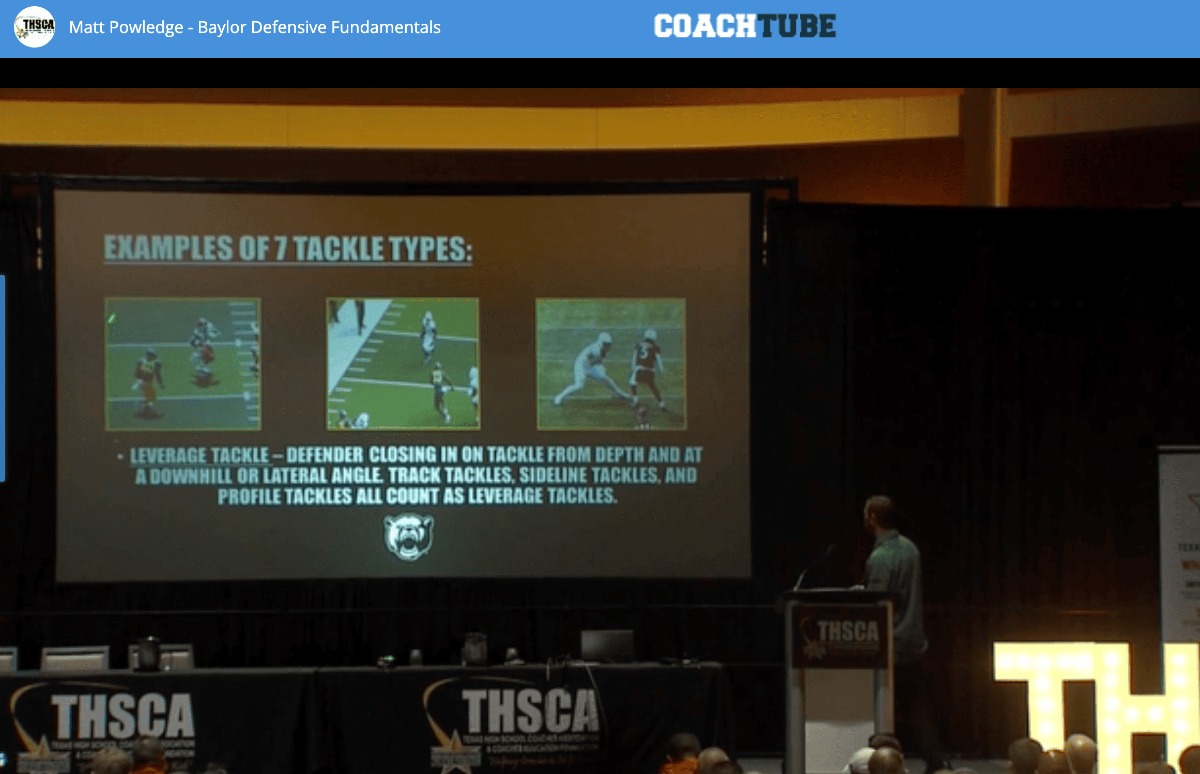
Coach Matt Powledge, now the defensive coordinator at North Texas, teaches all three as the same tackle in his Baylor Defensive Fundamentals clinic. Different drills, same body position, same rule: own your leverage. The leverage tackle family is the safety tackle install.
Video: Matt Powledge on the Leverage Tackle Family
The Sideline Is Your Second Man
Coach Powledge starts with the version most defenses see weekly. The sideline tackle.
There’s no teammate over there. The sideline is the help. That changes nothing about the leverage rule. The defender owns the inside, the sideline owns the outside, and the ball carrier has to choose.
He wants the rep coached both ways. Don’t let the ball carrier in the drill just run straight to the boundary and cut up on the cones. Front the defender up. Try to create a two-way go. Make him own his leverage.
The cues Coach Powledge teaches on tape:
– Two hands below.
– Eyes down low. A focal point on the steel frame. The eyes belong there.
– Tag off the back of the hamstring with two hands.
He shows a clean rep where the eyes drop, the hands punch low, and the back of the hamstring takes both hands. That’s the model.
Watch what happens with the ball carrier’s stutter step in the clip. That’s the rep that exposes a defender who didn’t actually own his leverage.
Long Stride to Short Stride: How the Body Moves Through It
The next drill in the progression is what Coach Powledge calls shuffle alley tempo. Same leverage tackle. Different drill to teach the footwork.
Here’s the rule.
When the defender is closing ground, it’s a long stride. Sprint, sprint, sprint. Don’t stop the feet on a profile situation. Get there.
When the ball carrier fronts him up, it’s a short stride. Shimmy. Get to the body position. Balanced, ready to redirect.
Then back to a long stride once the carrier commits. Track the hip the whole way.
Coach Powledge runs the drill with a defender attacking the alley. The ball carrier fronts him up, gets a small shimmy, and the defender comes back through in a long stride. The footwork is the lesson. The tackle is the result.
There’s a moment in the clip where the cue switches from sprint to shimmy. He teaches exactly when, and it’s the part most safeties miss.
Vice Tackles in Real Coverage: Outside-In and Inside-Out
The vice tackle isn’t a drill. It’s a coverage. Coach Powledge breaks down what it actually looks like in your scheme.
Outside-In: The Green Light to Shoot Your Shot
Quarters or cover two. The corner triggers low. The safety or DB is the outside-in piece. Or it’s the nickel up top in cover three with the corner driving from outside.
Coach Powledge shows a red-zone rep where the safety pulls the trigger violently on a perimeter run with a crack. And this is where he gives the most aggressive coaching point in the whole section.
When you’ve got nine, ten, eleven guys running inside-out to the ball, the outside-in defender can shoot his shot.
“Really run through this thing, and be violent and be aggressive.”
Why? Because the help is real. The pursuit is on its way. If the carrier escapes, the defense already has the inside angle covered. The outside-in player has the green light to be the hammer.
Inside-Out: Low Piece, High Piece
The curl-flat player or third corner is the low piece inside. The high piece is outside. Inverted cover two, quarters with the safety in the fit, cover three. Same vice, mirrored.
Coach Powledge shows the inside-out rep with the low piece beating the block and the high piece arriving from outside. The leverage rule holds. Each piece owns their side. The ball carrier doesn’t get the two-way go.
He works through both reps in detail in the clip and shows the alignment before the snap so the cue is obvious to the defender.
Own My Leverage: The Post-Safety Rep With No Help
This is the rep Coach Powledge wants to spend the most time on, and it’s the one most defenses skip.
Post safety. No vice. No sideline. The ball carrier is head up. There’s no built-in two-way go because the defender hasn’t picked a side yet.
His rule is direct.
Pick a side. Or own the slight tilt.
If the ball carrier has any small tilt to one hip, take that side. Coach Powledge coaches it as eyes on the right hip. Long stride to close. Late short stride on the shimmy. Then go.
What he doesn’t want, and this is the line that should be stapled to your safety room wall:
“The last thing I want to do is if I end up head up, is continue to track right down the middle of the man, because now I’m giving him a two-way go for the ball to spit out.”
Tracking down the middle is the mistake. The defender thinks he’s playing balance. He’s actually giving the carrier the choice. Pick the side, commit, and force the back to go where you’ve already won.
Coach Powledge also drills this from a backpedal and a walkout. Ball spits through the tackle box, the safety is working tracking and alley footwork from depth. He shows the rep on tape, including the variations where the ball spits to the edge.
The leverage tackle isn’t one drill. It’s a family. Sideline, vice, post-safety. The body position is the same in all of them. The rule is the same in all of them. What changes is where the help comes from, and how aggressive the defender gets to be once he knows.
This section is one piece of Coach Powledge’s full Baylor Defensive Fundamentals clinic, and it’s is the complete install for how he coaches the difference between technique and true fundamentals on defense.
He builds out the rest of the toolkit the same way: effort standards, block destruction, the takeaway drills, and the tackle progression beyond the leverage family. Every piece comes with the teaching progression, the drill setup, and the game-film examples to back it up.
If you’re rebuilding the standard your defense plays at this offseason, the full clinic is the blueprint.


