
In most Deep Choice installs, the inside Burry route isn’t live. The QB reads outside first, the concept works outside in, and the Burry is an alert at best.
Running the concept out of a “stack” alignment with a “switch tag” changes that.
Justin Gumm, Head Coach at Hamilton High School in Wisconsin, has run Deep Choice covers a wrinkle he’s added to the system: the stack switch release, where the Burry route becomes a live option and the quarterback works inside out for the first time.
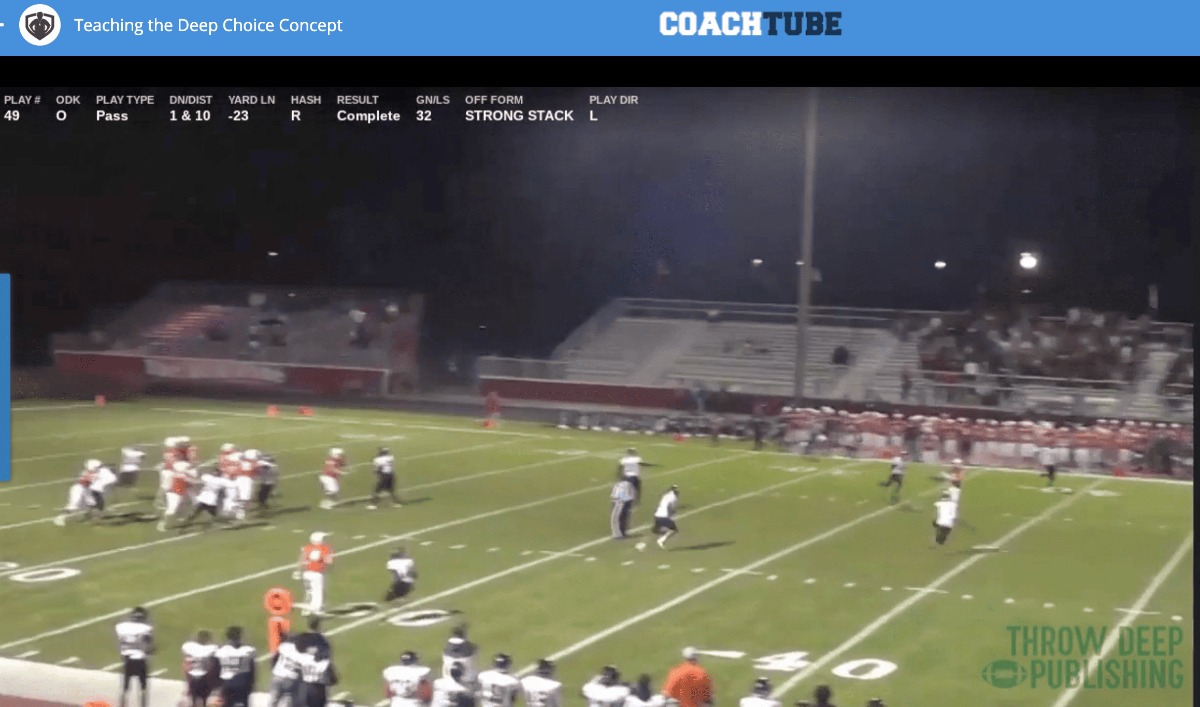
Video: Stack Switch in Deep Choice
Why the Stack Makes the Burry Route Live
When you run a standard choice route, the Burry route isn’t active as a concurrent read. But the moment you stack receivers and execute a switch release, it goes live.
The reason is mechanical. The stack and switch is a natural movement of the receivers. That movement is the only time in Gumm’s system where the QB reads inside out. The Burry route is inside, so it gets priority over the outside choice.
“Never pass a guy to get a guy.”
That’s the rule. If the Burry is open when the ball is snapped, throw it. Don’t hunt for the outside choice when the easier throw is right there. Gumm shows multiple reps in the clip, including one where the QB held the ball too long on a Burry route that was open at the snap.
The outside choice is still live. The Burry is the first look, not the only one. Both are available, but the read order is flipped.
Who Has What Route on the Switch Release
When the stack switch executes, route assignments inside the combination change.
The inside receiver works to the outside. He becomes the choice runner. The crossing action of the stack release naturally disguises his path, and defenders have to sort it out on the move.
The outside receiver (or tight end aligned in the stack) runs the Burry route, burying the defender to protect the choice outside while also being a live throw if he comes open.
Gumm shows a rep in the clip where both the outside choice and the Burry were open on the same snap. The QB had options. The rule stayed the same: whoever you see first that’s open, take him.
He also shows a rep where the defense did a good job sorting out the switch. His note: sometimes that happens. Good players make good plays. The design was right.
The Pre-Snap Key: Reading the Overhang
The simplest way to run stack switch is to call choice to both sides and let the quarterback decide at the line based on one read: the overhang.
If the defense shows an overhang to the field and nothing to the boundary, the answer is automatic. Take the boundary side. The tight end runs the Burry route against zero overhang coverage. Gumm calls it “easy money.”
In the film he covers, they’re facing a 4-3 front with an overhang to the field and nothing to the boundary. Pre-snap instruction to the QB: “take your side.” The TE runs the Burry, there’s no defender positioned to account for it, and the ball should have been out earlier than it was.
Because the read is that clean, stack switch works well as a one-word play call. The alignment, release, route assignments, and QB read all compress into a single word at the line. Gumm goes into the specific film cuts and timing cues in the clip above.
The stack switch isn’t a separate concept. It’s a variation built on top of what you’re already doing in Deep Choice. The stack activates the Burry route, the read flips inside out, and the pre-snap overhang tells the QB exactly where to go. One read, one rule.


