
The RPO works because your DB is guessing.
Bail and they hand it off. Bite up and they pull and throw the bubble or the slant. The offense is reading him. He’s reading nothing.
The fix is the flat foot. A DB who stays loaded, holds leverage, reads the play, and reacts after the offense has already committed. He doesn’t bail. He doesn’t bite. He plays the read.
Coach John McSheffery has the drill that builds it. Three to four minutes a day. Nine days of spring ball. By the time you break camp, every DB on your roster owns the footwork to defend RPOs from the same loaded stance. Corners, safeties, nickel, Rover. All of them.
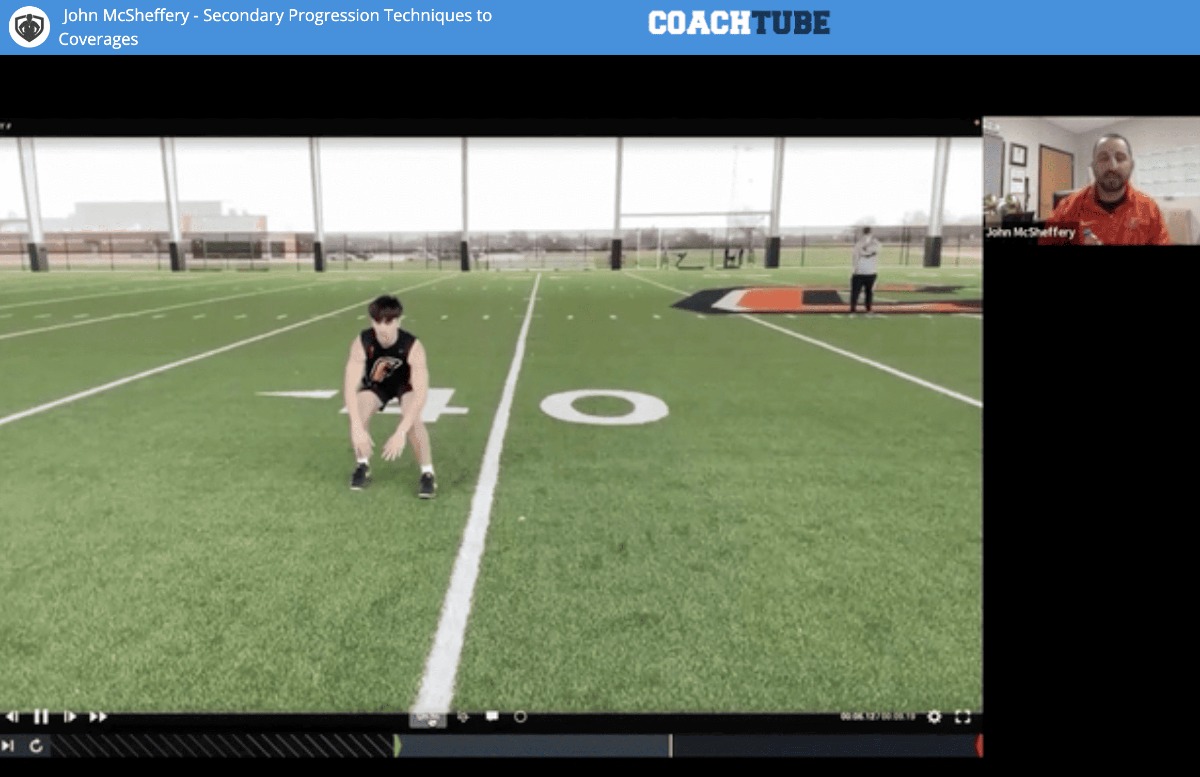
Video: John McSheffery on the Flat Foot Drill Progression for RPO Defense
Why Flat Foot Beats the RPO
Before the drill, the principle.
The RPO puts a perimeter defender in conflict. The QB is reading him. If he commits to the run, the throw is open. If he commits to the pass, the run is open. Coach McSheffery’s answer is to make sure that defender doesn’t commit at all.
Flat foot technique is built for this. Coach McSheffery says it directly: “I’m not worried about getting ran by, nothing like that. If I’m playing flat foot technique, I’m just getting ready to maintain my leverage, react to what they’re doing, and get hands on and wall them to wherever I need to go. Or getting ready to take on a blocker.”
That’s the entire RPO answer in one sentence. Hold leverage. React, don’t commit. Be ready for the block on the run side and ready for the route on the pass side. The drill that follows is how you teach his body to do all of it from the same starting point.
Start in the Bent Stance
Before any movement, the stance.
Coach McSheffery’s cue is one word. Bent. That’s the call. The DB drops his hips, knees, and ankles into a loaded stance, weight on the inside of his foot, toe dug into the ground.
He wants the foot pigeon-toed in. He wants the hip good. He wants everything balanced and ready to fire.
This is the position that lets him stay neutral against the RPO. Not high. Not narrow. Loaded and ready to go either direction the second the play declares.
Coach McSheffery shows what a clean stance looks like in the clip and points out where his current group still gets too narrow or too high.
Subtle Drive Steps Hold the Leverage
Now the play starts to develop, and your DB has to stay in his read.
When Coach McSheffery says “drive step right,” he wants three subtle steps. Not strides. Not gainers. Small steps.
Here’s why. Big steps commit you. The second your DB takes a long stride toward the run, the slant is open behind him. The second he turns and bails, the bubble is a walk-in. Subtle steps let him slide laterally, keep his eyes on the play, and still react to either the run fit or the throw.
He varies the count too. Sometimes two steps. Sometimes three. Sometimes four. The RPO doesn’t declare on a clock. Neither should the drill.
“Ready, bent stance, go.”
Coach McSheffery walks through the look on tape and what to coach when the steps get too big.
Load the Drop Step Like a Gun
Now the read declares run. The slot or the tight end is coming to crack your DB.
This is where the drop step lives. Coach McSheffery tells his DBs to load that drop step like a gun. Get it ready to strike. When the perimeter blocker arrives, every ounce of stored power in that loaded foot is going up through the punch.
That’s the difference between a DB who gets walled out of the run fit and a DB who stacks the block, sheds, and makes the tackle for a short gain. Drive step right, drop step left. Then flip it. Same loaded foot, opposite direction. Vary the count so nobody anticipates.
There’s a hand position cue Coach McSheffery flags in the clip that most groups never get coached. He calls it out on tape.
Crossover Run for the Cutback Fit
The last piece, and it shows up constantly against zone-read RPOs.
Drive step right. Crossover run. Back into the drive.
This is the cutback rep. The QB rides the mesh, the run goes one way, but the back has cutback eyes. Your DB is fitting from the backside, tracking the back hip, and arriving in a position to take on the cutoff block from the slot.
Coach McSheffery’s cue going the other way is specific. Throw the elbow. Swing the hips around. That’s how you get everything lined back up so you can drive back through the football and hit somebody from a powerful base.
He says it’s awkward early. The first few reps look ugly. By rep five or six, the body figures it out. By day nine, your DBs are doing it without thinking.
The whole sequence runs three to four minutes. One drill. Five movements. Every DB on the field does it the same way. By the end of spring, your secondary owns the exact footwork they need to play RPOs without guessing. They hold leverage. They read the play. They react after the offense commits.
Coach McSheffery walks through every rep in the clip, including the corrections he makes when stances get high, steps get long, or hips don’t open up on the crossover. The cleanest way to install this is to watch him run it once before you take it to your group tomorrow.
This drill is one piece of Coach McSheffery’s full Secondary Progression Techniques to Coverages clinic, and the full clinic is the complete RPO defense install for the secondary.
He builds out the rest of the DB toolkit the same way: pedal, flat, shuffle, drop, wall, and press. Each technique gets its own progression and its own connection back into the coverages your defense plays in the fall, with specific attention to how each one is used to defend modern RPO offenses.
If you’re using spring ball to build a secondary that doesn’t get put in conflict by the RPO game, the full course is the install plan.
Link: John McSheffery – Secondary Progression Techniques to Coverages


