
Spring practice is coming. If you’re like most staffs, you’re already thinking about what to add, what to cut, and how to make your passing game more efficient.
Dan Gonzalez, a well-respected passing game consultant who’s been on the cutting edge of spread offense evolution for years, just released a clinic on quick rhythm dropback passing that’s packed with game film and teaching progressions. But before he gets to the plays themselves, he spends serious time on what he calls “vital considerations”—the structural pieces that make everything else work.
This isn’t about concepts. It’s about how you set the table before you ever call a play.
Video: Dan Gonzalez – Quick Rhythm Dropback Passing
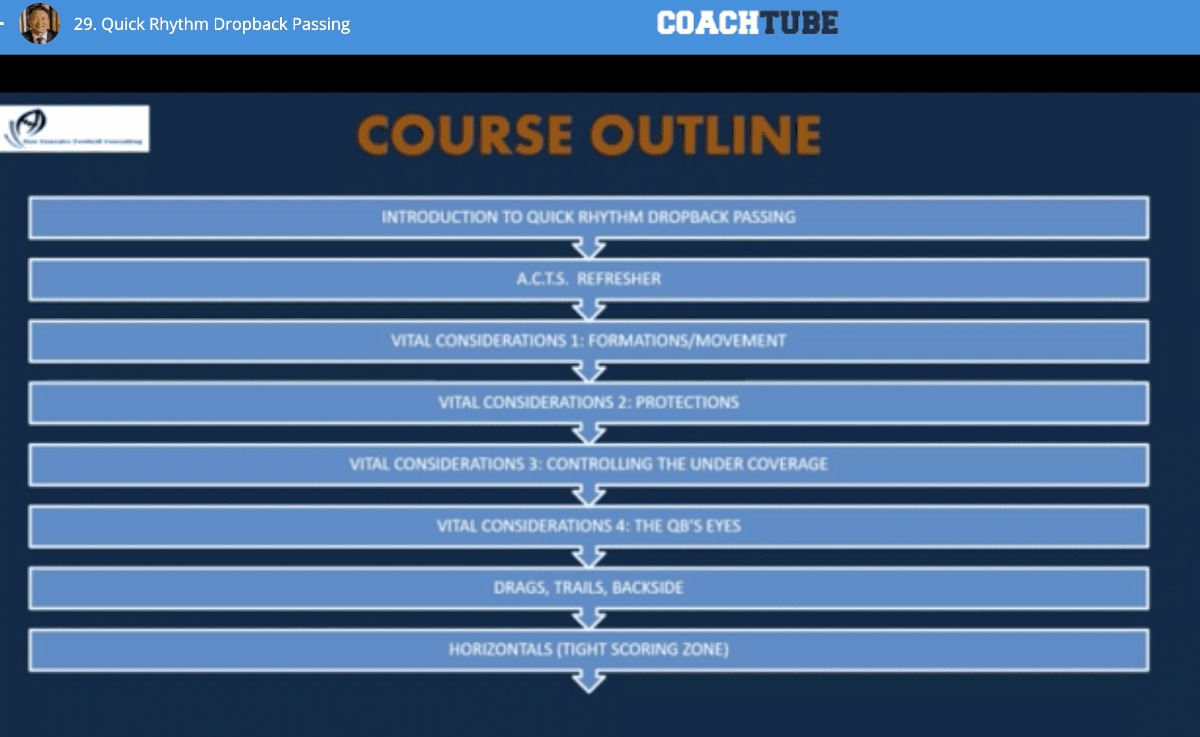
Formations and Pre-Snap Movement: Gathering Information Before the Snap
Gonzalez doesn’t treat formations as window dressing. For him, every alignment is a question you’re asking the defense. and the answer tells you what’s available.
When you line up in a 2×2 set, you’re getting one set of answers. When you condense into the boundary, you’re getting different information. When you empty the back outside, the defense has to declare something.
The point isn’t to trick the defense. The point is to force them to show you how they’re going to play before you snap the ball.
Gonzalez walks through what to expect from different formation structures: how defenses typically adjust to condensed sets, what you can learn from their response to empty, how boundary versus field alignments change the picture.
The goal is building a catalog of what each look tells you—so your quarterback and receivers are gathering intelligence, not just lining up.
Pre-snap movement layers on top of this. Motion isn’t just about creating advantageous blocking angles or getting a player in a better spot. It’s another question. How does the defense respond? Who moves with the motion man? What does that tell you about coverage?
The formation and motion aren’t the play. They’re setting the table for the play. If you’re not teaching your players to read what the defense gives you before the snap, you’re leaving information on the field.
Controlling Underneath Coverage: Building Structure Into Every Combination
Once the ball is snapped, somebody has to move the underneath defenders.
Gonzalez teaches this as a structural principle, not a concept-by-concept add-on. Every combination your offense runs should have a built-in answer for how you’re influencing the defenders in the throwing lanes.
This means option routes that read the defense and find soft spots. It means building into your system the idea that certain receivers are responsible for pulling defenders out of windows—not as tags, but as foundational technique.
The way Gonzalez explains it, a receiver who learns this as a freshman understands it as a JV player and executes it instinctively by varsity. It doesn’t matter if he’s playing inside, outside, or in the backfield. The principles carry because they’re baked into how every route combination is taught.
The practical value is consistency. You’re not re-teaching “how to clear the flat defender” every time you install a new concept. Your players already know. The route combination changes, but the underlying responsibility—pull this defender, find that soft spot, create that window—stays constant.
Gonzalez spends time on how he calls plays with this structure in mind and how he teaches option routes so players aren’t guessing. The details matter here. It’s one thing to tell a receiver to “find the open spot.” It’s another to give him a framework for reading leverage, recognizing coverage, and knowing where the soft spot will be based on what the defense shows him.
Directing the Quarterback’s Eyes: The Visioning Process
The last piece, and maybe the most important, is where the quarterback looks.
Gonzalez calls it the “visioning process,” and he’s adamant that this is the critical factor in attacking a defense. Your quarterback can have all the arm talent in the world, but if his eyes aren’t in the right place, the ball isn’t going where it needs to go.
This isn’t just about progressions. It’s about training the quarterback to understand what he’s seeing and putting his eyes in position to process it quickly.
The ability to direct a quarterback’s vision. to put his eyes on a specific spot based on formation, coverage, and route combination. is what separates systems that execute from systems that hope. Gonzalez teaches this as a deliberate skill, not something that happens naturally with enough reps.
When the visioning process is trained, your quarterback isn’t hunting. He knows where to look based on what the defense showed him pre-snap and what he sees post-snap. The ball comes out on time because the decision was made before the receiver broke.
Why This Matters Before Spring
These aren’t exciting topics. Formations, underneath control, and vision training don’t make highlight reels.
But if you’re building a quick rhythm passing package—or refining the one you have—these are the pieces that make everything else work. The plays Gonzalez covers in his course (drags, trails, horizontals, isolations, tight zone packages) are effective because the foundation is already in place.
Spring is when you install. This is the time to think about what you’re building on.
If you want to see how Gonzalez structures all of this—complete with playbook pages, install progressions, and recent game film—check out the full course.


