
Some plays survive scheme changes, personnel turnover, and a decade of defensive adjustments because the structure is sound. Three-man snag is one of those plays.
Bobby Acosta has been running this concept for 12 years. In this clip, he breaks down the base alignment, the QB’s read progression, backside tags, and what makes the play a consistent plus-yardage gain on film.
Video: Bobby Acosta – The Best Play in Football: 3 Man Snag
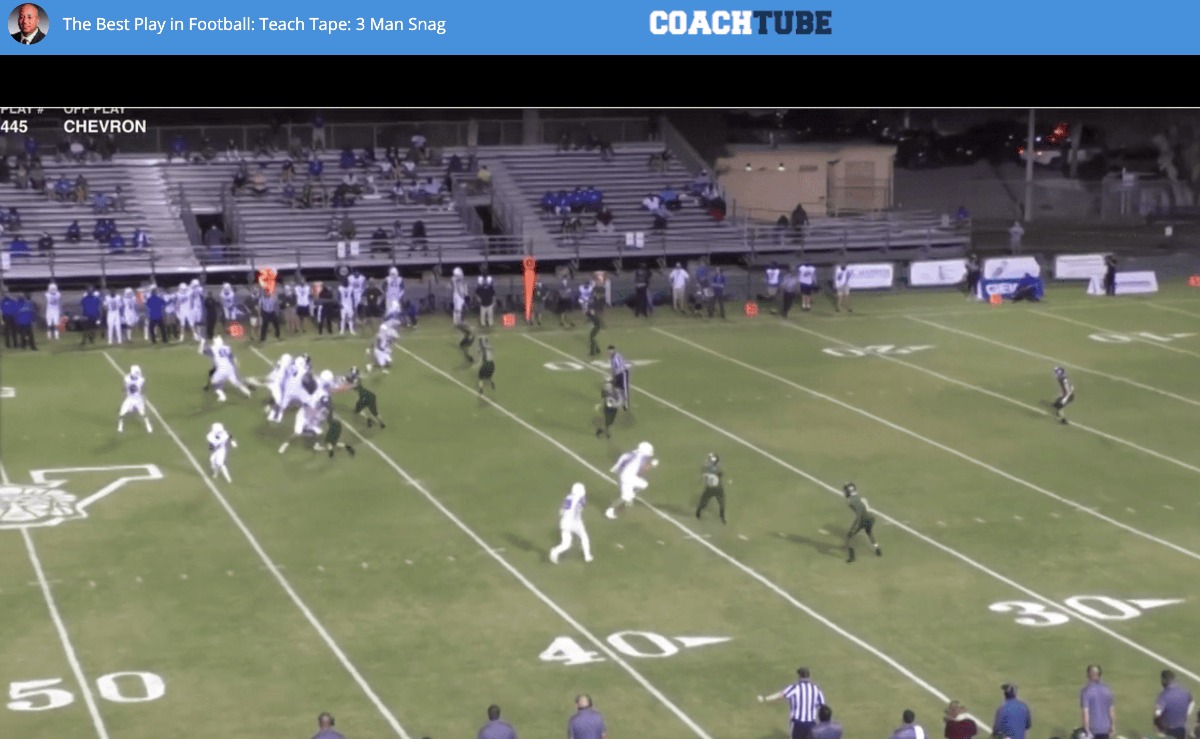
The Base Concept: Field Side and Backside
Acosta runs this out of a 2×2 alignment. The field side is the three-man side: snag, corner, flat. The backside is a grab, where his number two runs a hitch.
The alignment specifics on the field side:
– The Z lines up four to six yards off.
– On the high school hash, the inside receiver adjusts to about a yard inside the defender. Acosta notes the college alignment is different, so he makes that adjustment for his level.
– The back has five hard steps to the field.
The concept can also flip to the boundary. Acosta calls it Boundary Chevron when the three-man side goes to the short side. But the base call puts the concept to the field where there’s more room to work.
QB Footwork and Read Progression
The quarterback uses a one-piece: a jab step followed by a skip step. That’s the only footwork.
From there, it’s a pure progression:
1. Snag first: The quarterback reads the snag route and determines if the window is open.
2. High-low: If the snag isn’t there, the QB works the high-low between the corner and the flat.
3. Backside tag: If neither is there, the progression moves back to the number two receiver on the weak side. That’s the grab route. Beyond that, the dig on the backside is the last read.
Acosta teaches the QB to read snag first because “you just don’t know what it’s gonna pull up.” The play develops differently based on what the defense does with the linebacker, and the snag read tells the QB which level of the progression to move to. He walks through the footwork and timing on each clip in the video above.
What the Snag Route Does
The snag receiver’s job is to snag the first linebacker inside him. That means occupying the linebacker’s attention and sitting down in the void.
When the defense tries to plug the lane where the snag sits, the play changes. Acosta shows on film how the linebackers plug the snag window, and when they do, the backside opens up. The grab route and the dig both become available.
When the linebacker doesn’t plug, the snag is an easy completion. Acosta describes it as needing “about six inches to complete this pass.” The window is tight, but the throw is short, and the five-man protection gives the QB enough time to deliver it.
On one clip, Acosta points out the QB could have thrown the flat instead but was a beat late on the snag read. The play still worked. That’s the margin the concept gives you.
The Plus-Three Rule
This is where the receivers earn their money.
Acosta’s standard: “You catch a five-yard play, you need to go plus three.” That turns a five-yard completion into an eight-yard gain. First down in most situations.
He shows it on film. The receiver catches the snag at five and immediately turns upfield for three more. The play converts because the receiver knows the standard before he catches the ball.
Protection and the Back’s Role
The base protection is five-man: 50/51 in one-back, 60/61 in two-back.
Acosta gives the QB the option to keep the back in for protection. On multiple clips, the QB checks the back into pass pro when he feels he needs it. That’s a built-in adjustment at the line.
When the back isn’t needed in protection, Acosta can attach him to the route concept. He shows one play where the back runs a pipe straight up the seam. The goal is to stress the safety with the back up the middle while the snag works underneath and the dig comes across on the backside. On that play, the QB reads snag, sees he has leverage on the high throw, and hits the touchdown.
When the back is removed from the formation entirely, the numbers to the field are favorable. On one clip, Acosta says he would “rocket ship this to the back” in the flat because of all the open grass. The play still completes for a plus gain.
Twelve years of the same play. The concept works because the progression is clean, the reads are simple, and the play answers whatever the defense does with the linebacker. Plug the snag, the backside opens. Leave it alone, it’s an easy completion.


