
If you run tight zone or any variation of the split zone series, you already have the foundation for one of the best change-up plays in football. You just might not have installed it yet.
Cody Kennedy, Offensive Line Coach at Tulane University, breaks down the Wham play and how he thinks about it as a complement to the zone split game. In this clip, he covers what the play is designed to do, why he splits it into two separate concepts, and how the whole thing defaults back to split zone when the look isn’t right.
Video: Cody Kennedy on the Wham Play
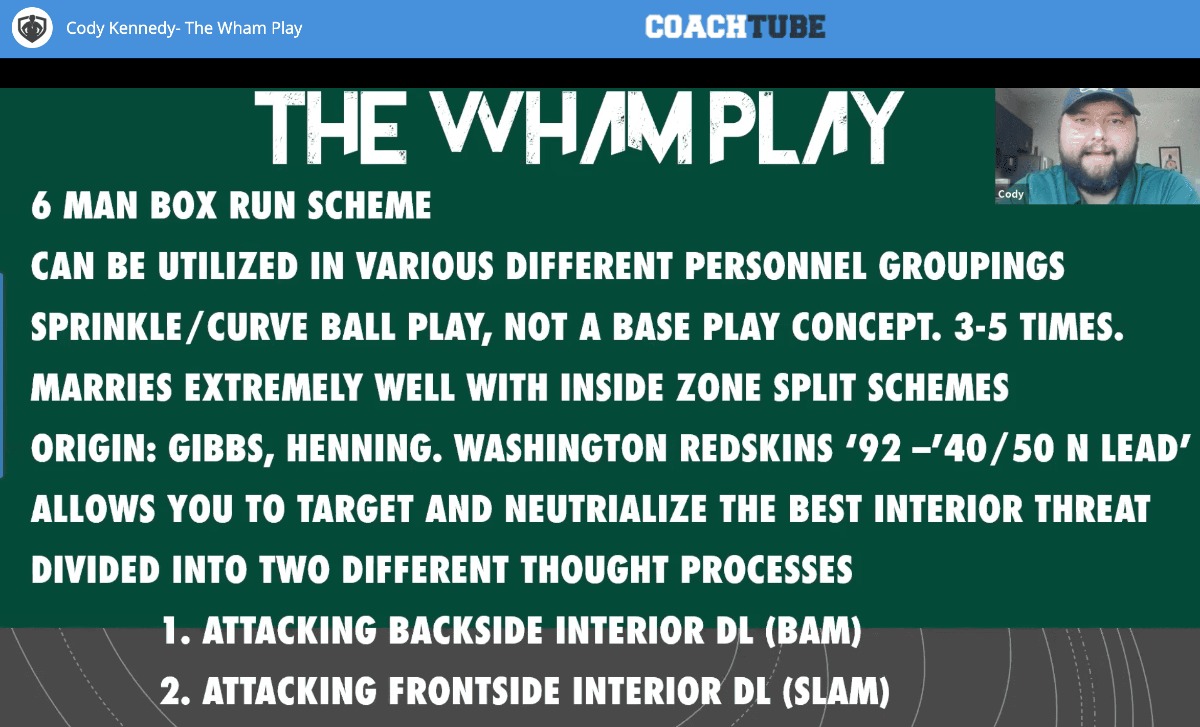
What the Wham Play Is (and Isn’t)
Coach Kennedy is direct about this: Wham is not a base concept. It’s a sprinkle play. A curveball. He advises running it three to five times a game as a change-up, giving interior defensive linemen another look they have to process and react to throughout the game.
It’s a six-man box run scheme. You can run it out of various personnel groupings. A tight end, a fullback, a hard nose slot you motion in to be your Wham guy. The target is always an interior defensive lineman. You’re bringing a blocker from off the line of scrimmage to kick that interior player, and the design is built to neutralize the best interior threat on the defense.
The reason Coach Kennedy sells this play to his staff and his players is how cheaply it installs. If you already run tight zone and the zone split series, whether you’re split and blocking the end, split and bluffing the end and arcing and reading, the Wham play fits right into the same framework. The footwork is similar. The offensive line’s rules overlap. It’s not a new scheme. It’s an addition to one you already have.
Two Concepts, Two Targets: Bam and Slam
This is where Coach Kennedy’s thinking separates the Wham play into two distinct concepts. The question is simple: which interior defensive lineman are you targeting?
Bam attacks the backside interior defensive lineman. The Wham blocker is coming from the front side and kicking the backside interior threat. Coach Kennedy uses “Bam” (B-A-M) as the tag for backside attacking.
Slam attacks the front side interior defensive lineman. The Wham blocker targets the strong side interior threat. “Slam” is the tag for strong side attacking.
These aren’t just two names for the same play. Coach Kennedy treats them as two different thought processes because the blocking concepts split based on which defender you’re targeting. The assignments change. The angles change. The way the rest of the line fits around the Wham block changes. Coach Kennedy walks through the specifics of how those concepts differ in the clip above.
The History
Coach Kennedy traces the Wham play back to Joe Gibbs and Dan Henning with the late-80s Redskins. The 1992 playbook had it listed as 40/50 Nose Lead. He’s quick to note they probably weren’t the ones who invented it, but that era made the play famous. It’s carried forward into what you see in the NFL today.
That’s not trivia for the sake of it. The point is that this play has survived decades of defensive evolution because the core idea works: take an interior defensive lineman who’s playing aggressively upfield and hit him with a block he doesn’t see coming.
The Built-In Off Call
This might be the most practical piece of the whole clip.
Coach Kennedy’s Wham play is part of what he calls his perfect play package. But he knows that sprinkle plays only work when the look is right. If you force them into a bad look, you lose the advantage.
So the Wham has a built-in off call that defaults to split zone. If the offense walks up to the line and the center sees an exotic front, a look they haven’t practiced against, or anything that isn’t advantageous for the Wham, the center calls “off, off, off.” The rest of the offensive line communicates the call, and everyone shifts to a split zone state of mind.
No timeouts. No frantic sideline signals. The center makes the call, the line echoes it, and the play becomes split zone.
Coach Kennedy puts it plainly: if the look isn’t one where you can hit the Wham big, like a curveball play should, off it to split zone and shuffle up and deal again. He goes into more detail on the situations where that off call comes into play in the video above.
Quick heads up: Coach Cody Kennedy if you are not yet registered is speaking tomorrow at the Hog OL Clinic this Monday, March 16th at 8:00 PM Eastern. His topic is “Pry Technique: Zone vs. Movement.” If you like what you see in the clip below, you can hear him teach live. Details and registration here:
The Wham play works because it gives interior defensive linemen a completely different look in their mental Rolodex. Bam and Slam let you target the specific defender who’s hurting you, and the off call makes sure you’re never stuck running a curveball into a look that takes away the punch.


