
The fastest quarterback on your roster isn’t the one with the best arm. He’s the one who processes the least before the snap and still makes the right decision.
That’s what the Air Raid is built on. Not complex coverage reads. Not pattern-matching the secondary. A system so simple that the quarterback’s job is reduced to three things before the ball is snapped.
Coach Jayson Lavender, a veteran offensive coordinator with over 25 years of experience in the DFW area and most recently the OC at Duncanville High School, breaks down exactly how he teaches it.
Video: Jayson Lavender – Quick & Bubble Screens Out of the Air Raid
One-High or Two-High. That’s It.
Coach Lavender does not teach his quarterbacks coverage.
He’s direct about this. The quarterback’s pre-snap job is to scan the field: left or right, deep, left or right, short. What he’s looking for is one thing. Is the middle of the field open, or is it closed?
Middle field open means some version of Cover 2 or Quarters. Middle field closed means man or Cover 3. That’s as deep as it goes. Coach Lavender doesn’t want his quarterback thinking about pattern reads, rotation tendencies, or coverage variations. He wants him identifying one-high or two-high and playing fast.
The only exception is zero coverage. That’s the one call Coach Lavender wants his quarterback to recognize immediately, because the answer changes. Everything else falls into the one-high or two-high bucket, and the system handles the rest.
He references a podcast between Bob Stoops and Kliff Kingsbury where Kingsbury talks about Mike Leach’s approach to coverage recognition. Leach’s answer was simple: he didn’t care about the coverage. The system took care of all coverages. The quarterback’s job was to go through the progression and throw to the open guy. Coach Lavender teaches it the same way.
“I do not want my quarterback thinking about a whole lot.”
Box Count Math in 2×2 Sets
Once the quarterback knows one-high or two-high, the second piece is the box count. And in any 2×2 set, this is pure arithmetic.
– Two safeties = five in the box
– One safety = six in the box
– Zero safeties = seven in the box
That’s the entire formula. Coach Lavender drills this into his quarterbacks because it directly feeds the RPO game. If you’re an RPO team, the quarterback has to know the box count before the snap. One equals six. Two equals five. Zero equals seven.
Here’s where it gets useful. If the quarterback sees two high safeties and still counts a six-man box, he should automatically know somebody is uncovered. That’s not something Coach Lavender has to spell out. If the math is trained, the quarterback sees the answer. Two safeties means five defenders in the box. If there are six, the offense has a numbers advantage somewhere, and the quarterback should find it.
Coach Lavender says they do this so often that the recognition becomes automatic. The quarterback isn’t solving a math problem at the line. He’s confirming what he already expects to see.
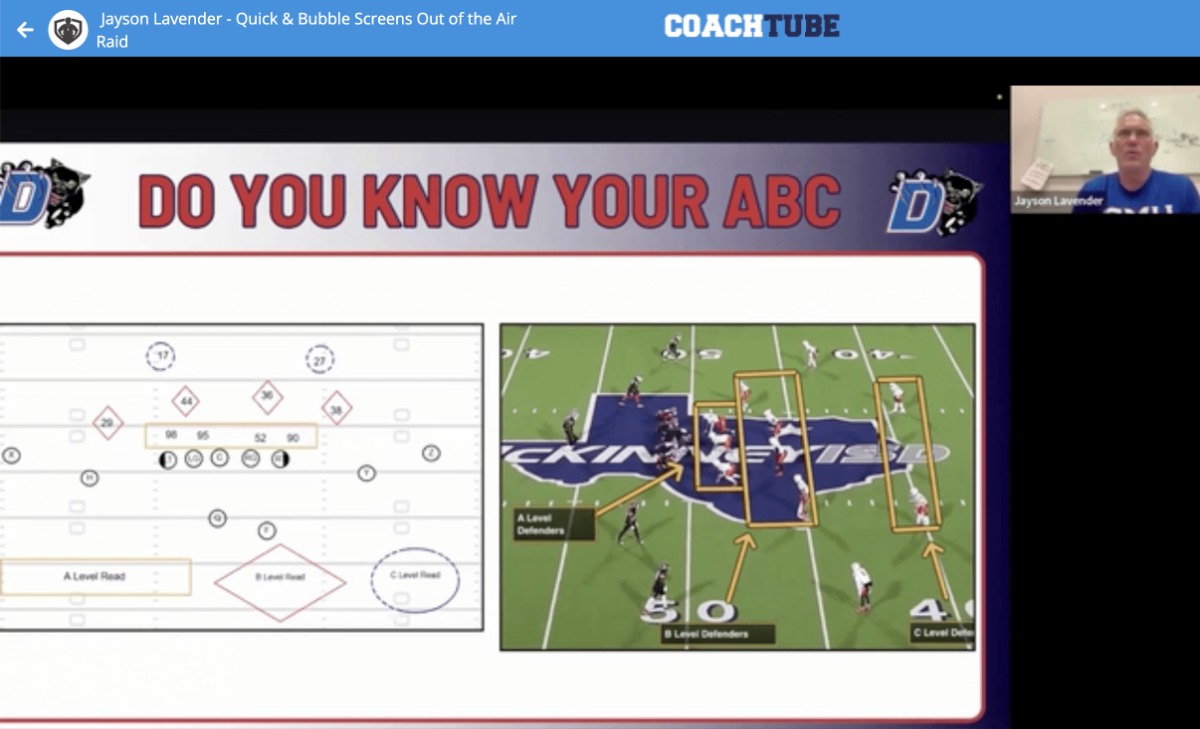
The ABC Level System
This is the piece that ties the whole thing together. Coach Lavender teaches his quarterbacks to categorize every play by the level of defender they’re reading: A level, B level, or C level.
A level is a first-level defender. If Coach Lavender calls “Zorro Apple”, everybody on the field knows the quarterback is reading a first-level player. On an inside zone to the right, that’s the backside defensive end. The read is right there at the line of scrimmage.
B level is a second-level defender. “Zorro Bible” tells the offense they’re locking the box on zone and the quarterback is reading a linebacker. The RPO concept attached to Bible works off that second-level read.
C level is a third-level defender. And this is where Coach Lavender’s naming convention gets smart. He uses “Coke” as the umbrella term for all third-level reads, the same way people in Texas use “Coke” to mean any soft drink. Under that umbrella:
– Pepsi = post route
– Sprite = streak
– Coke = corner route
So “Zorro Pepsi” tells the entire offense: inside zone, third-level read, post. “Zorro Sprite”: inside zone, third-level read, streak. Every player on the field, every coach in the press box, knows exactly what level the quarterback is reading based on the play call alone. No guessing. No checking the wristband for the read key. The read is baked into the name.
Why This Works at Every Level
Coach Lavender has taught this system to quarterbacks across a wide range of ability. He’s coached Keelan Russell, Grayson Muehlstein at TCU, and Trevon Boykin. He also taught it to a B-team quarterback who, as a freshman, threw for big numbers and led his team into the playoffs.
The system doesn’t require a five-star arm or an elite football IQ. It requires repetition and a structure simple enough that the quarterback can execute without processing. That’s the whole point. The quarterback isn’t diagnosing the defense. He’s checking one-high or two-high, confirming the box count, and reading the defender his play call already told him to read.
Coach Lavender walks through the full system in the clip, including how he presents it to his quarterbacks and how the naming conventions keep the communication clean from the sideline to the field. There’s more detail in the video on how each level connects to the RPO concepts he builds his offense around.
Whatever your system is, Coach Lavender’s challenge is the same: make it simple enough that your quarterback can play without thinking. Not simple as in easy. Simple as in stripped of everything that doesn’t help the quarterback make the right decision faster. One-high or two-high. Box count. ABC. That’s the whole pre-snap process, and it lets the quarterback play at a speed the defense can’t match.
This article covers Coach Lavender’s quarterback teaching system, but the full clinic goes much deeper into the Air Raid screen game itself.
He walks through the complete installation of quick screens and bubble screens, including blocking rules, receiver technique, the timing and decision-making the quarterback uses to get the ball out to the perimeter, and how the screen game ties into the RPO concepts built on the ABC levels.
If you’re looking to build or sharpen your perimeter screen package this spring, the full clinic breaks down the whole process from philosophy to execution.
Link: Jayson Lavender – Quick & Bubble Screens Out of the Air Raid


