
Most coaches think defending the triple option is a pre-snap math problem. Assign a dive player, a quarterback player, a pitch player, and you’re sound.
Brett Hickman calls that the biggest misnomer in option defense. He would know it from both sides of the mesh: he is the son of an option coach and a former triple-option quarterback, and in twenty years he has defended the Flexbone twenty-two times.
Hickman is the Assistant Head Coach and Defensive Coordinator at Anderson University and the architect of the Blackout Defense. In just the program’s second year of NCAA Division II ball under Bobby Lamb, his defense finished #19 in the nation in total defense.
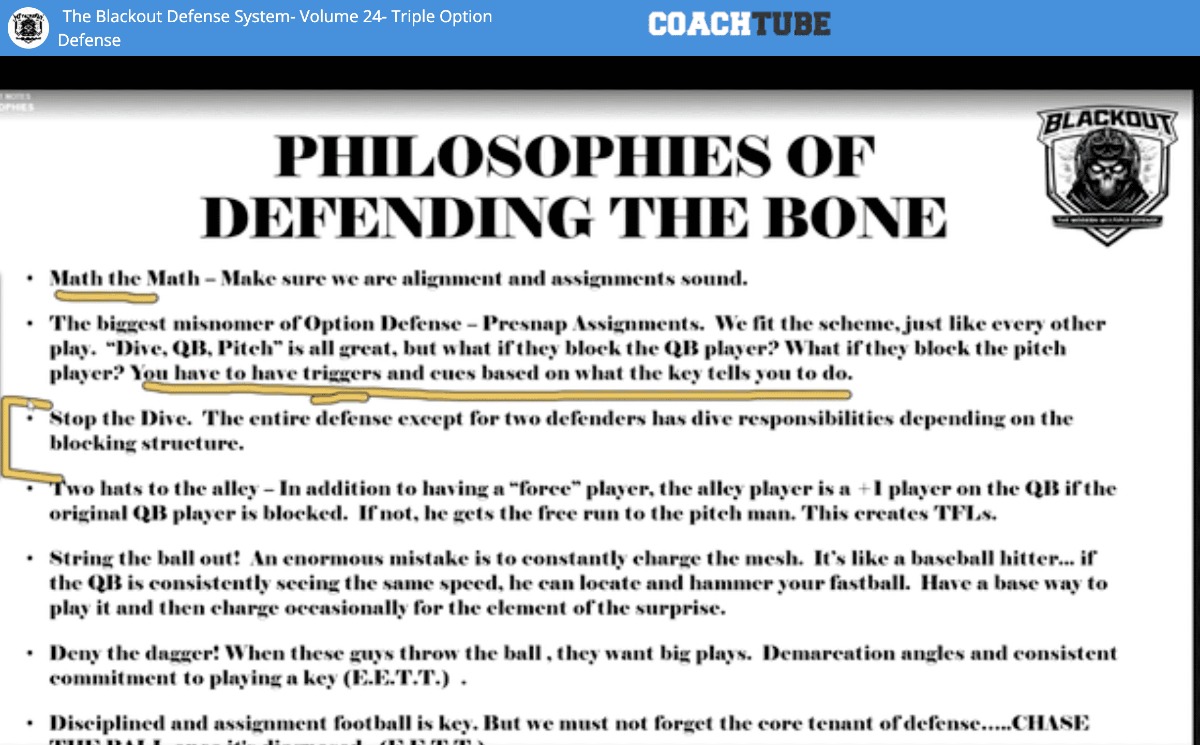
Video: Brett Hickman on the Philosophies of Defending the Flexbone
—
The 85% Problem: Why Pre-Snap Assignments Aren’t the Answer
Hickman isn’t arguing against the core tenets. Yes, you need a dive player, a quarterback player, a pitch player. It all makes sense on the board. But on the board is where it stays, because what you are actually fitting is individual schemes, not the textbook triple option.
He went back and cut a four-game sample of Tusculum and Carson Newman. The number of snaps that were NOT triple option? “Probably about 85 to 90 percent.”
So a defense that only knows how to fit pure veer is solving for one snap in ten and guessing on the rest. What happens when they block the pitch player? You had better have somebody in the alley.
What happens when they load up the quarterback player? You cannot let him run free down the field.
The answer is what Hickman calls triggers and cues: post-snap reactions keyed off what your read tells you to do. He puts it in terms every coach on your staff already teaches. A five-technique against zone read gets a look away and surfs with his eyes down the line. Same picture, but now the guard pulls, and the job changes completely. Same defender, same alignment, two different responsibilities off one key.
“I don’t want guys just running at the quarterback, just running at the pitch if there’s no component of that.” Hickman walks the trigger structure at both even and odd fronts in the clip.
Stop the Dive, Then Get Two Hats to the Alley
The first rule is the oldest one. Stop the dive. Hickman’s version is specific about the headcount: you allocate everybody to the dive except two defenders, and those two carry dive responsibility based on the blocking structure.
Who is exempt? The force player, who is a pitch player and never sticks his nose inside. And usually a second man through the alley, typically the backside safety in coverage. Everybody else fits the dive if his trigger tells him to.
Then comes the phrase you will hear him repeat: two hats to the alley. One of those hats is the force player, who is ultimate force on the pitch. The other is the alley player, a plus-one on the quarterback when the original quarterback player gets blocked. Here is the part that separates it from a clinic diagram: none of it is predetermined. If the ball gets pitched before it ever reaches the quarterback player, that quarterback player becomes the alley player on the fly.
This is also how Hickman manufactures tackles for loss. Overload the count, change the read key, and the quarterback ends up pitching off a defender he was never supposed to read. He gets into how the fit creates those negatives in the video.
Don’t Charge the Mesh. String It Out.
Here is where playing the position changes the lesson.
Early in his career Hickman worked for a coordinator with one answer: hit the quarterback. Charge the mesh, hit the quarterback, every snap. Hickman had taken those hits himself, and he knew the flaw. “When I get the ball out of my hands quicker, you can hit me under the chin.”
The quarterback knows how to protect himself. The faster you force the pitch, the easier you make it on the edge blockers, who, now that they cannot cut, only have to hold the block a beat longer the more you let the ball get out.
So he flips the priority. Charge the mesh as a change-up, never as your base. His model for it is a baseball hitter’s timing. If the hitter sees the same speed every pitch, meaning the four-technique takes the dive and the nine charges the mesh, the quarterback pulls, the wing blocks for half a second, and a back who can run is gone. String the football out as your base. Then, inside a call, charge the mesh for the element of surprise. That is the change-up that produces the swing and a miss: a bad pitch, a ball on the ground, a negative play.
Hickman shows the string-it-out fit and where the mesh charge lives inside a call in the clip.
Deny the Dagger: Demarcation Angles and Eye Control
When a Flexbone team throws, it is not to move the chains. It is for the kill shot. Hickman points to Coach Monken’s Army teams: a season where they completed somewhere around 28 balls total and still averaged better than 20 yards a completion. Every throw is a dagger.
His answer in the secondary is demarcation angles, getting defensive backs lined up deep enough and keeping their eyes where they belong. He is honest about the rep he lost. First year against Carson Newman, 0-0 late in the second quarter, his defense gave up a deep ball “for no reason other than we didn’t have the guy lined up deep enough” and the eyes were wrong.
That ties straight back to the bedrock of the Blackout system, the acronym he calls EETT. The first two letters are effort and eye control, and Hickman is blunt that you cannot play option defense without both. He benched a starter at halftime last year, a good player, because the kid would not put his eyes where he was coached to. A couple of late force angles turned what should have been a one or two yard gain into seven or eight. Against these teams, eye control in the secondary is the whole job.
They Have the Answers to the Test. Play Battleship.
Option coaches, like Wing-T coaches, have if-then answers for everything. “They have the answers to the test,” Hickman says. They carry their own personal Bible, twenty-five years of it, and you are not going to show them a single look they have not already filed away. Run one static defense and eventually they solve it, and it gets ugly.
So Hickman keeps moving. He stems and re-stems the front so the quarterback, the line, and the perimeter players never know where the bubbles are. He calls it playing battleship, borrowing Kirby Smart’s line from the Texas game: if they cannot find your ships, the quarterback loses his “look at me” on the sideline before the snap. Auto-stems are built in for when the offense checks.
The goal is to break their favorite marriages. They want inside veer against a four-down look, run to a bubble, a shade-five side. The midline follow play wants to read a B-gap defender. Hand them changing even and odd fronts with multiple coverage behind it, and you force the non-thinking play. Those are still hard plays. But you have taken away part of their core, and you have made them left-handed.
The last layer is pressure, and Hickman treats it as a change-up too. You have to manufacture a negative at some point, because on fourth and one they are going. To force a punt they need to be backed up behind their own 40 or sitting in fourth and three or longer, which means creating a no-gain or a loss.
And here is where he is refreshingly honest, the part most clinicians would leave on the cutting room floor: he has not been good at it. “We have just not been very good when I’ve called these pressures of creating negatives. In fact, a lot of times they’ve reverted into creating explosives for the other team.”
Against Carson Newman this year his defense held a top-three rushing offense to about four yards a carry, 65 carries for 270 yards, and still lost 21-7, because they never got them behind the chains. He gets into the pressures, and where they have to get better, in the clinic.
Defending the triple option is not about who you assign before the snap. It is about what your kids do after it. Triggers over assignments, string over charge, eyes deep and on the right key. The teams that get gashed by the veer are usually the ones still solving for a play that shows up one snap in ten.
This article is the philosophy. The full clinic, The Blackout Defense System, Volume 24: Triple Option Defense, is the two-hour build: the even and odd fits drawn up, the triggers that tell each defender when to sit on the dive and when to fall to the alley, the demarcation landmarks he gives his DBs, and the cut-ups of the Carson Newman reps he keeps referencing, the long run that got loose and the deep ball at 0-0, with the corrections on tape. Hickman defended the Flexbone twenty-two times against everything from Carson-Newman’s Split-Back Veer to the traditional sets of Navy, The Citadel, and Wofford. If you have a veer team on the schedule, whether you base out of three-down or four-down, this is the one to study.
Link: Brett Hickman – The Blackout Defense System, Volume 24: Triple Option Defense


