
There’s one thing Coach Prosser’s offensive line is not allowed to do on counter.
They’re not allowed to get spilled.
That’s the rule he draws in the room. Don’t get spilled. Don’t log it. Run through the guy’s face. Everything else in the counter blocking scheme is technique. That one is non-negotiable.
Coach Collin Prosser walks through counter on tape in his Gap Footwork clinic. The backside deuce. The kickout rule for the first puller. The block standard he holds his line to. And how the unit adjusts when the defense brings a blitz they didn’t see on Tuesday.
Video: Collin Prosser on Counter Blocking and the Pull Game
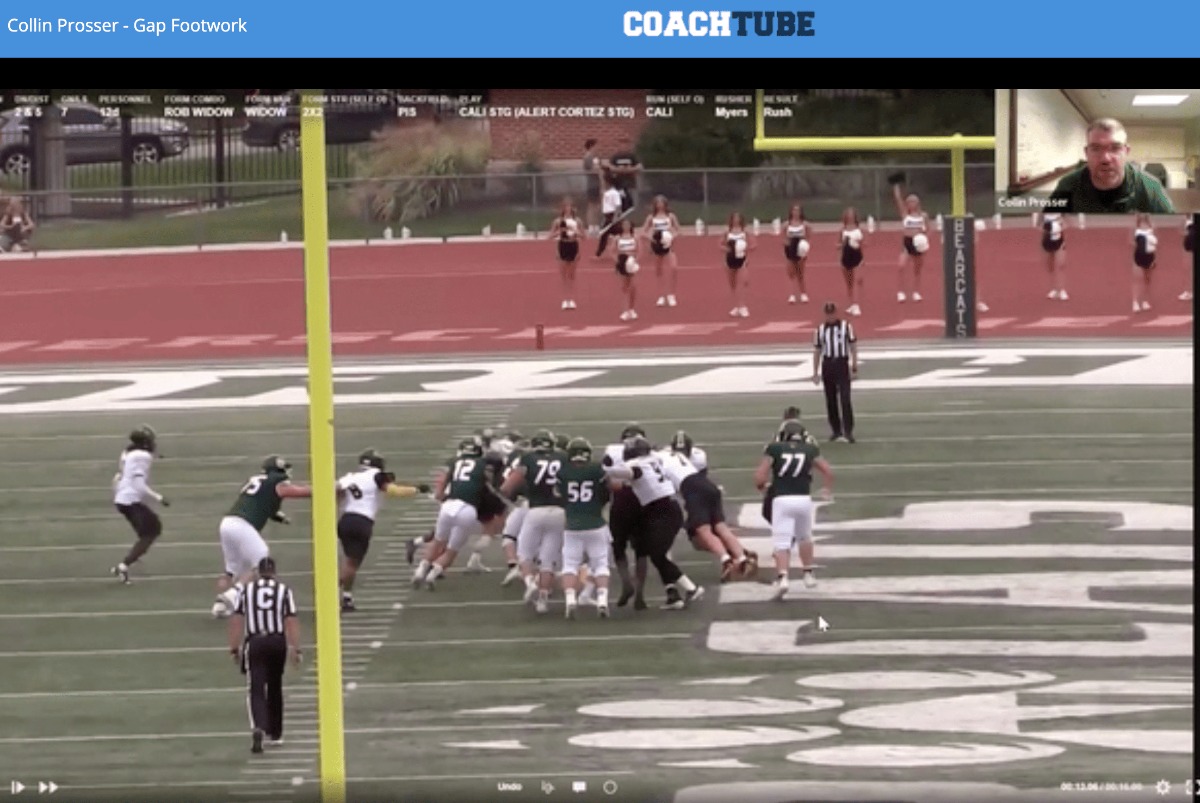
The Backside Deuce: Near Side Foot, Then the Wheel
The backside of counter starts the same way every time.
The two linemen working the deuce both take a near side foot to the adjacent shoulder. Both work down together. Even if there’s no defender in the true B gap, the rule doesn’t change. The double team install holds.
The decision is downstream of the footwork. If a defender shows up in the gap, the inside man takes him. If nobody shows, the inside man is in his gap on his track. The outside man works vertical through the inside guy. Feet move first. Vision second.
Then there’s the piece most coaches don’t have a name for.
If the deuce makes contact and the second-level defender starts flying over the top, the blockers wheel on him. They turn the block, redirect it back inside, and the back is taught to read it the same way. The instant the wheel happens, the running back is going down inside.
Coach Prosser frames the whole thing in one phrase: occupy guys. The backside isn’t trying to displace anyone. It’s trying to tie up bodies long enough for the puller and the back to get to the point of attack. He shows the rep on tape and points out exactly when the wheel call is the right call.
The Non-Negotiable: Run Through the Inside V
This is the rule that doesn’t move.
When Coach Prosser’s first puller kicks out on counter, he aims for the inside V of the defender and runs through the guy’s face. He gets his head inside. He accelerates through contact. The point isn’t to put the defender on the ground. The point is to drive him off the hash so the back can get inside.
That’s the test of a good kickout. Where did the defender end up? The hash is the goalpost. If the kickout drove him from his original alignment to outside the hash, the back has a runway.
The lineman Coach Prosser uses on tape is #75. He calls him “as good a player as I’ve ever had” at the technique. Watch his head placement on the rep. Watch the angle he gives the back. The rep produces a 7-yard run on 2nd and 5, which Coach Prosser says they’ll take all day.
He flags one piece on the puller he wants cleaner here. He goes into what he wants from the hips on contact in the clip. The correction is the part most coaches will want to slow down and watch twice.
The Block Standard: Freshman-to-Sophomore, Not Hall of Fame
This is the part that should change how you grade your line on Sunday morning.
Coach Prosser tells his unit the same thing every week:
“Our blocks don’t need to be NFL Hall of Fame knockout blocks every time. More times than not, our blocks are going to fall somewhere between the freshman and sophomore year of high school of being able to get to the guy.”
Read that twice. The standard isn’t a pancake. The standard isn’t a knockdown. The standard is get to the guy and create some space. That’s it.
On the second counter rep, the tackle works down with his near side foot to the adjacent shoulder. Same rule as before. Coach Prosser would have liked him to stay more square on contact. But the block was good enough. Pierce, he points out, does a good job of setting the wall. The back hits the crease. The play works.
Most offensive line meetings spend 80% of the time grading the missed knockout block. Coach Prosser is making the opposite point. Get to the guy. Set the wall. Let your athlete make something happen. He goes deeper on what “good enough” looks like in the clip and the difference between a tackle who stays square through contact and one who turns his shoulders too early.
There are two ways to coach counter. One is to install seventeen variations and hope one of them matches what you see on Saturday. The other is to install a small set of rules that hold no matter what the defense does. Coach Prosser teaches the second one. Don’t get spilled. Get to the guy. Wheel when the second-level defender chases over the top. The dagger blitz rep is what those rules look like when the picture is wrong and the offense scores anyway.
This article is the counter rules. The full Gap Footwork clinic from Coach Prosser builds the footwork those rules sit on.
He installs the deuce footwork that powers every gap concept, and applies the same rule set across power, counter, duo, pin and pull, and trap.
He breaks down hand placement against any front, the puller’s aim points by play, and the combo block transitions that let two linemen come off the ball as one. If you want a gap scheme your line can run on a single set of footwork rules, the full clinic is the install.


