
Nobody has good film on you.
That’s the quiet edge of running the Wing-T, and Coach David Weathersby builds the whole thing on it. Other schools don’t see a tight end wing formation enough to scout it, so you’re going to get funky fronts nobody’s drawn up for you. His answer isn’t a new adjustment for every look. It’s a rule for every man, so nobody on the line is thinking at the snap. “The Wing-T is an order of football,” he says. “We have rules for everything.”
In Part 3 of his Traditional Wing-T clinic, Coach Weathersby breaks down the 20 Series Buck. The rules below are exactly why it holds up against a defense that’s never seen it.
Video: David Weathersby on 20 Series Buck: Line Rules and Backfield Mechanics
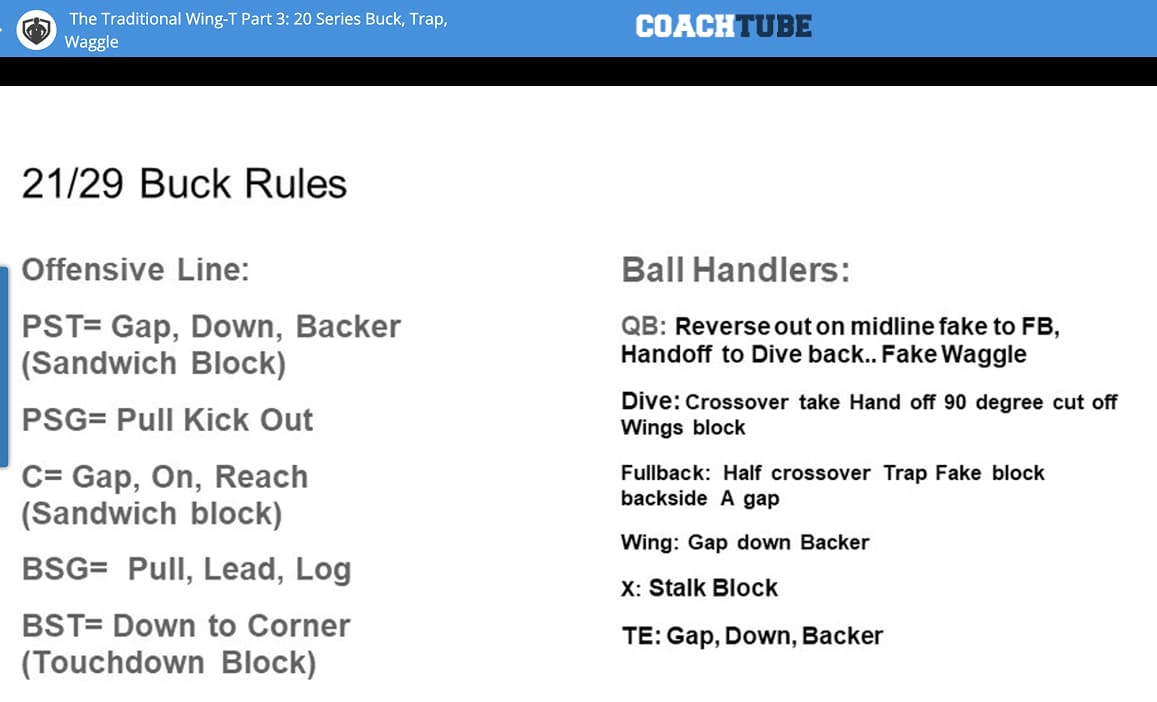
The Line Rules: One Phrase You’ll Hear All Series Long
Play Side: Gap, Down, Backer (and a Sandwich Block He Won’t Explain Yet)
The play side tackle’s rule is gap, down, backer. Underneath it, Coach Weathersby tags a wrinkle: about 85% of the time, that tackle ends up in a sandwich block with the center. He puts the word in parentheses on the board, names it, and then tells the room flat out, “I’ll explain what that is later.” So the rule is on the page, the technique that makes it work is in the clinic.
The center’s rule is gap, on, reach, and he’s the other half of that sandwich most of the time. The tight end and the wing both carry the same call: gap, down, backer. “You will hear that a lot in the wing and the Buck series,” he says. “It’s a great rule.” That’s the point of the whole system. One phrase travels across positions so the kid lining up isn’t decoding anything at the snap.
The Pulling Guards: Lose Ground to Win the Edge
The play side guard’s rule is pull, kick out, and the first move is counterintuitive on purpose. “We’re losing ground on that first step.” It’s a bucket step, and he wants the guard a yard to a yard and a half behind the line of scrimmage before he comes back downhill to kick out. The reason is the wash. “We’ve got to get around the wash that we know is coming,” so the guard buckets behind it instead of trying to fight through it.
The backside guard’s rule is pull, lead, and log. He also has to get depth, but there’s a timing key most coaches miss: he gets that depth after he crosses the center, “so he doesn’t run into the fullback.” Coach Weathersby walks the path on the diagram and then shows it live on film.
The Wing and the “Touchdown Block”
The wing has the gap-down-backer call too, but he’s usually stuck on a defensive end who’s much bigger than him. Coach Weathersby isn’t asking him to win that block. “All we want him to do is get ran over slowly and don’t get beat outside.” Get on the end’s hip, wash him down, give up a yard of penetration if you have to. What you can’t give up is the end getting over the top and outside. “Our guards will take care of the rest.”
Then there’s the backside tackle, and this is the one that sells itself to the kid. His rule is down to corner, and Coach Weathersby calls it the touchdown block. When Buck is called away from him, that tackle gets to run and block a little guy, “and if he gets to the little guy, it’s probably a touchdown.” If he doesn’t get there, no harm done, he’s a backside tackle. It’s a teaching trick as much as an assignment: give the big man a shot at a defensive back and a chance at six, and you’ve got him bought into a play that’s running the other way. The X, out wide, has a stalk block.
It’s Not a Sweep. It’s Off-Tackle.
Here’s the part Coach Weathersby is adamant about. He never calls it Buck Sweep. “It’s not a sweep. It looks like a sweep, but it’s really an off-tackle play.” The whole design is to make the defense think sweep, sweep, sweep to the outside while the ball is going off tackle.
You can see it in the ball carrier’s track. The back taking the handoff, his dive back, takes a crossover step to stay on his track at four yards deep, takes the ball, and runs to the wing’s block.
Then he makes a 90-degree cut. Not a bounce, not a loop to the sideline, a hard cut up off the wing’s wash-down block. Does it bounce outside every now and then? Sure. But it’s built to go off tackle, and that’s what he preaches to the back. Watch where he wants that cut to happen in the clip.
The Mesh: A Flipper, Not a Handoff
The quarterback reverses out on the midline and keeps the ball tight to his chest. The fake to the fullback is the detail. “This is not a ball fake. This is a flipper with the elbow.” The fullback comes over the quarterback’s elbow, the quarterback flippers the fake, and the ball never leaves his chest.
The why is all about ball security and disguise. The instant you try to put the ball in the fullback’s belly, “you’re asking for a fumble,” and it tips your hand: the defense sees the ball go in and sees you pull it back out. There’s no advantage to it. So the ball stays on the chest, the quarterback hands to the dive back, and then he fakes the waggle and rolls up to keep the boot alive.
The fullback finishes the picture. Half crossover step, trap fake, block the backside A gap. And Coach Weathersby wants the fake sold all the way: “I don’t care if he fakes a trap, stumbles, and runs into the defensive lineman’s hip.” If that fullback can get the defensive lineman to tackle him, he’s done his job. The fake that holds one more defender is worth as much as the block.
The Wing-T runs on order. Every man has a rule, the rules repeat from position to position, and the play that looks like a sweep is designed to cut up underneath it. Get the rules right and your line stops thinking against fronts they’ve never seen. That’s the offense, and the Buck is where it starts.
This article is the 21/29 Buck. The full clinic, The Traditional Wing-T Part 3: 20 Series Buck, Trap, Waggle, is where Coach Weathersby finishes the series: the sandwich block technique he promised to explain and didn’t here, the numbering system that organizes the whole offense, the 24/26 Guard Trap against aggressive fronts, and the 21/29 Waggle with its protection rules and route concepts off this exact backfield action.
He builds all of it on diagrams and then game film against real defenses. If the Buck rules made sense, the Trap and Waggle are how they multiply.
Link: David Weathersby – The Traditional Wing-T Part 3: 20 Series Buck, Trap, Waggle


