
The offense you face this fall spent all summer blocking a front you don’t play.
Ryan Pugh’s line wants a nose, a three-technique, a five, and a six or a nine to put their hands on. Day one, that is the picture they drill. The 3-3-5 hands them none of it, and on Sunday they turn on the film and the first words out of their mouth are, this is different.
Coach Keith Patterson has built defenses for nearly four decades, fifteen of them in Texas high school football and the rest across FBS and FCS, and he is the head coach at Abilene Christian. He runs the 3-3-5 for one reason above the rest: multiplicity that lives on the chalkboard, not in the kid’s head. The call he walks here is Okie Spy Cover Two.
Video: Keith Patterson on Okie Spy Cover Two in the 3-3-5
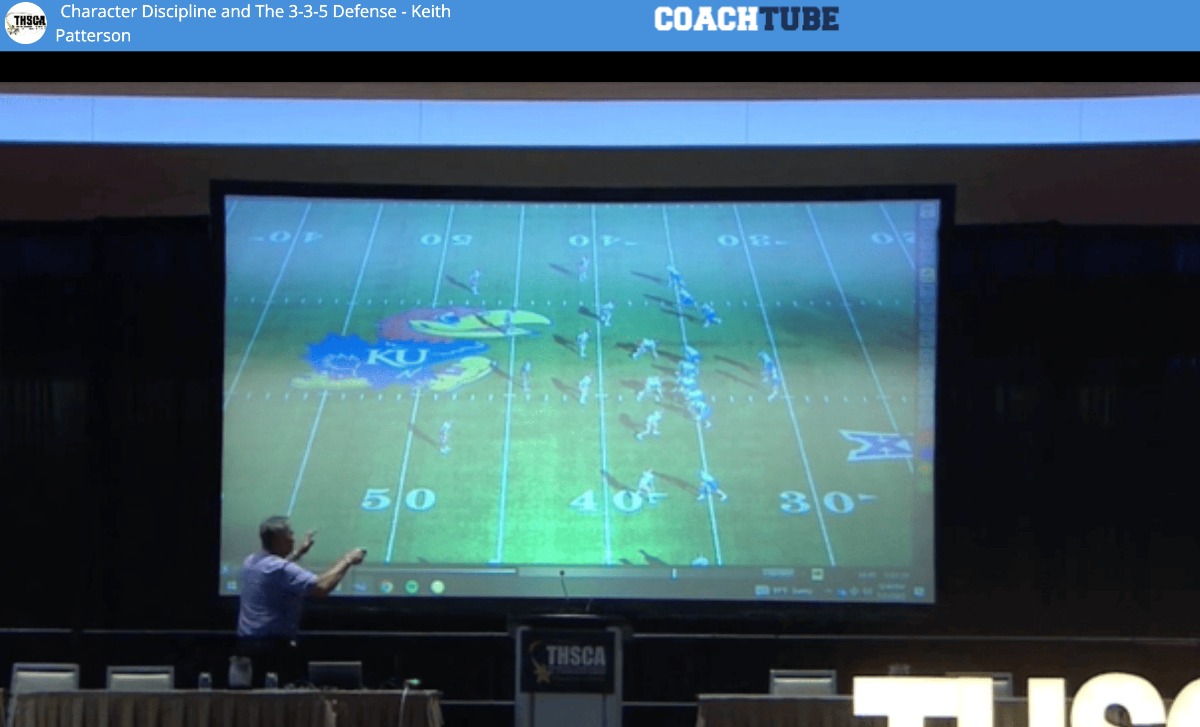
Peso Personnel and Eight Runners and Hitters
Start with the bodies, because the whole thing is built on athletes, not positions.
Patterson’s base package inside this is what he calls Peso: four linebackers, two defensive linemen, five defensive backs. From there he has base, nickel, and dime, dime being six DBs. Against a 10 personnel spread he counts it out and likes what he sees. A defensive end, a three-technique he has moved to nose, four linebackers, two corners, three safeties. Eight second-level defenders who, in his words, are runners and hitters.
That math only works if you stop coaching positions. “Football’s positionless,” Patterson says, and he means it as a recruiting rule. He will take the kid who thinks he is a point guard on the basketball team and put him at safety, maybe corner. His current starting corner is exactly that, a 6’3″ basketball kid a high school coach literally carried out of the gym and down to the football complex. That kid has his school paid for going into his senior year. The defense is built to keep eight of those athletes on the field at once.
And the offense is not ready for them. Most fronts get blocked against a nose, a three, a five, and a six or a nine. The 3-3-5 gives them a surface they did not rep all week. Patterson shows how he sets the front against 10 personnel in the clip.
Okie Spy Cover Two: The Call, the Spur, and the Landmarks
The name tells you the structure. Here is what each piece is doing.
The Corners and the Spur
On the corners, Patterson keeps it to three answers, all controlled from the sideline. Trap, cloud, or bang it. He calls which one from the boundary based on what he wants, so the corner is never guessing on his own.
The key body is the Spur, who lines up in the middle of the formation anywhere from seven to nine yards deep depending on the athlete, and progresses off number two to passing strength. Patterson played the spot himself in 1979, back when they called it the monster. He was, by his own account, a 163-pound monster in name only. Same job, older name.
The Safety Landmarks
The half-field safeties play to landmarks Patterson does not let them break. To the boundary, with the ball on the hash, the safety gets no closer than four yards to the top of the numbers. To the field, depending on the receiver’s cut split and the split variation, he is never more than four yards outside the hash. The line he repeats is the entire coaching point: stay on your landmark.
The Fourth Defender, In or Out
The front flexes off one body. When Patterson wants more of a four-man front, he puts a rush in the middle and starts forcing the offense’s fits, and that is his fourth rush. When he wants his 4-2-5 look back, he moves that same defender out to the end of the line of scrimmage. The wheel, the Sam, the Mike, sometimes a different body type in the middle. Same call, new front, and the offense has to re-sort the picture. He walks the in-and-out of that fourth defender in the video.
The Spy: Why the Fourth Rusher Doesn’t Rush
Here is the wrinkle that names the call. Anytime the quarterback is a run threat, Patterson does not send that fourth defender. He spies him.
“Anytime I play the quarterback, that’s a threat. All I do is my fourth rush is just to spy.” The spy gives token help in the coverage, but his real job is the quarterback. He pulls it down, and the spy is there to, as Patterson puts it, come make him right.
The reasoning is the part worth stealing. Patterson could put that same kid down at three-technique as a true rusher. He does not, and he is blunt about why. “If I put him up there at three-technique, at my rushing technique, he’s going to get level. And at my school, he’s probably going to get blocked. And he can’t get up.” So rather than ask a kid to defeat a block, disengage, and chase, he keeps him clean and lets him do the one thing he trusts every athlete on his roster to do. Run and tackle. “Let’s run tackling.”
That is the whole philosophy in one substitution. Patterson runs the spy rep against a quarterback pull in the clip.
When They Call It Soft, He Manipulates the Front
Patterson hears the same thing you are thinking. Eight guys at the second level, junk-dropping, playing with their eyes. “Everybody goes, well, that’s soft.”
His first answer is how the kids play. The whole defense junk drops, everybody plays with his eyes, and the rule never changes: see the ball, get the ball. But the eyes only matter if the bodies are physical, which is why he refuses to let coverage turn into seven-on-seven. “We’re not letting them play seven on seven in a game. It can’t be seven on seven. We’re still playing football.”
He wants the defender to reroute the receiver with his headgear, the two screws of his helmet, and let it become a natural collision. Route on air all summer is the offense’s game. The reroute is how Patterson takes it back. Man turn or zone turn, he leaves the technique to the player, but the receiver gets touched.
His second answer is structural. “If it’s soft, then what we start doing is manipulating the front. We’ll start forcing people’s fits.” He squeezes a defender, baits the look he wants, and plays it with leverage instead of cushion. To the boundary he shows a Delta concept, slants up top and Delta to the boundary, letting a defender take outside contain while everyone else rallies to the ball. He gets into how he manipulates the front to force those fits in the video.
None of this asks the kid to be more than he is. The multiplicity lives on Patterson’s chalkboard.
What the kid has to do is line up, play with his eyes, and run and hit. The offense sees a front it never blocked and a coverage that keeps changing faces. The defender just sees the ball. That is the trade Patterson is making, and it is why he has run this thing since the year they called him a monster.
This article is the X’s-and-O’s half. The full clinic, Character, Discipline and The 3-3-5 Defense, is where Coach Patterson connects the front to the program behind it: how he simplifies the install so a kid plays fast instead of thinking, the way he develops players regardless of position, and what he actually counts on Friday nights, effort, explosive plays, takeaways, and discipline, instead of the stat sheet everyone else watches. If this gave you the front, the clinic gives you the program it lives inside.
Link: Keith Patterson – Character, Discipline and The 3-3-5 Defense


