
Your pass game is busting because it’s too complicated.
Coach George Pachucy proved it the other way around. He stripped his quick game down to one yes-no question for the quarterback and one set of receiver numbers for everyone else. Last year his bust rate on pass plays was 5%.
Five percent. On every pass play, all season.
Most teams operate in the teens.
The lesson is the principle, not the number. In the quick game, simplicity is the performance lever. Every layer of complexity you cut out shows up as a completion. Every receiver who still has to think about the formation before he runs his route is a bust waiting to happen.
Coach Pachucy’s three-in-one package is the cleanest version of that principle on the market. One five-man route. One question for the quarterback. Three concepts that all install off the same rules.
Video: George Pachucy – Quick Game for Any Offense: The 3-in-1
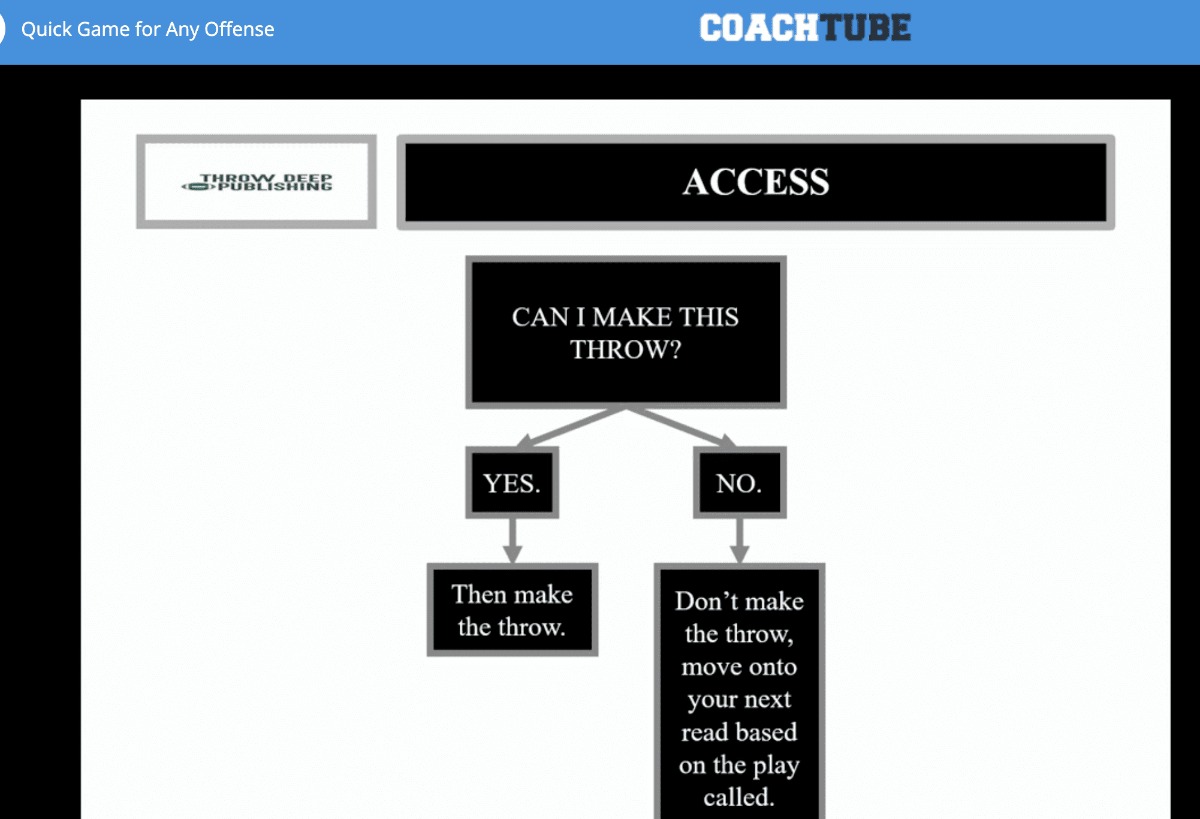
Simplification 1: One Question for the Quarterback
The first thing Coach Pachucy strips out is coverage recognition.
His quarterback isn’t reading Cover 2 or Cover 3 or matching pattern reads. He’s answering one yes-no question on every quick game call.
Can I make this throw?
The throw is the front-side access route: the hitch, fade, or speed out on the outside. Pre-snap, the QB looks at it. Yes, take it. No, work the progression on the same side. He’s adamant about the second part. On a three-step drop, the QB does not have time to scan from one side of the field to the other. Pick a side. Stick with it.
The access read also lives after the snap. Pre-snap “no” can become post-snap “yes” if the corner bails. Pre-snap “yes” can become post-snap “no” if the corner clouds. Coach Pachucy walks through how he trains that pre-snap-look-then-react sequence in the clip.
That’s the entire QB process. One question, asked twice.
Simplification 2: One Install for Every Formation
The second thing Coach Pachucy strips out is formation-specific learning.
Every pass concept in his system installs as a five-man route, called the same way regardless of the formation on the field. Boundary one, boundary two, field one, field two, field three. The receiver doesn’t memorize what hitch looks like out of empty versus trips versus pro. He memorizes his number.
If the call is hitch and he’s the number two receiver to the field, his job is the same in every formation he’ll ever line up in. Number one runs the access. Number two runs the hitch-to-out. Number three (in 3×1 or empty) runs the sit over the ball.
This is the piece that gets the bust rate to 5%. The kids aren’t learning four versions of every concept. They’re learning one job per number, once, and running it everywhere.
Simplification 3: Three Concepts, One Set of Rules
The third thing Coach Pachucy strips out is concept-by-concept install time.
Hitch, fade, and speed out are not three separate plays in his system. They’re one package with three front-side variations and the same back-side rules.
– Number ones run the called access (hitch, fade, or speed out)
– Number twos always run the hitch-to-out option
– Number threes always run the sit over the ball
The hitch-to-out is where the patience lives. Number two pushes from six yards back to five and runs the hitch. If the ball doesn’t show at the top, he slowly shuffles outside, mindful of spacing, because if the ball didn’t come, the hitch outside was either covered or already thrown. Drifting that direction brings him into the QB’s vision faster and shortens the time the QB needs to work back.
One install. Three concepts. The receivers don’t relearn anything when the call changes from hitch to speed out. They run their number’s job.
The Test: Trust the Kids to Make the Call
Here’s the proof that the simplification actually works.
Coach Pachucy almost never calls a straight fade. He lets the kids check to it.
If the receiver sees press, or feels he can beat the corner off the ball, he checks the access to fade and the QB throws it. That’s a real-time decision happening at game speed, made by a high schooler, on the most important throw in the concept.
The only way that works is if the system underneath it is clean enough that the QB and the receiver share a complete mental picture of what’s about to happen. Pachucy’s is. His call frequency proves it. He runs hitch or speed out 10 to 15 times a game. It’s the most-called pass concept in his system, dressed up with motions, shifts, condensed sets, and the snug formation he borrowed from the Sean Payton-era Saints (he draws that one up in the clip).
You can’t dress up a concept that often if your kids are still figuring out how to run the base version of it.
The 5% number is the headline. The principle is the takeaway. In the quick game, every layer of complexity you cut out shows up as a completion. Coach Pachucy’s three-in-one is the cleanest install of that principle running. One question for the QB. One set of numbers for the receivers. One package with three front-side options. One protection that mirrors.
If your pass game busts more than it should, the fix probably isn’t a new concept. It’s removing the layers your kids are still tripping over.
This article covers the three-in-one access piece, but the full Quick Game for Any Offense course goes through the rest of the install.
Coach Pachucy breaks down the quarterback mechanics that make the three-step game timing-perfect, the receiver and tight end technique that holds the quick game spacing, the stick concept and slants as the next layer of the install, and how he expands the same system into RPO packages.
If you want a quick game your kids can run without busting, regardless of formation, scheme, or quarterback, the full clinic is the build.


