
Your RPO system is only as good as the quarterback running it. And if you’re asking him to read two or three defenders before making a decision, you’re shrinking your pool of kids who can play the position.
Kenny Simpson, Head Coach at Southside High School in Arkansas, built his RPO game around one principle: the quarterback reads one defender. Every time. On every run and every pass. That’s it. Simpson took over a program that had won eight games in five seasons and was on a 20-plus game losing streak. He’s since led Southside to four consecutive playoff appearances and two conference titles in three years. His offense runs out of the Gun-T, and his RPO system is designed to let a good athlete play quarterback without needing to process the entire field.
In this clip, Coach Simpson breaks down the framework behind his RPO menu: the three categories every RPO falls into, how he organizes them by offensive line impact, and the vocabulary system he uses to eventually read every defender on the field.
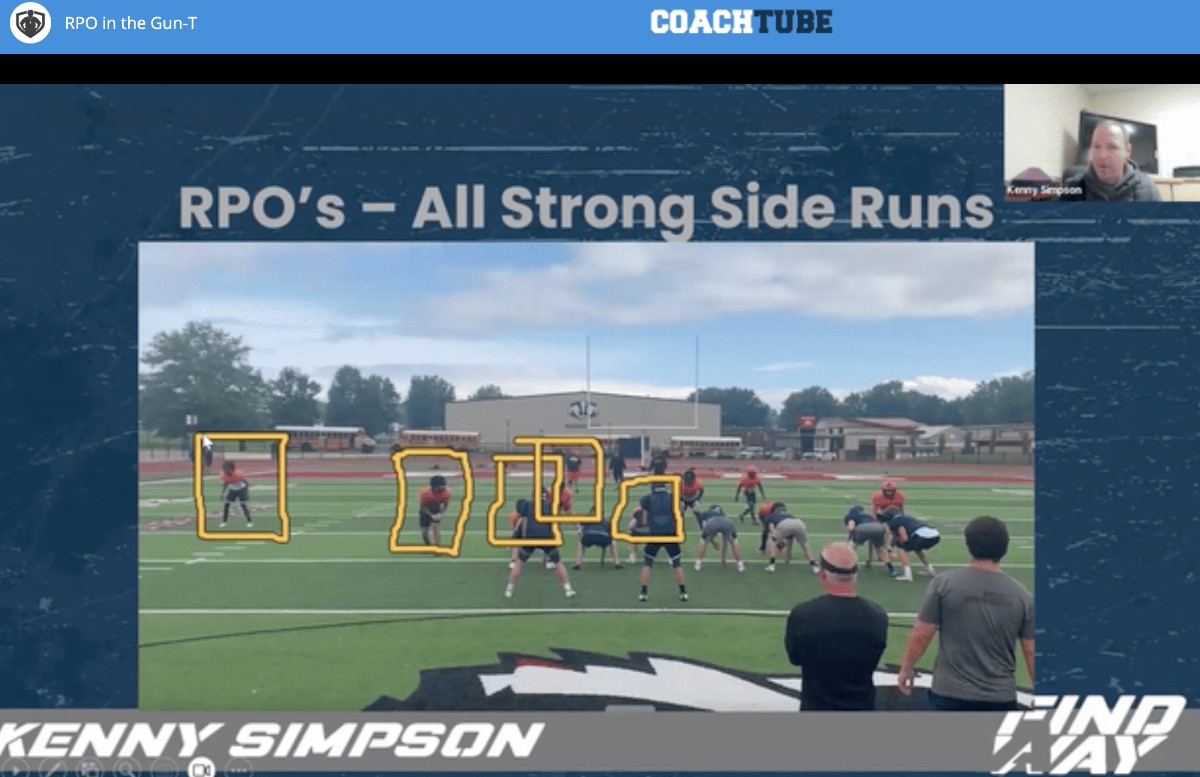
One Defender. Every Time.
Simpson is direct about this. His quarterbacks always read one defender. On all passes. On all runs. One guy.
The reason is practical. When you start asking a quarterback to read from one side of the field to the other, or to process two or three defenders before making a decision, you limit your talent pool. Not every kid who can play the position is going to be able to handle that. And at Southside, Simpson doesn’t have the luxury of waiting for a quarterback who can.
So he puts a good athlete back there and builds the system around him. One read. Hand it off or throw it. Give it or keep it. The decision tree stays short, and the quarterback plays fast.
That single-defender read is the foundation of everything else in the system.
The Three Buckets
Simpson organizes every RPO into one of three categories based on when the decision happens and what the quarterback does with it.
Bucket 1: Pre-Snap RPOs
These are the cheapest to install. The quarterback makes his decision before the ball is snapped based on numbers or leverage. The receivers are running a concept that’s completely independent of the run game, usually a screen, a one-receiver route, or maybe a two-receiver concept if you’ve developed it.
The coach can signal the decision in, or the quarterback can read it himself. Either way, nothing changes after the snap. Simpson says every offense should have something like this. It’s an easy way to get out of a bad play or into a better one without a heavy install cost.
Bucket 2: Run-Run Options
Now the read happens after the snap, but the quarterback isn’t throwing. He’s reading a first-level defender, usually a defensive lineman. If that defender takes the running back, the quarterback pulls it and runs to the space the defender left. If the defender stays still, comes at the quarterback, or doesn’t attack the back, the ball gets handed off.
These are effective, but Simpson notes the limitation: you need a quarterback you’re comfortable pulling the ball and running. If you don’t have that, this bucket gets harder to use.
Bucket 3: Post-Snap RPOs
This is where the explosive plays live. The quarterback catches the snap and rides the mesh. The tagged defender makes his decision, and based on what that defender does, the quarterback either hands it off or pulls it and throws.
Simpson is clear that these are the most explosive plays in the system, but they carry the most risk. You are throwing the football, and that can go wrong. They’re also harder to execute. But they’re becoming more and more common, and if your quarterback can handle the read, this is where you create the biggest problems for a defense.
If you’re new to RPOs, Simpson says start in Bucket 1. If you’ve been doing this a while, you can work more in Bucket 3. Coach Simpson goes deeper on each category in the clip above.
Building a Word for Every Defender
Here’s where Simpson’s system gets interesting. He doesn’t just run a handful of RPOs. He’s building toward a vocabulary that lets him read every defender on the field.
Each RPO in his menu has a word attached to it, and each word tells the quarterback which defender he’s reading. Some words read backside defenders. Others read the play-side edge. Others handle defenders inside the box.
Simpson shows his base menu of words in the clinic and explains that he’s added several more over the past couple of years. He used to only be able to read backside defenders with a word. Now he’s added words for the play-side linebacker and even some first-level defenders on the play side.
Think about what that means. If you have a word that accounts for every defender on the field, the defense can’t hide their best player. Wherever they put him, you have a tag that reads him. You don’t have to block him. You just read him and let him tell you where the ball goes. That creates confusion on the defensive side and explosive plays on yours.
Simpson doesn’t pretend every team needs the full menu on day one. But the framework is built so you can keep adding to it. Every new word is another defender accounted for.
Organized by Offensive Line Impact
Because Simpson runs a Gun-T offense, a lot of his RPOs come off buck sweep and pin-and-pull action. That means he has strong-side runs going to the tight end or wing side, and he has to account for what’s happening on the backside when a guard pulls.
So instead of organizing his RPOs by the three buckets, he organizes them by how they affect the offensive line.
The first group doesn’t change the blocking at all. The line blocks the run exactly the same way they would without the RPO tag. The quarterback just has a read built in.
The second group changes what the backside linemen do. Specifically, certain words tell the backside tackle or guard to leave a defender unblocked because the quarterback is going to read that guy. This is where the run-run option space lives, and it requires the line to know which word is called so they know who they’re not blocking.
Simpson walks through several specific RPOs in the full clinic, organized this way. He covers more of the details in the video above.
One read. Three buckets. A growing vocabulary of words that accounts for every defender the defense puts on the field. That’s the framework. The quarterback doesn’t have to be the smartest kid on the field. He just has to read one guy and make a decision. Simpson builds everything else around that.
This clip is just the opening framework of Coach Simpson’s full RPO clinic.
The complete clinic walks through his entire RPO menu word by word, with film and diagrams on each concept.
He covers the specific tags that read backside defenders, the play-side reads he’s added more recently, how each RPO works off his buck sweep and pin-and-pull run game, and the progressions he uses to install the system from the ground up.
If you run the Gun-T or any pin-and-pull based offense, the full breakdown is worth your time.


