
Are you looking for tips to make your offensive line indy more efficient?
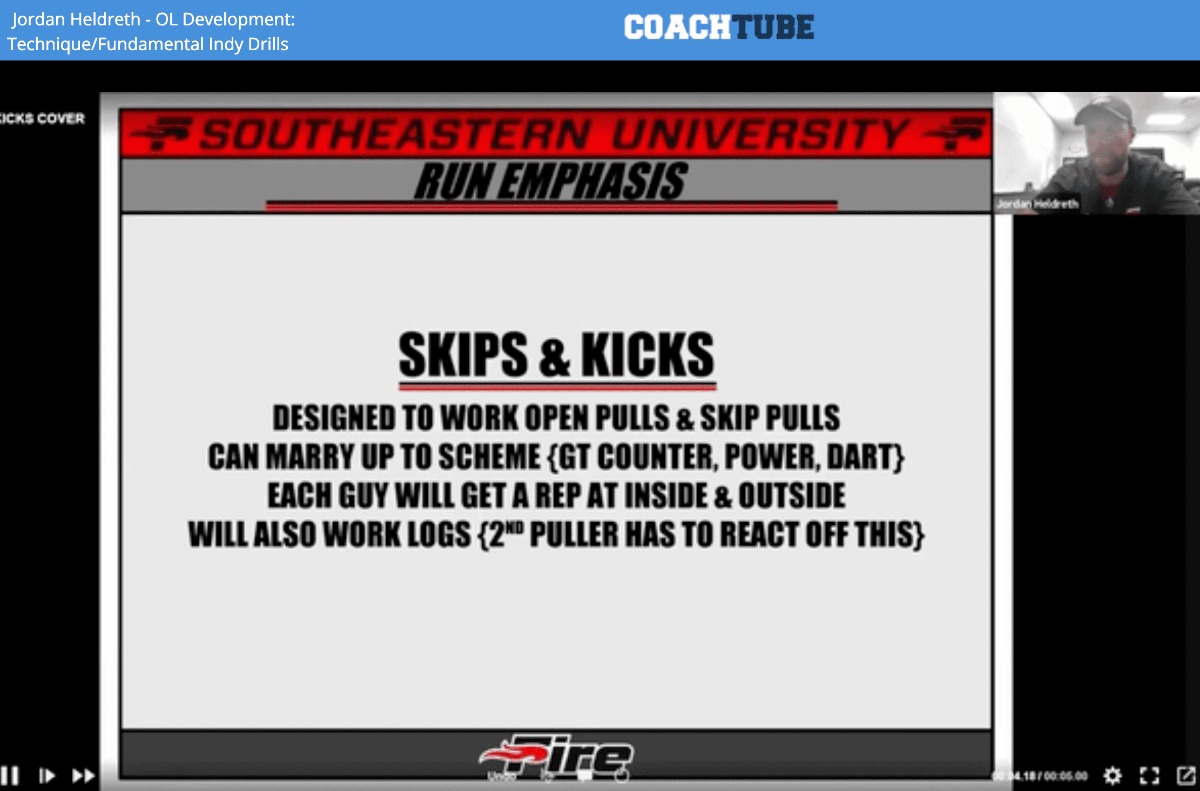
Four boards. Two groups. Two pullers per rep, alternating sides, with the next set already loaded up before the last rep is finished. That’s the entire setup, and it cuts the dead time out of the pulling install while marrying up to every gap scheme on the call sheet.
Coach Jordan Heldreth is the offensive line coach at Southeastern University, where he installs his pull game off this one drill setup. GT counter. Power. Dart. Trap. Same boards, same shields, same rotations. He walks the kickout, the insert, the log, and the second puller’s reaction off the log in his Technique and Fundamental Indy Drills clinic.
Video: Jordan Heldreth on Pulling Drills: Skips and Kicks
The Setup: Four Boards, Two Groups, No Standing Around
The drill needs four long boards and four hand shields. If his guys are in pads, the shields come off.
Two sets of boards, one on the left, one on the right. As soon as the first pair pulls, the next pair is jumping up on the opposite side. The shield holders alternate. Reps stack fast.
Every rep has two pullers. The open pull guy kicks out. The skip pull guy is the wrapper, the lead, the insert. Each lineman gets a rep inside and outside before the group rotates.
Then Coach Heldreth flips the rep to a log, and now the second puller has to react off whatever the first puller does. Kick if the kickout is there. Insert behind the log if it’s not.
That’s the install. He marries it up to the scheme of the week. GT counter and power get the kickout-and-insert version. Trap and dart slot right in the same way. He builds it once, and it covers the entire pull menu.
Coach Heldreth shows the rotation on tape and points out where the shield holders fit in for any unused indy time. There’s a piece on how he uses that leftover time that’s worth watching.
The Kickout: Outside V of My Neck to Inside V of Theirs
This is the cue that anchors the whole technique.
Coach Heldreth wants the puller’s outside V of his neck working to the inside V of the defender’s neck. That’s the angle of attack on the kickout. Head placement is the thing being coached. Get the outside V to the inside V, and the body will follow into a clean kickout.
Then comes the line he learned from one of his old coaches:
“Depending on what neighborhood you grew up in, you’re either painting the fence or keying the car.”
That’s how tight he wants his pullers to the line of scrimmage. Not a yard off. Not strolling through the gap. Right on the LOS. Painting the fence as they pull, and keying the car as they get to the contact point.
Right before contact, the cue changes. Dip and rise. Drop the level on the approach, then come up through the kickout with the outside V driving inside.
Coach Heldreth walks through what a clean rep looks like in the clip. The piece he flags on his pullers’ contact points is the part most OL coaches will want to pause on.
The Log: Backside Hand Stops the Penetration First
This is the rep that separates the pullers who can adjust from the ones who can’t.
When the first puller can’t kick the defender out, he’s logging him. The cue is two-handed and sequenced.
If Coach Heldreth is pulling right:
Backside hand stops the inside penetration first. Outside hand slams it shut.
The order matters. He calls out #68 on tape for striking with the right hand first and using the left as an afterthought. That’s backwards. The backside hand is the one that has to stop the defender from working underneath the block. Without it, the rusher slips inside and the play dies behind the line.
Then the outside hand closes the door. Slam it shut. Once the inside penetration is stopped, the play side hand finishes the block and seals the edge. The back is now reading the log and bouncing.
Coach Heldreth coaches this rep twice in the clip. Once on the bad rep, once on the cleaner rep. The hand sequence is the part that doesn’t show up in most pulling installs.
Kick Until They Won’t Let Us
This is the rule that lives behind everything else.
Coach Heldreth puts it this way: “We’re kicking until they won’t let us. I don’t like my guys having excuses. We’re going to kick it until there is literally no more daylight in there to be able to kick it.”
The default isn’t the log. The default is the kickout. The log only shows up when the defender takes the kickout away by squeezing down so hard there’s no room to drive him out.
That changes how the puller plays the rep. He’s not pre-deciding. He’s not looking at the defender on the snap and choosing a technique. He’s pulling with the kickout cue every time, and the log is what the rep becomes only when the kickout is physically impossible.
It’s a small mindset adjustment that has a big effect on what the back sees. Pullers who pre-decide leave easy kickouts on the field. Pullers who default to the kick force the defender to take it away first.
Coach Heldreth dives deeper into how he coaches the read on tape, including the second puller’s job when the first puller is logging.
The whole drill setup is built around a simple idea. One indy period, four boards, every pulling scheme on the call sheet, and a coach who doesn’t accept excuses on the kickout. Coach Heldreth’s pullers know the angle, know the cue, know the hand sequence on the log, and know that the default is to kick until the defender takes it away.
This drill is one piece of Coach Heldreth’s full OL Development: Technique and Fundamental Indy Drills clinic. The clinic builds out the rest of his pre-practice progression the same way: stance work, first-step drills, combo block install, second-level tracking, and the rest of the indy menu he runs at Southeastern.
He also walks through the two-and-a-half-pound change plate mentality that drives how he grades reps and builds the room week to week. If you’re putting together your OL indy progression for the offseason, the full clinic is the install plan.
Link: Jordan Heldreth – OL Development: Technique and Fundamental Indy Drills


